
AutoLearningAgents
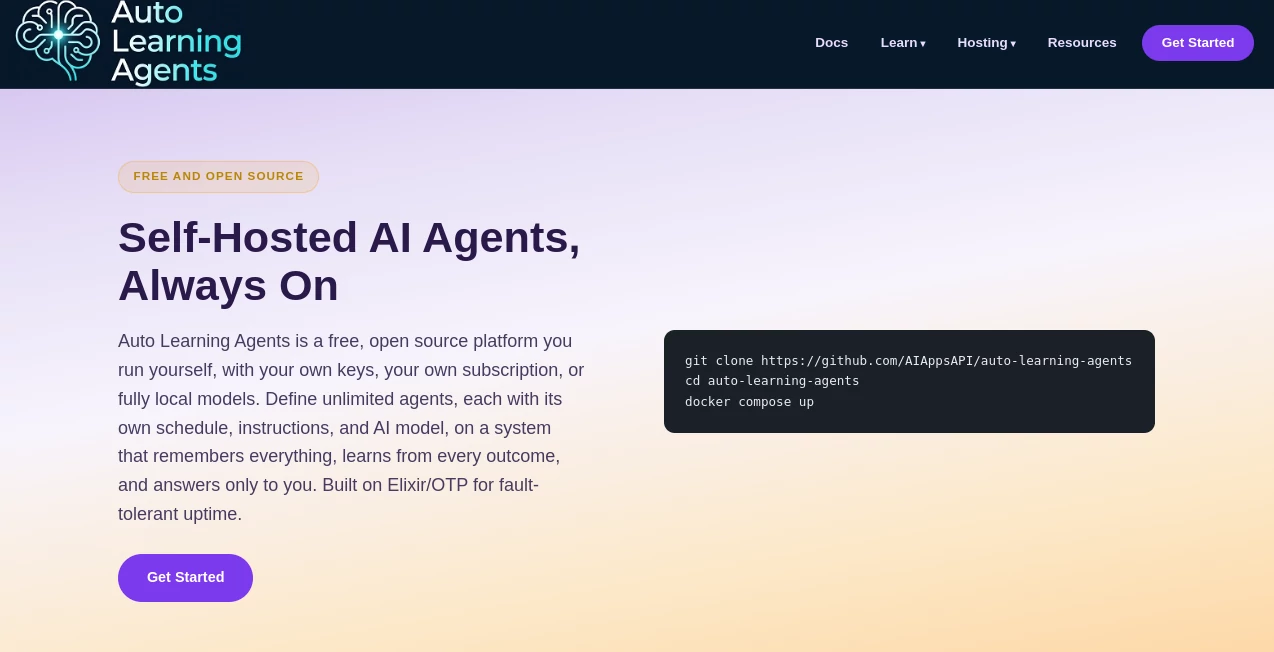
What is AutoLearningAgents?
Artificial intelligence is evolving at an incredible pace, but creating an agent that continuously improves requires much more than connecting a language model to a prompt. This platform focuses on one of the most important yet often overlooked topics in modern AI development: building learning systems that enable autonomous agents to become smarter through feedback, memory, evaluation, and experience.
Instead of offering generic tutorials, the platform provides practical guidance for developers, researchers, and AI enthusiasts who want to understand how intelligent agents acquire new skills, remember previous interactions, evaluate outcomes, and gradually improve their decision-making abilities. The educational content is structured around real engineering concepts, making complex ideas easier to understand without unnecessary jargon.
Whether someone is experimenting with personal AI assistants, enterprise automation, or multi-agent workflows, the knowledge available here helps transform static AI applications into systems capable of long-term learning and adaptation.
Key Features
User Interface
The website offers a clean reading experience with well-organized educational articles grouped into logical learning paths. Topics are divided into foundations, implementation guides, monitoring strategies, feedback systems, memory architectures, and model improvement techniques, allowing readers to progress naturally from beginner concepts to advanced implementations.
Accuracy & Performance
The educational material focuses on real-world AI engineering principles rather than speculative concepts. Readers learn practical architectures such as telemetry pipelines, evaluation frameworks, memory stores, retrieval systems, human feedback loops, and fine-tuning workflows that reflect current best practices used in modern AI development.
Capabilities
- Explains how AI agents learn from human feedback.
- Covers memory systems and long-term knowledge retention.
- Introduces evaluation pipelines for continuous improvement.
- Teaches feedback collection strategies.
- Explores agent learning architectures.
- Discusses reinforcement through experience.
- Provides implementation guides for production systems.
- Explains monitoring and quality control.
- Covers fine-tuning workflows.
- Demonstrates scalable AI learning pipelines.
Security & Privacy
One valuable aspect discussed throughout the educational resources is the importance of responsible data collection. Logging, telemetry, feedback storage, and evaluation are presented alongside considerations for data quality, controlled deployment, rollback mechanisms, and maintaining reliable AI systems while reducing operational risks.
Use Cases
- Learning how autonomous AI agents improve over time.
- Designing enterprise AI agent architectures.
- Building continuous learning workflows.
- Implementing feedback-driven AI systems.
- Understanding memory management for AI assistants.
- Studying evaluation frameworks for LLM applications.
- Training development teams on modern AI engineering.
- Researching production-ready AI deployment strategies.
Pros and Cons
Pros
- High-quality educational resources focused on practical AI engineering.
- Covers advanced concepts using understandable explanations.
- Useful for both beginners and experienced developers.
- Focuses on long-term learning instead of isolated AI prompts.
- Regularly expands with new implementation topics.
Cons
- Designed primarily as an educational resource rather than a software application.
- Requires some familiarity with AI concepts to fully benefit from advanced articles.
- Does not provide an all-in-one development environment.
Pricing Plans
The educational resources currently appear to be freely accessible, allowing visitors to explore comprehensive articles and implementation guides without requiring a paid subscription. Future offerings may expand as the platform continues to grow.
How to Use AutoLearningAgents
Start by exploring the introductory articles explaining how intelligent agents acquire knowledge. Continue through the sections covering memory systems, feedback collection, evaluation pipelines, monitoring strategies, and implementation guides. As your understanding grows, apply these concepts while designing AI assistants, autonomous workflows, or enterprise automation projects. The structured progression makes it easy to build practical knowledge step by step.
Comparison with Similar Tools
Unlike traditional AI blogs that focus primarily on prompt engineering or general AI news, this platform concentrates on one specialized topic: enabling AI agents to learn continuously after deployment. Its emphasis on telemetry, memory architecture, evaluation systems, and production-ready learning pipelines makes it particularly valuable for developers building intelligent autonomous systems rather than simple chatbot applications.
Conclusion
Creating AI agents that genuinely improve over time requires thoughtful system design, reliable feedback mechanisms, effective memory management, and continuous evaluation. This educational platform brings all of these concepts together in a practical, approachable format that benefits developers, researchers, and organizations alike.
Rather than chasing trends, it focuses on the engineering principles that make autonomous AI systems more reliable, adaptive, and capable over the long term. For anyone interested in the future of intelligent agents, it serves as an excellent knowledge resource that bridges theory and practical implementation.
Frequently Asked Questions (FAQ)
What is the primary purpose of this platform?
It teaches how AI agents learn, improve, and evolve through feedback, memory, evaluation, and continuous learning techniques.
Who should use these educational resources?
AI developers, researchers, software engineers, students, and businesses interested in autonomous AI systems can all benefit.
Does it explain production-ready AI architectures?
Yes. Many articles discuss real engineering practices including telemetry, evaluation pipelines, feedback loops, and deployment strategies.
Is programming knowledge required?
Basic AI or software development knowledge is helpful, although many articles explain complex concepts in an accessible way.
Can the concepts be applied to enterprise AI projects?
Absolutely. The learning strategies and architectural recommendations are highly relevant for scalable enterprise AI applications.
AI Tutorial , Large Language Models (LLMs) , AI Research Tool , AI Developer Docs .
These classifications represent its core capabilities and areas of application. For related tools, explore the linked categories above.
AutoLearningAgents details
Website unavailable — View Alternatives
Pricing
- Free
Apps
- Web App
Categories

AutoLearningAgents Alternatives Product

Kimi K2.5

Schema Synth

Toonifyit

Grok

EasyRouterAI

WhatsMyName …

Sellerview.ai

Google Skills
JSON to TOON…