

















EasyRouterAI
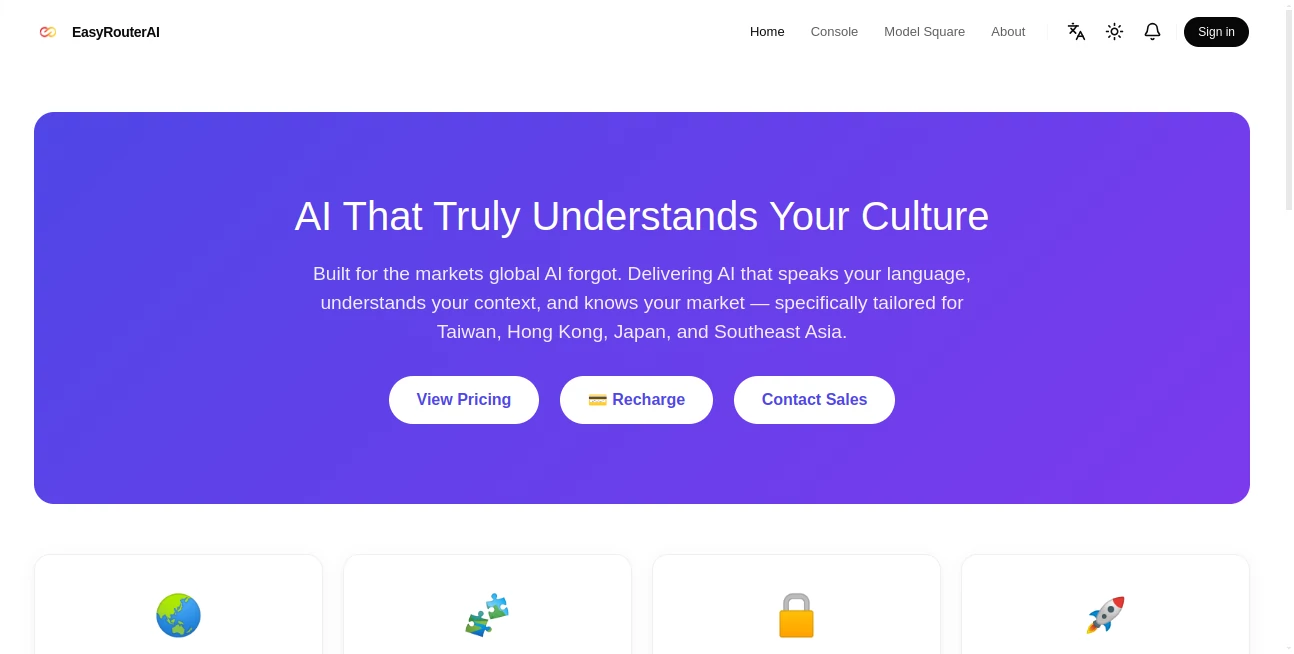
What is EasyRouterAI?
EasyRouterAI is an AI API platform designed to make access to modern AI models simpler through a unified API experience. Instead of building separate integrations for every model or provider, developers can use a centralized interface to connect their applications with AI services.
This approach is particularly useful for developers who are experimenting with multiple models, building AI-powered applications, or looking for a cleaner way to manage model access. The simple concept behind the platform is appealing: reduce integration complexity while giving developers a more convenient route into the rapidly expanding AI ecosystem.
Key Features
- Unified API access for AI-powered applications.
- A simpler approach to connecting applications with AI models.
- Designed with developers and API-based workflows in mind.
- Useful for projects that need flexible access to AI capabilities.
- Helps reduce the need to manage completely separate API integrations for every AI service.
User Interface
The platform takes a developer-oriented approach rather than trying to overwhelm users with a large collection of unnecessary controls. Its presentation is focused on the API experience, making it more suitable for people who want to connect AI capabilities to their own software, websites, services, or automated workflows.
For developers, this kind of focused interface can be a welcome change. When the primary goal is sending requests and receiving AI responses, a straightforward API environment makes the process easier to understand and integrate into an existing stack.
Accuracy & Performance
API performance ultimately depends on the underlying models, providers, request configuration, and workload. A routing layer can nevertheless make the overall development process more practical by giving applications a consistent point of interaction rather than requiring developers to repeatedly adapt their code to different services.
For production applications, developers should evaluate response quality, latency, availability, rate limits, and model behavior against their own workloads before choosing a particular configuration.
Capabilities
The main strength of the platform is its API-first approach. Developers can use an API layer as the connection point between their application and AI functionality, which can be especially useful when building chat applications, automation systems, AI assistants, internal tools, and other software that depends on language models.
A centralized approach also makes experimentation easier. Developers can test different AI configurations without necessarily redesigning the entire application around a single provider. This can be valuable as new models continue to appear and existing models change in price, performance, and availability.
Security & Privacy
When working with any AI API, security deserves careful attention. Developers should avoid sending unnecessary sensitive information through third-party services and should protect API credentials using environment variables or a secure secrets-management system.
Before using the service with confidential production data, organizations should also review its current privacy policy, data-retention practices, logging behavior, authentication mechanisms, and applicable terms. These details can vary by service and account configuration.
Use Cases
The platform can be useful in a variety of development scenarios where an application needs programmatic access to AI capabilities.
- AI applications: Add AI-powered functionality to websites, SaaS products, and mobile applications.
- Developer projects: Experiment with AI APIs without creating a completely separate integration strategy for every model.
- Automation: Connect AI capabilities with automated workflows and backend processes.
- AI assistants: Build conversational or task-oriented assistants around API requests.
- Prototyping: Quickly test ideas before committing to a larger AI infrastructure.
- Multi-model applications: Explore different AI models and configurations from an API-oriented environment.
Pros and Cons
Pros
- API-first approach suited to developers.
- Can simplify AI integration for software projects.
- Useful for experimentation with AI-powered applications.
- Provides a centralized approach instead of requiring developers to design every integration from scratch.
Cons
- Primarily aimed at users who are comfortable working with APIs.
- Developers should verify supported models and providers for their particular project.
- Production users should independently evaluate latency, reliability, limits, and privacy requirements.
Pricing Plans
Pricing and available usage plans should be checked directly through the service before deployment, as API pricing and limits can change as providers and model offerings evolve. Developers should pay particular attention to request limits, model-specific costs, included usage, and any additional charges when estimating the cost of a production application.
How to Use EasyRouterAI
- Create or access an account through the platform.
- Review the available API configuration and supported AI options.
- Generate the required API credentials if they are provided for your account.
- Add the API credentials securely to your development environment.
- Configure your application to communicate with the API endpoint.
- Send a test request and inspect the returned response.
- Once the integration works correctly, adjust the implementation for your application's workload and production requirements.
Comparison with Similar Tools
Traditional AI integrations often require developers to work directly with individual providers. That can mean separate authentication methods, SDKs, endpoints, documentation, billing systems, and implementation details.
An API routing platform takes a different approach by placing a common interface between the application and AI services. This can make experimentation and future changes easier because the application does not necessarily have to be tightly coupled to one particular AI provider.
For developers who only need one specific model, a direct provider API may remain the simplest choice. For projects that value flexibility and centralized API management, a routing-oriented solution can be more attractive.
Conclusion
EasyRouterAI presents an appealing idea for developers working in an increasingly fragmented AI ecosystem: make AI access easier to integrate through a centralized API experience. Its developer-focused approach can be particularly useful for experimentation, AI application development, automation, and projects that need flexibility as the model landscape changes.
The biggest advantage is not necessarily another AI model itself, but the possibility of making the connection between software and AI services less complicated. For developers building the next generation of AI-powered products, that simplicity can save valuable development time.
Frequently Asked Questions (FAQ)
What is EasyRouterAI?
It is an API-focused AI platform designed to provide a simpler way for developers to connect applications with AI capabilities.
Who is it designed for?
The service is primarily relevant to developers, technical teams, startups, and businesses building applications or automated workflows that use AI APIs.
Can it be used to build AI applications?
Yes. An API-based service can be integrated into applications such as AI assistants, automation systems, SaaS products, internal tools, and other software that needs AI functionality.
Is it suitable for beginners?
Users with basic programming and API knowledge should find the concept relatively straightforward. However, developers who are completely new to APIs may need to learn fundamentals such as authentication, HTTP requests, API keys, and JSON.
Should I use it for production applications?
It can be considered for production after evaluating its current documentation, supported models, pricing, rate limits, reliability, security practices, and privacy terms against the requirements of your application.