
Avis
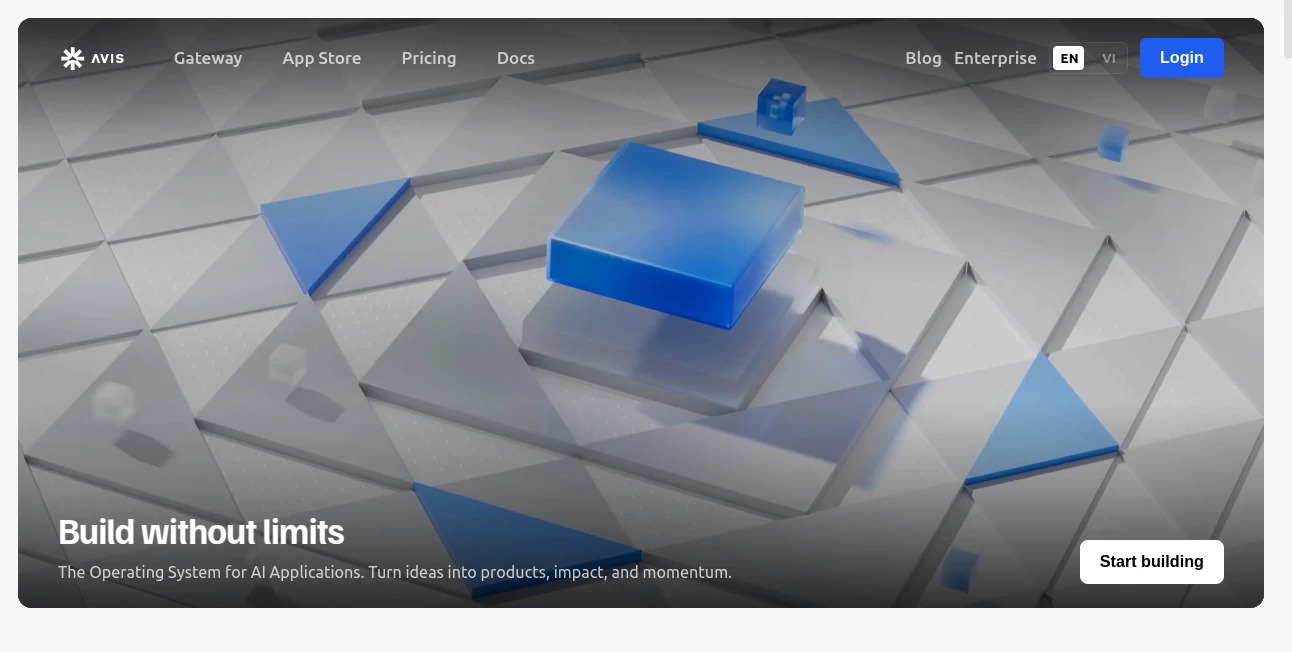
What is Avis?
AVIS is an AI infrastructure platform built for developers and teams that want a simpler way to create, launch, and scale AI applications. Rather than tying a project to a single model provider, the platform brings access to a broad collection of AI models through one integration. It also combines model access with an application marketplace, giving builders a path from development to distribution.
The idea is straightforward: connect once, experiment with different models, control costs, and focus on the product instead of constantly rebuilding the underlying AI stack. The platform currently presents more than 400 models across areas such as video, image, text, audio, and embeddings. :contentReference[oaicite:0]{index=0}
Key Features
- Unified access to a large selection of AI models through a single gateway.
- Support for different AI modalities, including text, image, video, audio, and embeddings.
- Flexible model switching without rebuilding an application around a new provider.
- An integrated App Store designed to help AI applications reach users.
- Pay-as-you-go pricing with model-specific billing rather than a single fixed usage tier.
- API documentation and developer-focused infrastructure for building AI products.
User Interface
The platform keeps its main navigation focused on the parts developers are likely to need: the Gateway, App Store, pricing, documentation, blog, and enterprise services. The pricing area also provides a searchable model catalog, which makes it easier to inspect available models and compare their billing units and prices.
For someone testing several models, this approach can save a surprising amount of time. Instead of opening several provider dashboards and learning different interfaces, the developer can work from a more centralized environment.
Accuracy & Performance
Performance ultimately depends on the model selected and the task being performed, so it would be misleading to treat the platform itself as a single AI model with one accuracy score. Its strength is the ability to access different models and select the one that fits a particular workload.
The pricing catalog lists models for different resolutions, modalities, and generation configurations. For example, its current catalog includes multiple video models with options ranging from lower-resolution generation to 1080p and 4K configurations. :contentReference[oaicite:1]{index=1}
Capabilities
The platform is particularly interesting for developers building AI-powered applications that may need more than one type of model. Its gateway is designed to provide one connection to multiple AI providers, while the marketplace provides a separate distribution layer for applications built on the infrastructure.
There is also a practical cost-control advantage. If a particular model becomes too expensive or another model becomes better suited to a workload, developers can switch models without redesigning the entire application around a different provider. The platform explicitly positions this flexibility as a way to avoid provider lock-in. :contentReference[oaicite:2]{index=2}
Security & Privacy
Security and privacy should be evaluated according to the specific application, API configuration, and data being processed. The platform provides dedicated terms for its API services as well as a privacy policy, giving developers documentation to review before connecting production workloads. :contentReference[oaicite:3]{index=3}
For businesses handling confidential customer information, it is still important to review the applicable service terms and privacy documentation carefully and avoid sending sensitive information unless the chosen setup and provider policies are appropriate.
Use Cases
AVIS can be useful in a wide range of AI development scenarios. A startup could use it to prototype an AI application without committing its architecture to one model provider. A development team might use different models for image generation, video creation, language processing, or other workloads while maintaining a common integration layer.
It can also make sense for teams experimenting with emerging models. Instead of rebuilding an application every time a new model becomes interesting, developers can evaluate alternatives through the same broader infrastructure.
The App Store adds another useful angle. Applications built on the platform can potentially use the marketplace as a discovery channel, giving developers a place to present their products to users rather than relying entirely on their own marketing and acquisition efforts. :contentReference[oaicite:4]{index=4}
Pros and Cons
- Pros: Access to a large model catalog, centralized integration, support for multiple AI modalities, flexible model selection, transparent usage-based pricing, developer documentation, and an integrated application marketplace.
- Cons: The platform is primarily aimed at people building AI applications, so casual users looking for a simple standalone AI chatbot may find its infrastructure-oriented approach more than they need. Pricing also varies considerably between models and workloads, making it important to check the selected model before estimating costs.
Pricing Plans
The platform uses a pay-as-you-go approach rather than presenting AI usage as one simple flat subscription. Its pricing page lists individual models alongside their supported modalities, billing units, API prices, and App prices. This makes the cost structure more transparent for developers who want to estimate usage before committing to a particular model. :contentReference[oaicite:5]{index=5}
Prices vary substantially by model and generation settings. For example, the current catalog includes video models billed per second and image models billed per image, while some models use token-based billing. Because the catalog is model-specific, checking the current pricing before production deployment is the safest way to calculate expected expenses.
How to Use AVIS
- Create an account and access the developer environment.
- Explore the available AI models and identify the models that match your application.
- Review the model's supported input types, output configuration, billing unit, and current price.
- Connect your application through the available gateway and API documentation.
- Test the selected model with representative workloads before moving to production.
- Compare alternative models when quality, speed, or cost requirements change.
- If you have built a user-facing application, explore the marketplace as an additional distribution channel.
Comparison with Similar Tools
Traditional AI API platforms often concentrate on providing access to a particular provider's models. AVIS takes a broader infrastructure approach by placing multiple models behind a unified gateway and adding an application marketplace on top.
This distinction matters for teams that value flexibility. If a project depends heavily on one specific model and does not need alternatives, a direct provider API may be simpler. On the other hand, developers who expect to test several models or want to reduce dependency on a single provider may find a multi-model gateway considerably more convenient.
The marketplace is another notable difference. It turns the service from a pure infrastructure layer into an ecosystem where applications can also be discovered. The company describes this as a combination of unified access, marketplace distribution, and network effects. :contentReference[oaicite:6]{index=6}
Conclusion
AVIS is an appealing option for developers who see AI infrastructure as a long-term product decision rather than simply another API endpoint. Its combination of a multi-model gateway, usage-based pricing, developer resources, and application marketplace addresses two common challenges at once: getting reliable access to changing AI models and finding users for the applications built with them.
For teams experimenting with several AI technologies, the ability to connect once and change models as requirements evolve can be especially valuable. The platform is best suited to builders who want flexibility and are prepared to work with an infrastructure-oriented AI environment.
Frequently Asked Questions (FAQ)
What is AVIS?
AVIS is an operating layer for AI applications that provides a unified gateway to multiple AI models and an App Store for application distribution.
How many AI models are available?
The platform currently highlights access to more than 400 models, covering multiple modalities such as video, image, text, audio, and embeddings. :contentReference[oaicite:7]{index=7}
Does it support different AI providers?
Yes. The platform is designed around a multi-model gateway, allowing developers to work with models from different providers through a unified integration.
How is AI usage charged?
Pricing is primarily pay-as-you-go and depends on the selected model and its billing unit. Depending on the model, usage may be calculated per second, per image, or by tokens. :contentReference[oaicite:8]{index=8}
Is it suitable for developers?
Yes. The service is specifically designed around AI application development and provides a gateway, API documentation, model catalog, and an application distribution layer.
Can developers distribute their applications?
Yes. The App Store is designed to help applications built on the platform get discovered and reach users.
Can I change AI models without rebuilding my entire application?
The unified gateway is designed to make model switching easier, allowing developers to connect through a common integration instead of becoming dependent on a single AI provider.
Does the platform offer enterprise services?
Yes. Enterprise services are presented as part of the platform's offering for organizations with larger or more specialized requirements.
AI App Builder , AI API Design , Large Language Models (LLMs) , AI Developer Tools .
These classifications represent its core capabilities and areas of application. For related tools, explore the linked categories above.

Avis Alternatives Product

Jujutsu Zero…

JSON-Tools

JSON to TOON…

Latency Atlas

Somnio

Project Genie

ShipAhead

Sendmux

ModelsLab