
BaziCalculator
What is BaziCalculator?
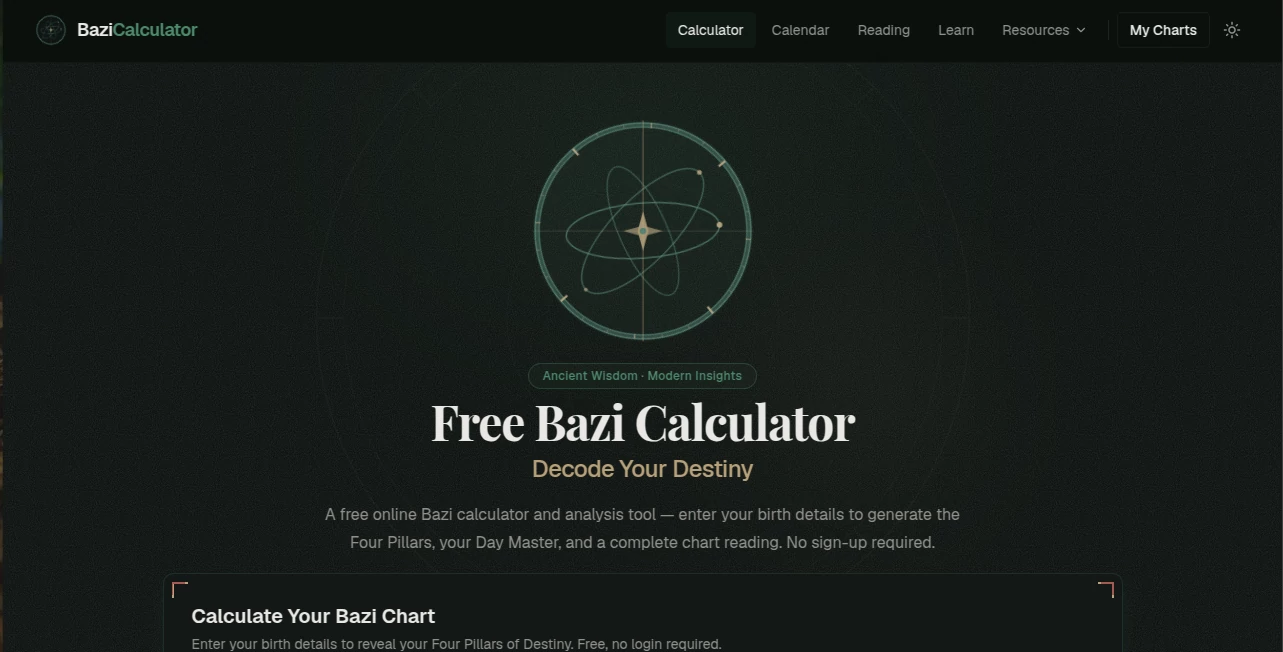
BaziCalculator.ai is a free online tool designed to make the traditional Four Pillars of Destiny easier to explore. Instead of stopping at a simple Chinese zodiac animal, it uses a person's birth date, birth time, gender, and birthplace to build a complete Bazi chart.
The experience is particularly approachable for people who have heard about Bazi but are not sure where to begin. There is no account required to generate a chart, and the results go beyond the basic calculation by explaining the Day Master, Five Elements balance, and longer-term Life Chapters.
One of the more thoughtful aspects of the experience is that calculation comes before interpretation. The chart is produced through a rules-based calculation process rather than asking an AI model to guess the result. AI can then be used when a deeper explanation is requested, giving the experience a useful separation between calculation and interpretation.
Key Features
- Free Four Pillars of Destiny chart generation
- No sign-up required for the basic calculation
- Day Master identification and explanation
- Five Elements balance covering Wood, Fire, Earth, Metal, and Water
- Life Chapters showing major decade-by-decade periods
- True Solar Time correction based on the birth location
- Three-pillar analysis for users who do not know their exact birth time
- Optional AI-assisted deeper interpretation
- Plain-English explanations of traditional Bazi concepts
- Educational guides for people who want to understand their chart
User Interface
The interface keeps the starting point simple. Users enter their Gregorian birth date, gender, birth time, and birth city before generating their chart. The location field is especially useful because the calculator uses the selected birthplace when handling true solar time.
There is also an option for people who do not know their exact birth time. Rather than inventing an Hour Pillar, the tool clearly switches to a three-pillar analysis based on the Year, Month, and Day pillars.
That small detail makes the experience feel more practical. Many people know their birthday but have no reliable record of their exact birth hour, and the calculator gives them a way to explore Bazi without pretending that missing information is available.
Accuracy & Performance
The calculation approach is one of the strongest parts of the service. The chart is generated using calendrical rules, with the server recalculating the result from the supplied birth information. The system also applies true solar time correction using information connected to the birthplace rather than relying only on the clock time entered by the user.
This matters in Bazi because the Hour Pillar can be affected by the actual solar position. The calculator therefore considers the historical time-zone offset, the longitude of the birthplace, and the Equation of Time before determining the relevant hour.
As with any Bazi system, the final result depends on the accuracy of the birth information and the conventions used for chart calculation. The tool is best viewed as a structured way to explore the traditional system rather than as a scientific prediction engine.
Capabilities
The calculator provides considerably more than a set of eight characters. The Day Master is presented as the central reference point of the chart, while the Five Elements section shows how Wood, Fire, Earth, Metal, and Water are distributed.
Users can also explore Life Chapters, which organize major periods of life into roughly decade-long cycles. The combination gives newcomers several useful entry points: personality-oriented interpretation, elemental balance, and a longer timeline.
The surrounding educational material is another advantage. Traditional concepts such as Heavenly Stems, Earthly Branches, the Five Elements, and the Four Pillars are explained in accessible English, making the tool useful even for someone encountering Bazi for the first time.
Security & Privacy
The basic chart can be generated without creating an account, and the site states that it does not create a saved AI-reading record for the free chart. Birth information is processed to calculate the chart, while a copy of the most recently used inputs may remain in the browser until the user clears it.
The separation between calculation and optional AI interpretation is also clearly explained. AI is not used to decide what the underlying chart should be; it is used only when the user asks for a deeper reading.
Use Cases
The most obvious use case is personal exploration. Someone curious about Chinese astrology can enter their birth information and immediately see a complete Four Pillars chart without committing to a course, consultation, or account.
It can also be useful for people comparing Bazi with Western astrology. Rather than focusing on a single zodiac animal, the system introduces a more detailed structure involving four pillars, elemental relationships, and timing cycles.
Another practical use is educational. Students of Bazi can use the calculator to generate charts and then study how the Day Master, Heavenly Stems, Earthly Branches, and Five Elements relate to one another.
For people who only know their birth date but not their birth hour, the three-pillar option provides a sensible starting point instead of forcing an inaccurate Hour Pillar into the chart.
Pros and Cons
- Pros: Free basic chart generation, no registration required, clear interface, true solar time correction, detailed elemental analysis, Day Master information, Life Chapters, and beginner-friendly educational explanations.
- Pros: The calculation process is separated from AI interpretation, which makes the underlying chart easier to understand.
- Pros: Users without an exact birth time can still perform a three-pillar analysis.
- Cons: The depth of interpretation may not satisfy experienced Bazi practitioners looking for advanced traditional study or professional consultation.
- Cons: Results depend heavily on accurate birth details and the calculation conventions being used.
- Cons: Bazi is a traditional destiny-analysis system, so its interpretations should be treated as reflective or educational rather than scientifically proven predictions.
Pricing Plans
The core Four Pillars calculation is free and does not require a login. Users can generate their chart and access the main analysis without paying for a basic calculation.
Deeper AI-powered interpretation is available as an optional layer rather than being required to use the calculator. This makes the free experience particularly attractive for anyone who simply wants to generate and understand a Bazi chart before deciding whether they want additional interpretation.
There is no conventional multi-tier pricing structure presented for the basic calculator, so users can start with the free experience without having to choose between several subscription plans.
How to Use the Calculator
- Open the calculator and enter your Gregorian birth date.
- Select your gender.
- Enter your birth time if it is known.
- Search for and select your birth city so the system can account for the location when calculating true solar time.
- If you do not know your exact birth time, choose the three-pillar analysis option.
- Generate your Bazi chart.
- Review your Four Pillars, Day Master, Five Elements balance, and Life Chapters.
- Use the educational guides to understand unfamiliar Bazi terminology and relationships.
- Request a deeper AI-assisted interpretation when you want additional context around the calculated chart.
Comparison with Similar Tools
Many astrology calculators focus on giving users a quick result, often centered around a zodiac sign or a simplified personality description. This approach takes a more structured route by calculating the complete Four Pillars and then explaining the relationships inside the chart.
Compared with traditional Bazi education platforms, the main advantage is accessibility. A beginner can generate a chart for free and start exploring its meaning immediately, without first buying a course or learning a large amount of classical terminology.
Compared with more basic Chinese zodiac calculators, the experience is also considerably deeper. The zodiac animal is only one component of the Year Pillar, while the complete chart incorporates the Year, Month, Day, and Hour pillars along with the Five Elements and other relationships.
The result is a useful middle ground: more detailed than a simple zodiac calculator, but much easier to approach than a full traditional Bazi study program.
Conclusion
This is a strong option for anyone curious about Bazi who wants more than a generic Chinese zodiac result. Its combination of a free chart, detailed elemental analysis, Day Master information, Life Chapters, true solar time correction, and accessible explanations gives newcomers plenty to explore.
The calculation-first philosophy is particularly appealing. Rather than presenting AI as the source of the chart itself, the system uses structured rules to calculate the underlying Four Pillars and leaves AI to the interpretation stage.
For casual curiosity, self-reflection, or learning the basics of Chinese astrology, it offers an easy starting point. More experienced practitioners may still want deeper traditional resources, but for someone opening a Bazi chart for the first time, the experience is clear, approachable, and surprisingly detailed.
Frequently Asked Questions (FAQ)
Is the calculator free?
Yes. The basic Four Pillars chart can be generated for free without creating an account.
Do I need to know my exact birth time?
No. If your exact birth time is unknown, you can choose the three-pillar analysis option. It covers the Year, Month, and Day pillars while leaving out the Hour Pillar.
What information do I need to generate a Bazi chart?
You need your birth date, gender, and birth location. Your birth time is also useful when available because it allows the complete four-pillar chart to be calculated.
Why is my birth city important?
The birthplace helps determine the appropriate solar-time correction. Longitude and historical time-zone information can affect the relationship between the recorded clock time and the actual local solar position.
What is a Day Master?
The Day Master is the Heavenly Stem of the Day Pillar. Within Bazi interpretation, it serves as the central reference point for understanding how other elements and characters in the chart relate to the individual.
What are the Five Elements in Bazi?
The Five Elements are Wood, Fire, Earth, Metal, and Water. Bazi uses their relationships and balance as part of its traditional framework for interpreting patterns in a birth chart.
Is Bazi the same as the Chinese zodiac?
No. The Chinese zodiac animal associated with a person's birth year is only one part of a complete Bazi chart. Bazi considers four pillars and eight characters, providing a much broader framework for interpretation.
Does the tool use AI to calculate the chart?
The chart calculation itself is handled through a rules-based process. AI is used separately when a user requests a deeper interpretation of the calculated result.
Can the results predict my future?
Bazi is a traditional system of destiny analysis rather than a scientifically validated prediction method. The results are best used as a cultural, educational, or reflective framework rather than as guaranteed forecasts.
Can beginners understand the results?
Yes. The surrounding educational material explains major Bazi concepts in plain English, so users do not need prior knowledge of Chinese astrology to begin exploring their chart.
AI Life Assistant , AI Fun Tools .
These classifications represent its core capabilities and areas of application. For related tools, explore the linked categories above.
BaziCalculator details
Website unavailable — View Alternatives
Pricing
- Freemium
Apps
- Web App
Categories

BaziCalculator Alternatives Product

Roblox Man F…

MixBooze

We Are Charl…

tarotguide

Roblox The F…

Pixel Flow L…

AI Prank Call

DLSS 5 Meme …

Olabiba