

















Olabiba
Verified Blue CheckMark
Verified Blue CheckMark products are featured above free or unverified listings.
This badge indicates authenticity and builds trust, giving your product higher visibility across the platform.
Upgrade to get verified
Verified Blue CheckMark products are featured above free or unverified listings. This badge indicates authenticity and builds trust, giving your product higher visibility across the platform.
Upgrade to get verified
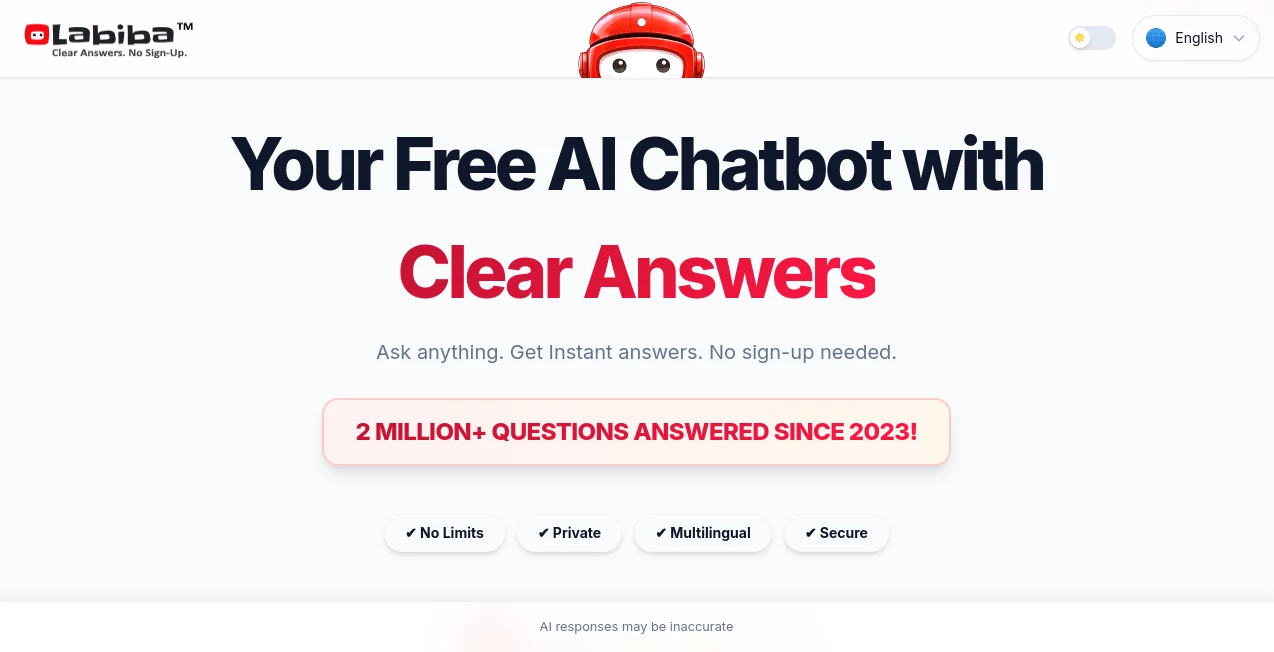
What is Olabiba?
Getting a useful answer from an AI assistant should not require creating an account, entering an email address, or working through a complicated setup. Labiba takes a refreshingly simple approach: open the chat, ask a question, and start a conversation.
Built as a free conversational AI service, it is designed for everything from everyday questions and homework help to language practice, creative ideas, entertainment, and casual conversation. Since 2023, the service has answered more than two million questions and supports more than 50 languages, making it useful for people with very different needs and backgrounds.
One of its most appealing qualities is accessibility. There is no subscription to choose, no credit card requirement, and no account creation before chatting. For someone who only needs a quick explanation or wants to explore an idea for a few minutes, that simplicity can make a real difference.
Key Features
- Free AI conversations without a subscription or trial period.
- No account, email address, or password required to start chatting.
- Support for more than 50 languages.
- Five conversation moods: Friendly, Tutor, Funny, Charming, and Mentor.
- Homework help and explanations for educational topics.
- Creative writing, brainstorming, games, jokes, and casual conversation.
- Ability to continue a conversation and use previous context within the chat.
- Works directly in a modern web browser without installing an application.
- Available around the clock for quick questions and conversations.
- Can assist with images, videos, shopping-related questions, and current information within conversations.
User Interface
The interface is deliberately straightforward. The main experience revolves around the conversation rather than a crowded dashboard full of settings and menus. A visitor can arrive, choose a preferred mood or language, and begin typing.
The mood selector is one of the more distinctive touches. Someone working through a difficult school topic may prefer Tutor, while a casual conversation can feel more natural with Friendly or Funny. Mentor provides another option when the conversation calls for a more thoughtful style.
The browser-based design also makes the service convenient across phones, tablets, Chromebooks, and desktop computers. There is no separate application that needs to be downloaded before getting started.
Accuracy & Performance
Responses are designed to arrive quickly, which suits the service's focus on direct answers and spontaneous conversation. Instead of presenting a page of search results, the assistant responds conversationally and allows users to ask follow-up questions when the first answer is not enough.
For example, a student who does not understand photosynthesis can first request a simple explanation, then ask for an analogy, and finally ask for a short quiz. That conversational approach is often more useful than receiving a single block of information.
As with any generative AI system, answers should still be checked when accuracy is important. Academic research, medical decisions, financial matters, and other high-stakes topics deserve verification from reliable sources rather than being accepted solely because an answer sounds convincing.
Capabilities
The service covers a surprisingly broad range of everyday tasks. It can explain unfamiliar concepts, help users work through homework, practice languages, summarize information, brainstorm ideas, generate creative stories, and participate in games or casual discussions.
Its multilingual capability is particularly useful for international users. More than 50 languages are supported, allowing people to communicate in the language they are most comfortable using without having to configure a complicated interface first.
The conversational experience also extends beyond traditional question answering. Users can ask for jokes, riddles, writing ideas, social conversation practice, recommendations, or help thinking through a problem. The result is closer to an always-available digital conversation partner than a traditional search box.
Security & Privacy
Privacy is an important part of the product's positioning. Users do not need to provide an email address, create an account, or enter personal information before starting a conversation. This makes the service particularly convenient on shared computers, school devices, or situations where creating another online account is unnecessary.
The service also describes its conversations as private and anonymous and states that it does not sell or share users' personal data with third parties. At the same time, visitors should remember that browser-based services can use essential cookies or local storage for functions such as preferences, language settings, themes, and conversation history.
For sensitive information, it is always sensible to follow good online privacy practices and avoid entering passwords, financial credentials, or other confidential information into any AI chat service.
Use Cases
Education: Students can use the assistant to understand difficult subjects, review lessons, practice languages, prepare for tests, and work through homework questions. Asking for an explanation in simpler language can be especially helpful when a textbook explanation feels too complicated.
Everyday Questions: The service is useful for quick questions that do not justify opening several search results. Users can ask for explanations, recommendations, definitions, comparisons, or practical suggestions and continue the conversation naturally.
Creative Projects: Writers and creators can use it to brainstorm story ideas, develop characters, create prompts, play with different scenarios, or overcome a blank page. The Funny and Charming moods can make creative sessions more playful.
Language Practice: Multilingual support makes it suitable for practicing conversations and exploring vocabulary in different languages. Users can switch between questions and ask for explanations when they encounter an unfamiliar expression.
Entertainment: Not every AI conversation needs to be productive. Users can ask for riddles, jokes, trivia, word games, collaborative stories, or unusual creative challenges. The mood system gives these interactions a more personal feel.
Brainstorming and Problem Solving: When an idea is still rough, having a conversational partner can help turn scattered thoughts into possible directions. Users can explain what they are trying to accomplish and then refine the response through follow-up questions.
Pros and Cons
Pros
- Completely free to use.
- No registration or login required.
- No credit card or subscription required.
- Supports more than 50 languages.
- Five different conversation moods.
- Useful for education, entertainment, brainstorming, and everyday questions.
- Works directly from a web browser.
- Designed for quick, accessible conversations.
Cons
- AI-generated answers can occasionally contain mistakes and should be verified for important topics.
- The experience is primarily focused on conversational assistance rather than advanced professional workflows.
- Some school or workplace networks may still restrict access to AI services depending on their filtering policies.
- Users looking for highly specialized professional software may need a more dedicated solution.
Pricing Plans
The entire service is available for free. There is no subscription plan, premium tier, trial period, or credit card requirement. Users can begin chatting without creating an account and can continue using the conversational experience without paying a recurring fee.
This pricing model is particularly attractive for students and casual users who want occasional AI assistance without committing to another monthly subscription. It also removes one of the most common barriers to trying a new AI service: having to provide payment details before knowing whether the product is useful.
How to Use It
Getting started takes only a few moments.
- Open the service in a modern web browser.
- Choose a conversation mood such as Friendly, Tutor, Funny, Charming, or Mentor.
- Select a language if necessary, or simply begin writing in your preferred language.
- Type a question, request, idea, or conversation starter.
- Read the response and ask a follow-up question when you need more detail.
A useful way to get better results is to be specific. Instead of asking, “Explain science,” try asking, “Explain photosynthesis to a 12-year-old using a simple everyday example.” Clear instructions give the conversation a much better starting point.
Comparison with Similar Tools
Many popular AI assistants are built around accounts, subscription tiers, large feature sets, or extensive productivity ecosystems. This service takes a different route by putting immediate access first.
The biggest distinction is the lack of registration. Someone who wants to ask one question does not have to create a profile first. The five conversation moods also add a more personal element than a basic question-and-answer interface.
Compared with a conventional search engine, the experience is more conversational. Instead of moving from one result page to another, users can ask a follow-up, request a simpler explanation, change the style of an answer, or continue discussing the same subject.
It is not necessarily a replacement for every specialized AI platform. Developers may prefer dedicated coding tools, professionals may require advanced business software, and researchers may need systems designed specifically for source-heavy research. Where this service stands out is the simple, low-friction experience of having an AI conversation whenever a question comes to mind.
Conclusion
For users who want an AI assistant without the usual registration process, this is an appealing option. Its strongest advantage is not an overwhelming list of complicated features; it is the ease of getting started.
The combination of free access, more than 50 supported languages, five conversation moods, educational assistance, creative capabilities, and anonymous use makes it suitable for a wide audience. A student can use it as a study companion, a writer can use it for brainstorming, and someone simply looking for a bit of entertainment can start a conversation without setting up an account.
The experience is best approached as a helpful conversational assistant rather than an unquestionable source of truth. With that expectation, it can be a convenient addition to the growing collection of everyday AI tools.
Frequently Asked Questions (FAQ)
Is it free to use?
Yes. The service is completely free, with no subscription, trial period, or credit card requirement.
Do I need to create an account?
No. Users can start a conversation without registering, providing an email address, or creating a password.
How many languages are supported?
More than 50 languages are supported, allowing users to communicate in many different languages without complicated setup.
Can students use it for homework?
Yes. It can explain concepts, help students work through questions, support language practice, and create quizzes for revision. Students should still follow their school's rules regarding AI use and verify important academic information.
Does it have different personalities or moods?
Yes. Users can choose between Friendly, Tutor, Funny, Charming, and Mentor moods to change the style and feel of the conversation.
Can it be used for entertainment?
Yes. Users can ask for jokes, riddles, trivia, word games, creative stories, roleplay ideas, and other casual activities.
Can I use it on my phone?
Yes. The browser-based experience can be accessed from modern phones, tablets, Chromebooks, laptops, and desktop computers without installing a separate application.
Is it suitable for important decisions?
It can help users understand a topic or explore different ideas, but important medical, financial, legal, academic, or professional decisions should always be checked against authoritative sources and qualified professionals.