Big Walk Atlas
What is Big Walk Atlas?
Getting stuck in a cooperative puzzle game can be surprisingly frustrating, especially when the solution depends on communication, timing, symbols, hidden buttons, or a clue that is easy to overlook. Big Walk Atlas is designed to solve that exact problem by giving players a practical place to find walkthroughs for the puzzles they encounter during BIG WALK.
Instead of forcing players to browse through unrelated guides, the site takes a search-first approach. Players can search by tower, area, puzzle number, symbol, map coordinate, or even a simple description of what they are seeing. The result is a focused way to get past a difficult section without turning the entire game into a spoiler-filled walkthrough.
The current catalog contains 38 verified guides covering island coordinates, the beach and drawbridge, Red Tower, Blue Tower, Green Tower, Yellow Tower, optional island puzzles, and postgame Purple puzzles. Each guide is built around practical steps rather than vague hints, making the resource particularly useful when a group is already standing in front of a puzzle and needs an answer quickly.
Key Features
- Search-first puzzle discovery based on towers, areas, numbers, symbols, coordinates, or descriptions.
- 38 verified walkthroughs covering major and optional puzzle areas.
- Complete solutions presented before lengthy explanations.
- Step-by-step instructions for cooperative puzzles.
- Gameplay evidence connected to individual actions and solutions.
- Player-count guidance for puzzles that behave differently depending on group size.
- English and Chinese versions using stable page addresses.
- Coverage ranging from early island puzzles to postgame challenges.
User Interface
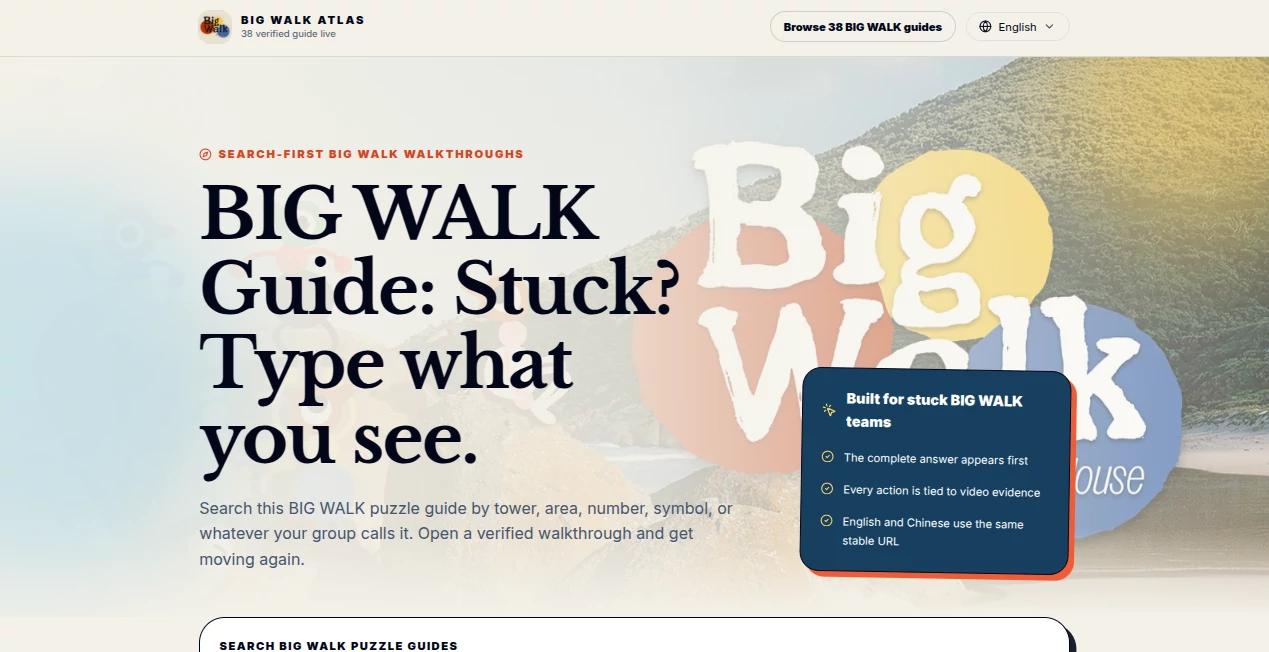
The interface is intentionally focused on the task at hand. The homepage puts the puzzle search directly in front of the player, with examples such as a coordinate, a hidden button, or a tower name. This is a sensible design choice for a game guide because players rarely arrive with a perfectly formatted search query. They usually know what they can see on screen.
The area filters also make navigation easier. Players can move directly into sections for the Island, Beach and Drawbridge, Red Tower, Blue Tower, Green Tower, Yellow Tower, optional island puzzles, or the postgame Purple content.
Accuracy & Performance
Accuracy is one of the strongest aspects of the guide collection. The walkthroughs are not written as generic puzzle summaries. Individual actions are connected to gameplay evidence, and the guides frequently distinguish between a reusable solving method and a sequence that changes from one run to another.
For example, some puzzles use current-world symbol orders, changing displays, or dynamically generated counts. The guides warn players not to blindly copy numbers or sequences from a previous run. That distinction makes the instructions much more useful than simply publishing a fixed answer.
The site also includes practical details such as approximate map coordinates, player roles, common mistakes, recovery steps, and the expected completion feedback. These details can save a group considerable time when a puzzle does not work on the first attempt.
Capabilities
The collection covers a surprisingly broad range of cooperative puzzle mechanics. Players can find solutions for symbol-matching rooms, hidden controls, communication puzzles, counting challenges, sound-based puzzles, climbing challenges, timed rooms, relay mechanics, object transportation, and location-based discoveries.
Some guides are especially useful for multiplayer groups because they explain how to divide responsibilities. A two-player solution may use a caller and an operator, while larger groups can assign players to separate areas or controls. This turns the guide into more than an answer database; it becomes a practical coordination aid.
Another useful capability is the emphasis on recovery. When a team makes a mistake, the instructions often explain where to restart, what to check, and which part of the puzzle should be repeated rather than simply telling players to start over.
Security & Privacy
This is primarily a public gaming reference and walkthrough website rather than a service that requires users to submit sensitive personal information. The public-facing experience is centered around searching and reading puzzle guides.
Players should still follow normal online privacy practices and avoid entering personal information into any website unless it is genuinely required. For a guide resource of this type, the main value comes from its accessible puzzle documentation rather than user account functionality.
Use Cases
The most obvious use case is helping a group that is completely stuck. Imagine two players standing on opposite sides of a room, one seeing a set of symbols and the other controlling the buttons. Rather than spending another fifteen minutes guessing, they can search for the visible puzzle and follow the documented communication method.
It is also useful when the location is known but the exact solution is not. A player can search for a tower, coordinate, puzzle number, or distinctive object and narrow down the relevant walkthrough.
Another strong use case is multiplayer coordination. Several guides explain which player should watch, which player should operate a control, who should carry an object, and when the team should communicate. That is particularly valuable for puzzles where everyone acting at once makes the situation harder.
Players who want to minimize spoilers can also use individual walkthroughs instead of reading a complete game guide. The search-based structure makes it possible to look for the problem currently blocking progress and stop there.
Pros and Cons
- Pros: Search-first design makes finding a specific puzzle quick.
- Pros: A growing catalog covers 38 verified walkthroughs.
- Pros: Guides include practical multiplayer strategies rather than only final answers.
- Pros: Gameplay evidence adds confidence to important instructions.
- Pros: Coverage includes optional and postgame puzzles as well as main progression.
- Pros: Many guides explain common mistakes and recovery methods.
- Cons: The resource is focused specifically on BIG WALK rather than a broad collection of games.
- Cons: The catalog is still developing, so not every possible puzzle or variation is necessarily covered.
- Cons: Some puzzle solutions depend on the current game state, meaning a fixed sequence from an example should not always be copied directly.
Pricing Plans
The public site is presented as a free-to-access puzzle guide rather than a conventional subscription-based software product. The homepage and puzzle catalog focus on accessing walkthroughs and searching the available guide collection, with no conventional paid plan presented as part of the main user experience.
For players looking for a quick solution without creating a complicated workflow around subscriptions or premium features, this straightforward approach is a welcome advantage.
How to Use This Guide
Start by identifying the strongest clue you have. It could be the name of a tower, a map coordinate, a visible symbol, a distinctive object, or simply something unusual happening in the room.
Enter that clue into the search area and review the matching walkthroughs. Once you find the relevant puzzle, begin with the direct solution and then use the detailed steps when you need additional context.
For multiplayer puzzles, assign the roles described in the guide before starting. One player may need to watch a clue while another operates a control, or one teammate may need to hold a button while another travels to a distant location.
Pay particular attention to warnings about changing sequences. If the guide says that a number, symbol order, or display changes between attempts, treat the published example as an explanation of the method rather than a permanent answer.
Finally, use the recovery instructions if the first attempt fails. In many cases, checking one missed control or repeating a communication step is enough to complete the puzzle.
Comparison with Similar Tools
General gaming search engines and video platforms can certainly help players solve difficult puzzles, but they often require more searching. A player may need to watch a long video, find the correct timestamp, or determine whether the footage actually matches the current puzzle.
A dedicated puzzle catalog offers a more focused experience. The walkthroughs here are organized by area and puzzle family, while individual pages put the actionable solution near the beginning. Video evidence is then used to support the instructions rather than forcing the player to search through an entire gameplay session.
Another difference is the attention given to multiplayer roles. Instead of simply showing what happens, many guides explain how teammates should divide the work. For a cooperative game, that extra layer of information can make a meaningful difference.
Conclusion
For BIG WALK players who want help without digging through hours of gameplay footage, Big Walk Atlas is a useful and focused companion. Its strongest feature is not simply the number of walkthroughs, but the way the information is organized around the moment when a player gets stuck.
The combination of search-based discovery, area organization, verified walkthroughs, gameplay evidence, multiplayer role planning, and recovery advice makes the resource particularly practical. It respects the reality of cooperative puzzle games: sometimes the problem is not understanding the objective, but figuring out exactly what to do next.
With 38 verified guides already available and coverage extending from early island challenges through optional and postgame puzzles, the catalog provides a solid starting point for players who want to spend less time guessing and more time exploring the game.
Frequently Asked Questions (FAQ)
What can I search for?
You can search using a tower name, area, puzzle number, map coordinate, symbol, object, or a description of what you are seeing. This makes the search useful even when you do not know the official name of the puzzle.
How many walkthroughs are currently available?
The current public catalog lists 38 verified walkthroughs across the main tower routes, island areas, optional puzzles, and postgame Purple content.
Are the solutions suitable for multiplayer?
Yes. Many walkthroughs include player-count plans and explain how teammates should divide responsibilities. Two-player strategies are commonly described, with additional guidance for larger groups where relevant.
Are puzzle codes always the same?
No. Some puzzles use current-world symbols, counts, sounds, or sequences. The guides specifically warn players when an example value should not be treated as a permanent code.
Does every guide include video evidence?
The site states that its walkthrough actions are tied to video evidence. Individual guides also document their source footage and verification details where applicable.
Can I use the guides for optional puzzles?
Yes. The catalog includes a dedicated section for optional island puzzles, along with postgame challenges.
Is the guide available in more than one language?
The site currently provides English and Chinese versions using stable URLs, making the same guide structure accessible to players using either language.
Is every puzzle in the game covered?
No. The catalog describes itself as a practical first version and does not claim that every puzzle is covered. The collection is expanding as additional walkthroughs are documented and verified.
What should I do if a solution does not work?
First check whether the puzzle uses a changing sequence or current-world value. Then review the common mistakes and recovery instructions in the relevant walkthrough. Repeating the puzzle from a clearly defined starting position is often more reliable than copying an old code or sequence.
Other .
These classifications represent its core capabilities and areas of application. For related tools, explore the linked categories above.

Big Walk Atlas Alternatives Product

Robux Tax Ca…

ColoringWell

Mp3tag

Suno list

AI Fruit

Fleetproxy

The Audio St…

GoDices

AIForest