
















What is AIForest?
Finding the right AI tool can take almost as much time as using it. There are thousands of products available today, and many of them look similar at first glance. AIForest takes a more practical approach by bringing AI products into a searchable directory where users can browse categories, compare options, and check important details before making a decision.
The platform is designed around discovery rather than hype. Visitors can search for products, browse focused categories, and move from a broad workflow such as writing, marketing, development, video, images, or productivity to a more relevant selection of tools. For someone who has ever opened ten browser tabs just to compare AI services, that simple workflow can make a real difference.
There is also a useful side for founders and AI developers. Product creators can submit their tools with descriptions, screenshots, pricing information, keywords, and official links, giving potential users a clearer way to understand what a product actually does.
Key Features
- Searchable directory for discovering AI tools across multiple categories.
- Category-based browsing for areas such as writing, development, marketing, video, images, productivity, sales, and more.
- Product pages containing descriptions, pricing context, screenshots, and official website links.
- Tool comparison and alternative-focused discovery paths.
- Free AI tool discovery sections for users looking for options without an immediate financial commitment.
- Submission tools for founders who want to publish their AI products.
- Multiple listing plans with different levels of visibility, verification, analytics, and promotional placement.
- Dedicated, indexable product pages designed to make individual listings easier to discover through search.
User Interface
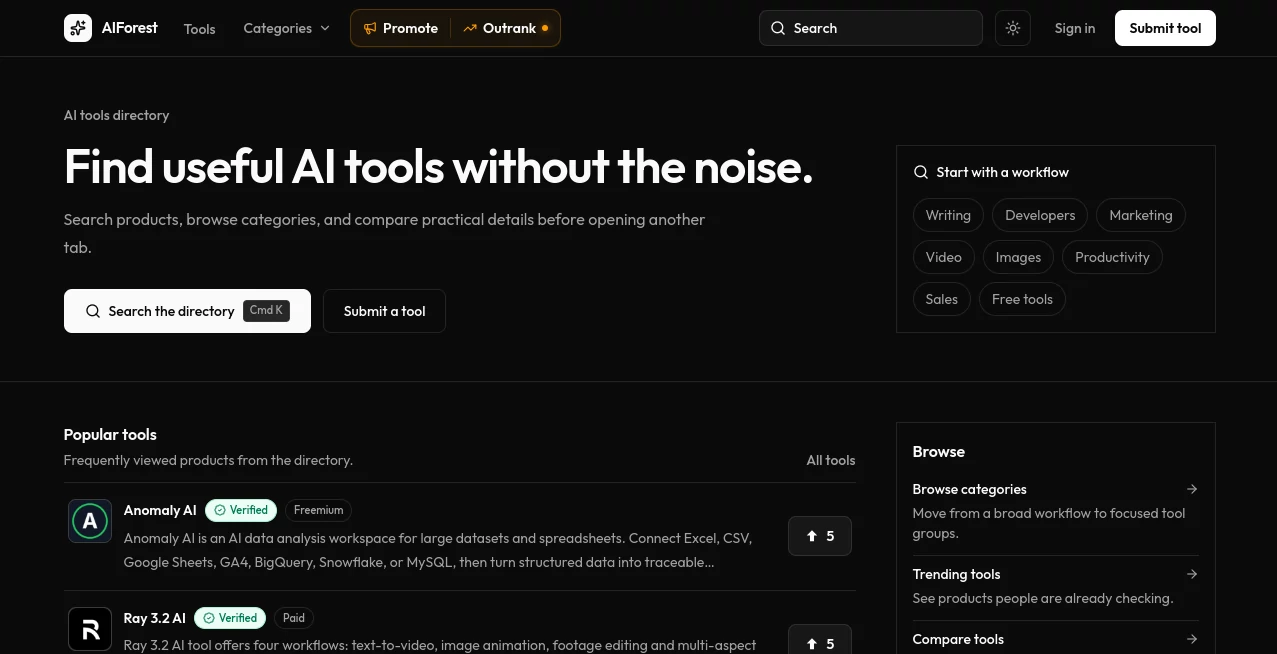
The interface keeps the main task straightforward: find something useful and understand it quickly. The homepage places search and category discovery near the center of the experience, while workflow shortcuts make it possible to jump directly into areas such as writing, developers, marketing, video, images, and productivity.
Product discovery is also supported by popular and recently added sections. This is a nice touch for users who do not have a specific product in mind and simply want to see what is worth exploring. The overall structure feels closer to a curated product catalog than a complicated software marketplace.
Accuracy & Performance
A useful directory depends heavily on the quality of the information it presents. The submission process asks makers to provide specific product details, including a clear description, official website, category, pricing type, screenshots, keywords, and social links. This gives listings a stronger foundation than a simple name-and-link directory.
The platform also states that submissions are reviewed for relevance, completeness, and usefulness. Paid visibility does not automatically guarantee approval, traffic, conversions, or search rankings, which is an important distinction for both tool makers and visitors.
Capabilities
The strongest capability is structured discovery. Instead of relying only on a generic search box, users can move through categories and use comparison-oriented pages to narrow their choices. The directory covers areas ranging from content creation and conversational AI to developer tools, business, productivity, finance, education, and healthcare.
For founders, the platform provides a separate publishing workflow. A listing can include a product description, logo, screenshots, pricing information, keywords, social profiles, and a direct website link. Higher-level plans can add verification, additional screenshots, richer descriptions, analytics, and priority placement.
Security & Privacy
Privacy should always be considered when using any online directory, particularly when creating an account or submitting business information. The platform provides dedicated privacy, terms, cookie, and disclaimer pages so users can review its policies before using the service.
For tool discovery, the platform mainly acts as a directory and discovery layer rather than replacing the individual AI products themselves. Users should therefore review the privacy and data-handling policies of the actual AI service before uploading sensitive documents, personal information, or business data.
Use Cases
- Finding new AI software: Users can search the directory when they know the type of solution they need but do not know which product to choose.
- Comparing AI products: Category browsing and alternative pages can help users create a shortlist before testing individual services.
- Discovering free tools: People who want to experiment without paying immediately can focus on free AI options.
- Researching AI for work: Professionals can explore tools for writing, marketing, development, productivity, sales, and other business workflows.
- Launching an AI product: Founders can submit their software with structured information and screenshots to create a public product listing.
- Improving product visibility: Product creators can use featured and promotional placements when they want additional exposure beyond a standard directory listing.
Pros and Cons
Pros
- Simple approach to discovering AI products without browsing dozens of unrelated websites.
- Wide range of categories and workflow-focused entry points.
- Product listings can contain useful information beyond a basic website link.
- Founders can submit products with screenshots, pricing, keywords, and social links.
- Dedicated indexable product pages can improve the discoverability of individual listings.
- Multiple listing and promotional options are available for AI companies at different stages.
Cons
- The quality of individual listings depends partly on the information supplied by product makers.
- A directory cannot replace testing an AI product yourself when accuracy or workflow fit is important.
- Some visibility features are paid, so users should distinguish promotional placement from organic discovery.
- The platform does not guarantee traffic, conversions, or search rankings for paid listings.
Pricing Plans
The platform uses a listing-based pricing model rather than charging ordinary visitors to browse its directory. At the time of review, the Fast Listing plan has an introductory one-time price of $9.99 and provides a searchable product listing with a dedicated indexable page, standard directory placement, product information, one screenshot, SEO metadata, and dashboard management.
The Verified Listing plan is offered at an introductory one-time price of $29.99 and adds verified status, limited analytics, priority ranking, a longer description, up to two screenshots, social links, and additional visibility features.
The Featured Launch plan costs $79.99 at the current introductory rate and adds higher placement priority, full analytics, unlimited description length, up to three screenshots, social and product links, YouTube video support, featured status, and priority exposure in selected homepage areas.
There are also separate one-time promotional placements. A category spotlight is listed at $29 for seven days, a homepage spotlight at $79 for seven days, and a launch bundle at $149 for fourteen days across the homepage and one relevant category. Promotional placements are clearly labeled, helping distinguish sponsored visibility from regular discovery.
How to Use the Platform
- Open the directory and decide whether you want to search for a specific type of AI product or browse by workflow.
- Use categories such as writing, development, marketing, video, images, or productivity to narrow the selection.
- Open individual product listings and review their descriptions, pricing information, screenshots, and external website links.
- Compare promising options and check alternatives when you are unsure which product best matches your needs.
- Visit the official product website before signing up or purchasing, especially when you need detailed information about features, pricing, or data handling.
- If you are a founder, create an account and submit your own product with accurate information, screenshots, pricing, category data, keywords, and relevant links.
Comparison with Similar Tools
AI directories often compete on the size of their databases, but size alone does not make discovery easier. A large list with weak descriptions can leave users doing the same research they were trying to avoid. The approach here is more focused on structured listings, categories, comparison paths, and practical product information.
Another difference is the attention given to product makers. Instead of treating a listing as nothing more than a backlink, the submission workflow encourages founders to provide screenshots, specific positioning, pricing information, keywords, and social profiles. This makes the resulting page more useful to someone evaluating the product for the first time.
It is also worth noting that promotional visibility is separated from the standard listing experience. Sponsored placements have defined time windows and are labeled as promoted, while paid plans do not claim to guarantee search rankings or traffic. For users who value transparency when browsing recommendations, that separation is helpful.
Conclusion
AIForest is a practical option for people who want a more organized way to explore the growing AI software market. Its strength is not simply putting products into one database; it is the combination of search, categories, product information, comparison paths, and discovery workflows.
For everyday users, it can shorten the process of finding tools for a particular job. For founders, it provides a structured place to present an AI product with enough context for potential customers to understand its purpose. The result is a useful meeting point between AI discovery and product promotion, particularly for users who prefer researching several options before committing to one.
Frequently Asked Questions (FAQ)
What is this platform used for?
It is an AI tool directory designed to help users discover, browse, and compare AI products across different categories and workflows.
Can I discover free AI tools?
Yes. The directory includes free AI tool discovery alongside products with other pricing models, making it possible to search for options that do not require an immediate paid subscription.
Can founders submit their own AI tools?
Yes. Product makers can create an account and submit their AI tool with information such as a description, official website, category, pricing type, logo, screenshots, keywords, and social links.
Does a paid listing guarantee Google rankings or traffic?
No. Paid plans provide the features and visibility associated with the selected plan, but they do not guarantee traffic, clicks, conversions, or search rankings.
What is the difference between a verified listing and a standard listing?
A verified listing adds a verification badge, limited analytics, priority ranking, a longer description, additional screenshots, and social links. Verification represents a paid listing status and should not be interpreted as a security certification.
Are promotional placements permanent?
No. Promotional placements are sold for defined periods. For example, category and homepage spotlight options currently use seven-day windows, while the launch bundle provides a fourteen-day promotional period.
Can users compare AI tools before choosing one?
Yes. The platform provides comparison and alternatives-focused discovery paths, allowing visitors to investigate different products before deciding which one deserves a closer look.
Is the directory useful for AI startups?
It can be. Startups can use structured listings to explain their product, provide screenshots and pricing context, and give potential customers a direct path to the official product website.