
bkabhi
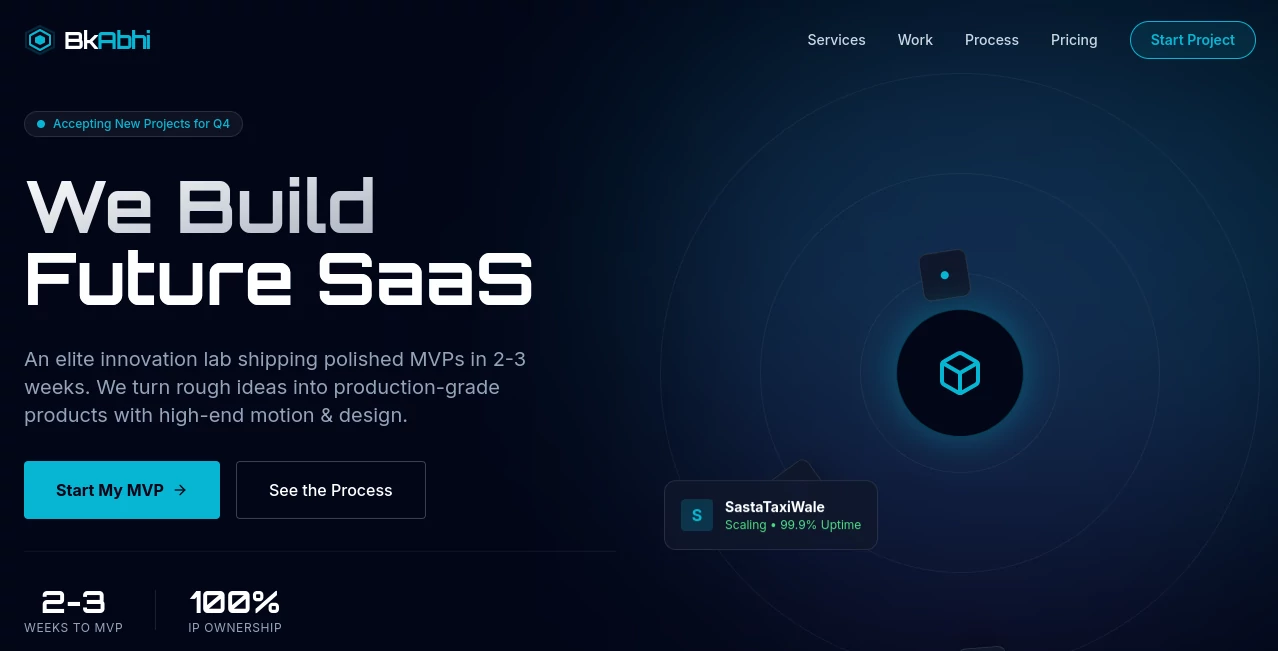
What is bkabhi?
Building a digital product is rarely just about writing code. A good idea also needs thoughtful product planning, a reliable technical foundation, a clean user experience, and the ability to grow without becoming difficult to maintain. BkAbhi brings these pieces together for startups, businesses, creators, and enterprises looking to turn ideas into practical digital products.
The company focuses on modern web and mobile applications, AI-powered solutions, automation systems, SaaS platforms, APIs, and cloud infrastructure. Instead of treating development as a one-size-fits-all process, its approach is centered around creating solutions that match the actual needs of a business.
This makes the service particularly interesting for founders who have a product concept but need experienced technical support to move from an idea or early prototype toward a working application. Whether the goal is launching an MVP, automating an internal process, or developing a larger SaaS platform, the team covers a broad range of technical requirements.
Key Features
- Custom web application development
- Mobile application development for Android and iOS
- AI-powered application development
- Business workflow automation
- SaaS application development
- Custom API development and integrations
- Backend and cloud infrastructure development
- CRM and business application development
- Admin dashboards and enterprise solutions
- Progressive Web App development
User Interface
User experience is treated as an important part of the development process rather than something added at the end. The team highlights modern UI/UX design, responsive interfaces, and professional digital experiences as part of its development approach.
For a startup, this can make a meaningful difference. A technically capable application can still struggle if users cannot quickly understand where to click, what to do next, or how the product solves their problem. The focus on clean interfaces helps keep the finished product practical as well as visually polished.
Accuracy & Performance
Performance is particularly important when developing SaaS products, business applications, and systems expected to grow over time. The development approach emphasizes scalable architecture, performance optimization, and reliable backend systems.
Rather than building only for the first group of users, the technical foundation can be planned with future growth in mind. This is useful for products that may eventually require more users, additional integrations, larger datasets, or more advanced functionality.
Capabilities
The range of development capabilities is one of the strongest aspects of the service. Web projects can be built using technologies such as React.js, Next.js, Node.js, TypeScript, Tailwind CSS, MongoDB, and PostgreSQL. Mobile development includes cross-platform applications as well as business, utility, and real-time applications.
AI and automation are another major area. The company works on AI-powered applications, smart automation systems, AI chat solutions, data processing systems, workflow automation, and custom AI integrations. It also develops SaaS products with features such as authentication, subscription management, payment integration, analytics dashboards, multi-tenant architecture, APIs, and cloud deployment.
For businesses with existing software, API development and third-party integrations can also connect payment systems, CRM platforms, marketing tools, cloud services, and other external services. This gives organizations a practical way to extend their current technology stack instead of replacing everything from scratch.
Security & Privacy
Security is presented as part of the overall development approach, with an emphasis on secure systems, reliable infrastructure, authentication, and data protection. SaaS projects can include user authentication and multi-tenant architecture, while backend development focuses on secure and scalable infrastructure.
For projects involving sensitive business information, organizations should still discuss their exact security, privacy, compliance, hosting, and data-retention requirements during the planning stage. The right implementation depends heavily on the type of information being handled and the industry in which the product operates.
Use Cases
The service can fit a wide variety of development scenarios. A startup founder might use it to turn an early concept into an MVP before investing heavily in a full-scale product. An established business could use the same development capabilities to replace manual processes with custom automation or build an internal business application.
- Launching startup MVPs and SaaS products
- Building custom business websites and web applications
- Creating Android and iOS applications
- Developing AI-powered business solutions
- Automating repetitive business workflows
- Creating CRM and administrative systems
- Connecting different business platforms through APIs
- Building analytics dashboards and reporting systems
- Developing enterprise and multi-tenant applications
- Creating custom cloud-based software
Pros and Cons
Pros
- Broad range of software development services
- Strong focus on scalable architecture
- AI and automation capabilities alongside traditional development
- Web, mobile, SaaS, API, and cloud services under one provider
- Suitable for startups as well as established businesses
- Modern technology stack covering popular development frameworks
Cons
- It is primarily a custom development service rather than a ready-to-use AI application
- Project cost depends on the scope and technical requirements
- Businesses looking for an instant self-service AI tool may need a different type of solution
Pricing Plans
There are no standard self-service subscription plans publicly presented for the development services. Pricing is therefore better understood as project-based rather than as a typical monthly AI software subscription.
The final cost of a project can depend on factors such as application complexity, number of platforms, integrations, AI requirements, authentication, payment systems, infrastructure, and ongoing support. For founders, this approach can be useful because the development scope can be discussed around the actual product rather than forcing a business into a fixed feature package.
How to Use the Service
The process starts with a product idea, business requirement, or existing software project. A founder or organization can describe what they want to build and identify the problem the product is intended to solve.
From there, the development scope can be defined around the required features, technology, integrations, user experience, and infrastructure. For an MVP, keeping the first version focused can help validate the idea before investing in more advanced functionality.
For example, a founder planning an AI SaaS product may begin with authentication, a simple dashboard, the core AI workflow, billing, and basic analytics. Once real users provide feedback, additional automation, integrations, or advanced AI functionality can be introduced.
Comparison with Similar Tools
Unlike a conventional AI writing, image, or chatbot product, this service operates at the development level. Users are not simply given a finished interface and a fixed collection of AI features. Instead, businesses can work toward creating their own customized software product.
This distinction matters. Someone who only wants to generate a few pieces of content each week may be better served by a specialized AI application. A founder who wants to build an original SaaS platform, automate a business process, connect multiple services, or integrate AI into a custom application has a very different requirement.
The broader development model can therefore be more suitable for organizations that need flexibility, ownership of the resulting product, and a technical architecture designed around their specific workflow.
Conclusion
For businesses and founders that need more than an off-the-shelf AI application, this development service offers a practical route from concept to working software. Its combination of web development, mobile applications, AI solutions, automation, SaaS development, APIs, and cloud infrastructure makes it capable of supporting projects at different stages.
The strongest advantage is flexibility. Instead of adapting a business to someone else's software, organizations can build technology around the way they actually operate. For a startup validating a new idea or an established company looking to modernize its systems, that can be a valuable difference.
Frequently Asked Questions (FAQ)
What type of projects can be developed?
The service covers web applications, mobile applications, SaaS platforms, AI-powered systems, automation solutions, APIs, CRM systems, dashboards, and custom business software.
Can startups use the service to build an MVP?
Yes. MVP development is an important use case, particularly for founders who want to validate a product idea before committing to a larger development project.
Does the service support AI development?
Yes. The company offers AI-powered application development, AI chat solutions, smart automation, data processing systems, and custom AI integrations.
Can existing software be connected to new systems?
Yes. API development and integrations can be used to connect systems such as payment gateways, CRM platforms, marketing tools, cloud services, and external APIs.
Is pricing subscription-based?
The development services do not appear to use a standard public subscription model. Project pricing can instead depend on the scope, features, integrations, and technical requirements of each project.
AI Workflow Management , AI App Builder , AI No-Code & Low-Code , AI Developer Tools .
These classifications represent its core capabilities and areas of application. For related tools, explore the linked categories above.

bkabhi Alternatives Product

Emergent

Somnio
Dedoctive

AgentOne

AI Complianc…

Lovable APP

HeyZinc

Motion
axiom.ai