
Blastra
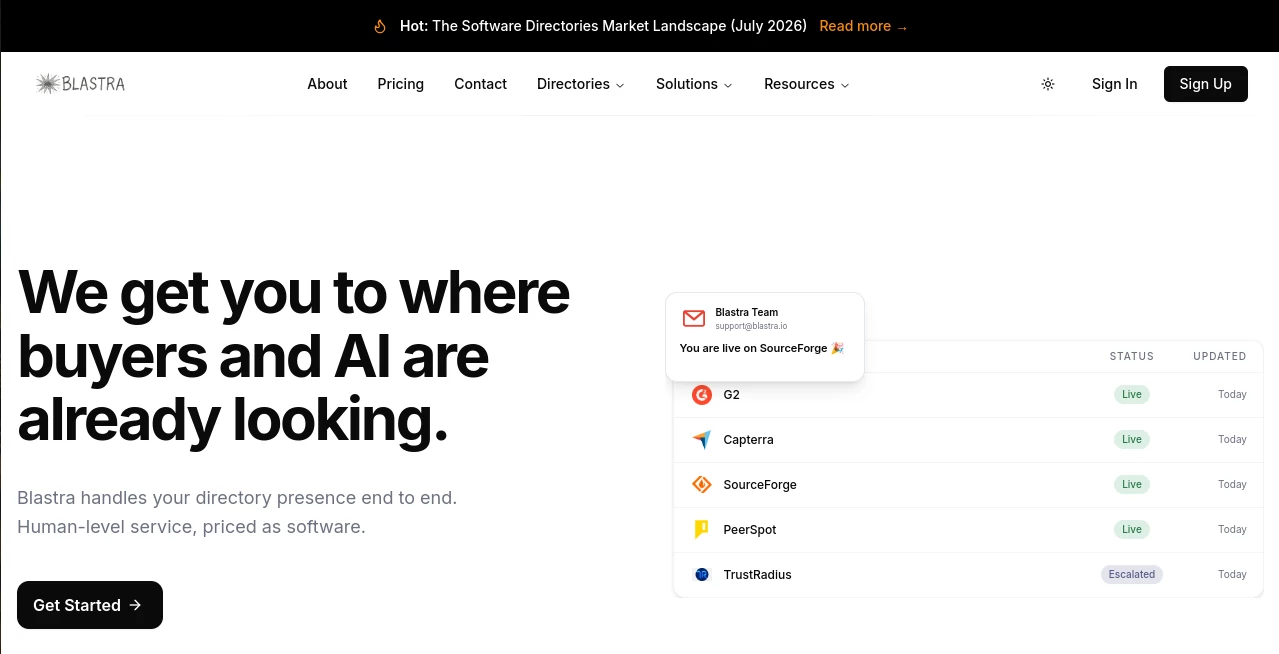
What is Blastra?
Getting a software product listed across the right business directories sounds simple until the work actually begins. Every platform has different requirements, verification steps, profile fields, categories, and rules. Keeping those listings accurate over time can quickly become a job of its own.
Blastra takes a done-for-you approach to directory presence. It scans the directories that buyers and AI systems use, identifies missing, outdated, or inaccurate listings, and then handles submissions and updates. The service is particularly useful for B2B software companies that want their product information to appear consistently across important discovery platforms without having to manage each directory manually.
The platform also pays attention to how products are represented in AI answers. Listings can be built out with complete information, screenshots, pricing, and aligned categories, helping companies maintain a clearer and more consistent public narrative.
Key Features
- Directory presence scanning across more than 20 software and business directories.
- Identification of missing, unclaimed, outdated, or inaccurate listings.
- Done-for-you directory submissions and listing updates.
- Listing optimization with complete fields, screenshots, pricing, and appropriate categories.
- Monitoring of a company's presence and perceived narrative across tracked directories.
- Competitive intelligence for understanding how competing products are represented.
- Centralized visibility into listings, credentials, submission statuses, and updates.
- Support for ongoing directory maintenance as products and their positioning change.
User Interface
The experience is designed around reducing the administrative burden rather than adding another complicated marketing dashboard to manage. After signing up, customers receive an assessment of their existing directory presence and can approve the scope of work.
A centralized dashboard provides visibility into listing coverage and submission status. Instead of keeping spreadsheets of which directories have been contacted, which profiles need verification, and which listings require updates, the information is brought together in one place.
This approach should feel especially practical for small marketing teams. You can see what has been handled and where attention is still needed without having to repeatedly check individual platforms.
Accuracy & Performance
Accuracy matters when directory profiles become part of the information buyers use to compare software. Incorrect pricing, incomplete descriptions, outdated screenshots, or poorly matched categories can make a product look less credible than it actually is.
The service focuses on closing those information gaps. Its directory workflow combines automated assistance with human involvement for tasks such as account creation, verification, and final content review. This is an important distinction for directory work, where simply generating text is not enough to get a profile published correctly.
The company states that it has submitted and optimized more than 500 listings across 20 or more directories. Its approach is also designed around maintaining consistent product information as a company's public narrative changes.
Capabilities
The platform goes beyond simply finding directory websites. It can identify where a product is already listed, where it is missing, and where existing information needs attention. Customers can then have listings created or updated on their behalf.
For teams focused on AI visibility, another useful capability is optimizing directory information for AI answers. The service considers details such as product descriptions, pricing, screenshots, and categories so that important facts are represented clearly rather than being scattered across incomplete profiles.
For larger organizations, the enterprise offering supports multiple products, shared submission resources, ongoing narrative monitoring, competitive insights, and regular reporting.
Security & Privacy
Directory management often involves credentials, verification processes, and access to vendor accounts, so responsible handling of account information is an important part of this type of service. The platform provides centralized credential management as part of its workflow, while human review is used for sensitive publishing and verification steps.
Businesses should still review the service's current privacy and security documentation before providing account access or other confidential information, particularly when managing a large portfolio of software products.
Use Cases
- B2B SaaS companies: Keep software listings accurate across the directories potential customers use during research.
- Startups: Establish an initial directory presence without assigning valuable founder or marketing time to repetitive submissions.
- Growing software companies: Update existing profiles when pricing, positioning, features, or screenshots change.
- Marketing teams: Replace scattered spreadsheets and manual directory checks with a centralized workflow.
- Agencies: Manage directory presence for multiple clients and products through a more structured process.
- Companies focused on AI visibility: Improve the consistency and completeness of the information available across directories that AI systems and buyers may reference.
Pros and Cons
Pros
- Done-for-you directory submission and update service.
- Coverage across 20+ software and business directories.
- Combines automation with human review and verification.
- Useful monitoring and reporting capabilities.
- Supports screenshots, pricing, categories, and other listing details.
- Can monitor competitive positioning as well as a company's own presence.
- Suitable for both individual products and larger portfolios.
Cons
- The service is more expensive than handling directory submissions internally.
- Monthly plans have limits on the number of listings submitted or updated.
- Some directories may still require platform-specific verification or approval.
- Companies wanting complete control over every submission may prefer a fully self-managed workflow.
Pricing Plans
The service currently offers several ways to manage directory presence. The Pulse plan is priced at $59 per month after the first month, with a one-time $99 setup fee. It includes a monthly presence scan and one listing submission or update per month after the initial setup work.
The Minimum Viable Presence plan costs $99 per month after the first month, with a one-time $299 setup fee. It includes weekly scans and three additional listings submitted or updated each month. Both plans currently advertise the first month as free.
For companies managing multiple products or requiring more extensive support, the Enterprise option uses custom pricing and includes portfolio-level management, regular monitoring, competitive insights, and additional submission capacity.
There are also one-time action packs. The Action Pack 3 provides three additional listing submissions or updates for $99, while the Action Pack 12 provides twelve for $299. These packs do not expire.
How to Use It
- Create an account and begin the directory presence assessment.
- Review the assessment to understand where listings are missing, incomplete, or inaccurate.
- Approve the scope of work and identify the listings that should be created or updated.
- Provide the required product information and access needed for directory management.
- Let the service handle submissions, profile completion, verification steps, and updates.
- Use the dashboard to monitor listing coverage, status, and historical activity.
- Continue with ongoing monitoring or add additional submission actions as the product portfolio grows.
Comparison with Similar Tools
Traditional directory management usually means opening each platform separately, creating accounts, completing forms, uploading screenshots, answering verification requests, and maintaining spreadsheets to track progress. That method can work for a small number of listings, but the workload grows quickly as the number of directories increases.
Generic SEO and marketing platforms can help with visibility, but they do not necessarily handle the hands-on process of creating and maintaining software directory profiles. Directory submission agencies can provide that human service, although their workflows and reporting structures vary considerably.
The main difference here is the combination of directory discovery, monitoring, listing execution, AI-oriented profile optimization, and centralized status tracking. For a team that wants the work handled rather than simply being told what to do, that distinction can be valuable.
Conclusion
Directory presence is easy to overlook because each individual listing seems like a small marketing task. In practice, maintaining dozens of profiles can consume considerable time, especially when a company has multiple products or frequently changes its positioning.
This service offers a practical alternative by taking responsibility for the operational side of directory management. Its combination of scanning, submissions, profile optimization, human review, monitoring, and reporting makes it a strong option for B2B software companies that want broader and more accurate directory coverage.
For a small team that would rather spend its time on product, sales, and customer growth than chasing directory forms and verification emails, having this work handled externally can be a worthwhile investment.
Frequently Asked Questions (FAQ)
What does the service do?
It helps software companies find, create, update, and monitor listings across software and business directories. It can also optimize those profiles so important product information is presented clearly for buyers and AI systems.
How many directories are supported?
The service currently states that it supports more than 20 software and business directories, with coverage including well-known platforms used for software discovery, reviews, and business information.
Can it update existing listings?
Yes. The service can identify existing profiles that contain outdated or incomplete information and submit updates on behalf of the customer.
Does it only work for one product?
No. Larger customers can use the enterprise offering for multiple products and portfolios, with shared submission resources and ongoing monitoring.
Is there a free option?
The current recurring plans advertise the first month as free, although setup fees apply when purchasing those plans.
Can I purchase additional submissions?
Yes. Additional action packs are available as one-time purchases, including packs for three or twelve extra listings. These actions do not expire.
Who can benefit most from this service?
It is particularly suitable for B2B SaaS companies, startups, marketing teams, agencies, and organizations managing several software products that want directory management handled without maintaining the process manually.
AI SEO Assistant , AI Digital Marketing Generator , Other .
These classifications represent its core capabilities and areas of application. For related tools, explore the linked categories above.

Blastra Alternatives Product

pixel flow g…

URL2Pin

Sound Level …

StyleBias

zGEO Ranker

AiToolsObser…

forge calcul…

TonesMatch

RankPeak