

















What is Business Chinese AI?
Business Chinese can be difficult to learn from textbooks alone. Knowing the right vocabulary is only part of the challenge; professionals also need to understand how to negotiate, introduce a company, discuss products, and communicate with Chinese business partners naturally. Business Chinese AI takes a practical approach by letting learners practice these situations through AI-powered role-play.
The platform is designed around realistic business conversations rather than isolated language exercises. Users can step into scenarios involving meetings, negotiations, supplier discussions, product presentations, and other professional situations. The AI responds dynamically, making the experience feel closer to a real conversation than a traditional language lesson.
One of the most useful aspects is the feedback after each interaction. Instead of simply marking an answer right or wrong, the platform looks at grammar, fluency, business tone, and cultural awareness. That makes it particularly interesting for professionals who already know some Chinese but want to become more comfortable using it at work.
Key Features
- 30+ practical business scenarios covering common professional situations.
- AI role-play with dynamically generated responses.
- More than 20 conversation turns available within a scenario.
- Grammar and vocabulary corrections.
- Suggestions for improving tone and politeness.
- Explanations of Chinese business culture and communication habits.
- Detailed scoring across language accuracy, fluency, business tone, and cultural awareness.
- XP, achievements, vocabulary tracking, and learning history.
- Different difficulty levels for learners at different stages.
User Interface
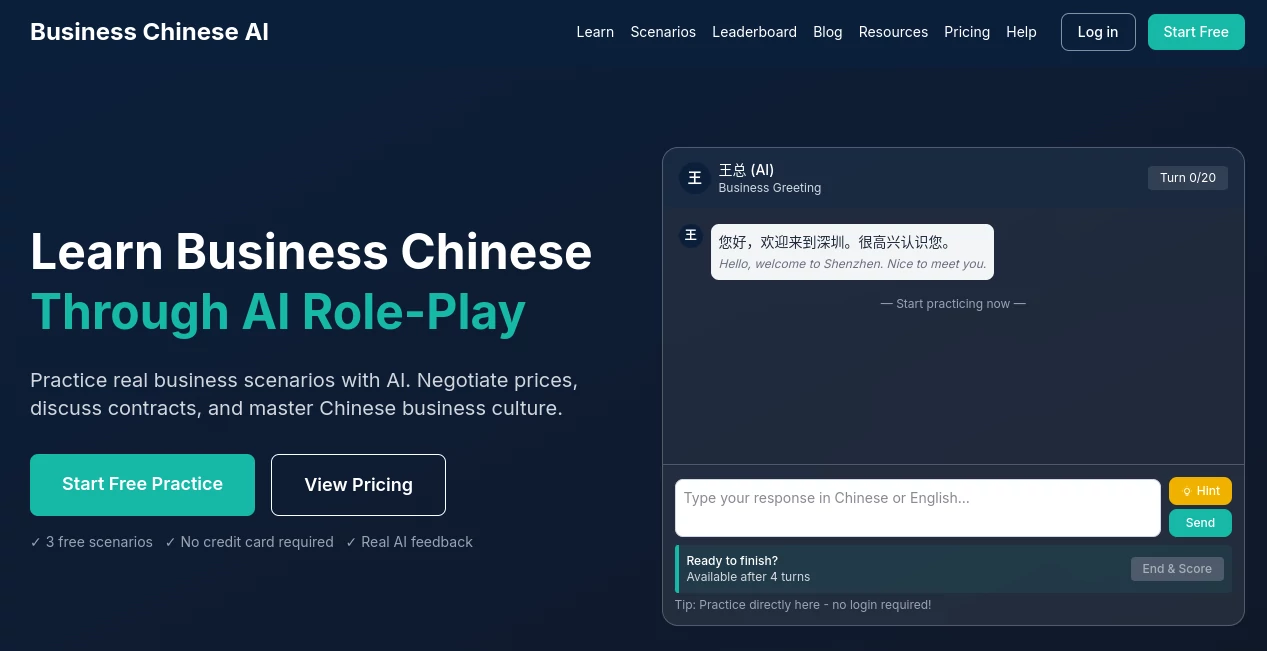
The interface keeps the learning process straightforward. A learner chooses a business scenario, enters the conversation, and responds directly to an AI business counterpart. Chinese dialogue is accompanied by English translations, which can make the first few practice sessions easier to follow.
The conversation screen is intentionally focused on the exchange itself. There is a clear message area, a response field, and an option to finish the session and receive a score. This simple setup works well for short practice sessions when you want to prepare for an upcoming call or meeting without spending an hour navigating through lessons.
Accuracy & Performance
Rather than focusing only on grammatical correctness, the platform evaluates how appropriate a response is within a business context. For example, a sentence can be grammatically correct while still sounding too direct during a negotiation. The feedback system can point out that difference and suggest a more professional alternative.
Its scoring system separates language accuracy, fluency, business tone, and cultural awareness. This gives learners a more useful picture of their performance than a single language score. In a sample negotiation scenario, for example, a learner can see exactly where communication was strong and where the wording could be improved.
Capabilities
The platform currently offers more than 30 business situations, including business greetings, company introductions, product presentations, price negotiations, and contract discussions. Scenarios are built around practical communication skills and include different difficulty levels and industry-specific situations.
The role-play format is particularly useful for learners who need Chinese for work. Someone preparing to negotiate with a supplier can practice explaining a target price, responding to an offer, and asking for flexibility before having the real conversation.
After practice, the system provides corrections and cultural guidance. Learners can also build a personal vocabulary collection, earn XP, review previous performance, and track improvement across different areas.
Security & Privacy
For privacy-conscious users, the service provides dedicated Privacy Policy and Terms of Service pages. The platform also uses account-based features for saving learning history and progress. Users should review the current privacy documentation before entering any confidential business information into practice conversations, especially when using scenarios based on real negotiations or company situations.
Use Cases
This platform is especially useful for professionals who expect to communicate with Chinese-speaking clients, suppliers, partners, or colleagues.
- Business negotiations: Practice discussing prices, quantities, and possible concessions before entering a real negotiation.
- Supplier communication: Rehearse conversations with manufacturers and suppliers in a realistic setting.
- Business meetings: Improve introductions, company presentations, and professional conversation.
- Market expansion: Prepare for communication when entering the Chinese market.
- Product presentations: Practice explaining products and responding to questions in Chinese.
- Cultural preparation: Learn how tone, politeness, and indirect communication can affect professional conversations.
- Independent learning: Practice whenever convenient without arranging a lesson or language partner.
Pros and Cons
Pros
- Focused specifically on professional Chinese communication.
- Realistic role-play instead of simple vocabulary drills.
- 30+ business scenarios with different difficulty levels.
- Useful feedback on tone and cultural appropriateness.
- Detailed performance scoring.
- Free scenarios are available without requiring a credit card.
- Progress tracking and vocabulary tools are available on paid plans.
Cons
- The platform is specialized around business Chinese rather than general Chinese learning.
- The free plan limits each scenario to one attempt per day.
- Some of the more advanced scenarios require a paid plan.
- Paid subscription and payment integration are still being rolled out.
Pricing Plans
The service uses a free-to-paid model, allowing learners to test the experience before committing to a subscription. The Free plan costs $0 per month and includes seven free scenarios, one attempt per scenario per day, basic scoring, and vocabulary cards. Learning progress is not saved on this plan.
The Plus plan costs $9.99 per month or $59.94 per year, with the annual option listed as a 50% saving. It provides access to all 30 scenarios, unlimited practice, deeper scoring analysis, progress tracking, and a vocabulary notebook.
The Pro plan costs $18.99 per month or $113.94 per year. It includes the Plus features along with AI learning suggestions, trend analysis reports, priority support, and learning report exports.
For larger teams, enterprise pricing starts at $49 per seat per month for teams of 20 or more. The pricing page also notes that payment integration is being updated, so availability of paid subscriptions may change as the service develops.
How to Use Business Chinese AI
Getting started is straightforward. Begin by selecting a business scenario that matches the situation you want to practice. Beginners can start with basic options such as business greetings or company introductions, while more experienced learners can move into product presentations, price negotiations, and contract-related conversations.
Once the scenario starts, respond to the AI business counterpart in Chinese. The conversation can continue for multiple turns, allowing you to react to changing questions and situations instead of simply completing predefined exercises.
When you finish, review the feedback and score. Pay particular attention to comments about tone and cultural appropriateness. If a sentence is technically correct but too direct, try the suggested alternative and repeat the scenario. Over time, reviewing these small differences can make professional communication feel much more natural.
Comparison with Similar Tools
Many language-learning platforms concentrate on vocabulary, grammar exercises, or general conversation. This service takes a narrower approach by focusing on professional situations where language and business etiquette overlap.
That distinction matters for learners who already have basic Chinese knowledge. A general language app may teach the words needed to say that something is expensive, while a business-focused role-play can help you practice expressing the same idea without sounding unnecessarily blunt during a negotiation.
It also sits somewhere between a conventional language course and a conversation partner. The AI provides an interactive counterpart, while the scoring and feedback add a learning layer that is often missing from ordinary conversational practice.
Conclusion
Learning business Chinese requires more than memorizing industry vocabulary. Professionals need to know how to introduce themselves, negotiate carefully, respond to unexpected questions, and adapt their language to Chinese business culture.
This platform addresses that practical side of language learning through AI-driven role-play and immediate feedback. Its collection of business scenarios, detailed scoring, cultural explanations, and progress features make it a compelling option for professionals preparing for real interactions with Chinese-speaking business partners.
The free plan also makes it easy to test the concept before paying. For learners whose main goal is confident and professional Chinese communication rather than general language study, the focused approach can be a valuable addition to their learning routine.
Frequently Asked Questions (FAQ)
Is there a free plan?
Yes. The Free plan costs $0 per month and includes seven free scenarios, one attempt per scenario per day, basic scoring, and vocabulary cards.
How many business scenarios are available?
The platform currently advertises more than 30 business scenarios covering areas such as greetings, company introductions, product presentations, supplier discovery, price negotiation, and contract terms.
Can beginners use the platform?
Yes. There are beginner-friendly Level 1 scenarios, including business greetings and company introductions. Learners can gradually move toward more advanced situations.
Does it provide feedback on grammar?
Yes. Feedback can include grammar and vocabulary corrections as well as recommendations for improving tone, politeness, and cultural appropriateness.
Can I practice business negotiations?
Yes. Price negotiation is one of the available business scenarios, allowing learners to practice responding to offers and discussing prices in Chinese.
Does it explain Chinese business culture?
Yes. Feedback can include cultural context. For example, the system can explain why a grammatically correct but overly direct refusal may not be ideal in a Chinese business negotiation.
Is progress tracking available?
Progress tracking is included in the Plus and Pro plans. These plans also provide access to features such as vocabulary management and deeper performance analysis.
Are there plans for teams?
Yes. Enterprise pricing is available for teams of 20 or more, starting at $49 per seat per month.