
BuyMicroStartups
What is BuyMicroStartups?
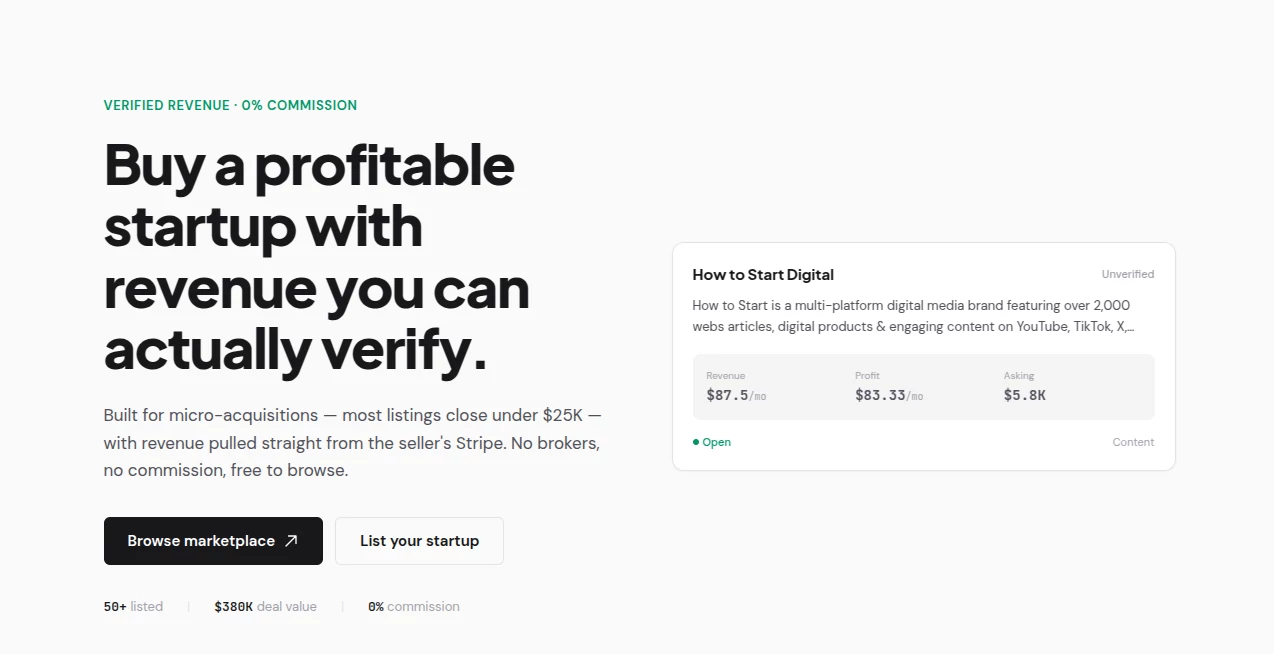
Buying a small online business can be surprisingly difficult. Many marketplaces are built around larger acquisitions, complicated processes, broker involvement, and fees that can make a small deal feel unnecessarily expensive. BuyMicroStartups takes a more focused approach by creating a marketplace specifically for micro-acquisitions, where founders can buy or sell smaller digital businesses without the traditional middleman.
The marketplace is designed around transparency. Listings can include revenue and profit information, while verified listings connect directly to the seller's Stripe data. Most available opportunities are aimed at the micro-startup market, with many deals positioned below $25,000. Buyers can browse the marketplace without paying for access, making it easier to discover projects before deciding whether an opportunity is worth pursuing.
Key Features
- Micro-startups and small digital businesses available for acquisition
- Stripe-based revenue verification for eligible listings
- Zero commission on completed deals
- Public marketplace browsing without a subscription or paywall
- Direct communication between buyers and sellers
- One-time listing fees with no recurring renewal costs
- Different visibility options for sellers
- Listings covering SaaS products, newsletters, marketplaces, browser extensions, mobile apps, content businesses, and other digital projects
User Interface
The marketplace keeps the discovery process straightforward. Listings are presented with practical information such as asking price, revenue, profit, business type, and acquisition status, allowing potential buyers to compare opportunities without opening a lengthy sales presentation for every business.
This simple presentation is particularly useful for independent founders who already know what they are looking for. Instead of navigating through layers of sales assistance, a buyer can scan available projects, look at the numbers, and decide which opportunities deserve a closer look.
Accuracy & Performance
One of the strongest parts of the marketplace is its approach to financial verification. Sellers can connect a read-only Stripe API key, allowing revenue information to be pulled directly from Stripe. The system checks successful charges from the previous 30 days and active MRR, then displays a verification indicator when the figures have been confirmed.
This does not remove the need for proper acquisition due diligence, but it gives buyers a much stronger starting point than relying entirely on screenshots or manually reported numbers. For someone evaluating a small SaaS or online business, having a dated revenue verification attached to a listing can make the initial screening process considerably easier.
Capabilities
The platform serves both sides of a micro-acquisition. Buyers can browse opportunities for free and contact sellers when they find something interesting. Sellers can create a listing, select a visibility package, connect Stripe for revenue verification, and communicate directly with potential buyers.
The available businesses can vary considerably. A listing might be a small SaaS product, a newsletter, a content website, an e-commerce operation, a browser extension, or another digital business. That variety makes the marketplace useful for entrepreneurs who are interested in acquiring an existing asset rather than starting completely from zero.
Security & Privacy
The Stripe verification process is designed around a read-only API key. According to the marketplace, the connection is used for reading charges and subscriptions rather than making changes to the connected account. This is an important distinction when financial verification is involved.
Buyers should still perform their own due diligence before completing an acquisition. Revenue verification can confirm important financial information, but ownership, intellectual property, customer relationships, operating costs, liabilities, traffic sources, and other business details should also be reviewed before a transaction is finalized.
Use Cases
- Buying a micro-startup: Entrepreneurs can search for an existing digital business instead of building a product from scratch.
- Acquiring a small SaaS: Buyers looking for recurring revenue opportunities can review SaaS listings and examine available financial information.
- Finding side projects: Developers and indie hackers can discover smaller projects that may be improved, expanded, or integrated into an existing portfolio.
- Selling an online business: Founders can list digital products and reach potential buyers directly.
- Portfolio building: Experienced entrepreneurs can evaluate multiple small acquisitions rather than concentrating their capital on a single large transaction.
- Finding businesses under $25K: The marketplace is particularly suited to buyers interested in smaller acquisition opportunities.
Pros and Cons
Pros
- Zero commission on completed transactions
- Free access to browse marketplace listings
- Revenue verification through Stripe for eligible listings
- Direct communication between buyers and sellers
- Focused specifically on smaller digital acquisitions
- One-time seller listing fees rather than recurring charges
- Useful financial information is displayed directly on listing cards
Cons
- Buyers and sellers are responsible for negotiating the transaction directly
- Verified revenue does not replace complete acquisition due diligence
- Escrow or buyer protection is not currently the central part of the transaction process
- The quality and maturity of individual businesses can vary significantly
Pricing Plans
Browsing the marketplace is free for buyers, and there is no buyer subscription or success commission. Sellers pay a one-time listing fee depending on the level of exposure they want.
- Basic – $19: Marketplace listing, visibility to buyers, and direct buyer contact.
- Boost – $59: Includes the standard listing features plus a custom highlight color, newsletter exposure, and higher search ranking.
- Premium – $149: Adds enhanced visibility, newsletter exposure, top search ranking, 30 days of pinned placement, and buyer matching notifications.
The listing remains available until the business is sold or the seller removes it, so sellers do not need to worry about recurring renewal payments simply to keep an opportunity online.
How to Use the Marketplace
- Browse the available micro-startups and narrow the options based on business type, price, revenue, or other relevant information.
- Open promising listings and review their financial and operational details.
- Look for the revenue verification indicator when financial figures have been verified through Stripe.
- Create a free account when you are ready to contact a seller.
- Message the seller directly and ask detailed questions about revenue, expenses, customers, technology, traffic, ownership, and the reason for selling.
- Carry out appropriate due diligence before agreeing to a transaction.
For sellers, the process is similarly direct: create a listing, choose the appropriate visibility package, connect Stripe for verification when applicable, and communicate with interested buyers. This makes the platform particularly appealing to founders who prefer to manage a sale themselves rather than work through a broker.
Comparison with Similar Tools
Traditional startup and online-business marketplaces often target larger transactions and may charge success commissions when a deal closes. Some competitors also introduce additional layers between the founder and buyer.
This marketplace takes a different position by concentrating on smaller acquisitions and using a zero-commission model. Its one-time listing structure can be especially attractive when the business being sold is relatively small, because a percentage-based commission can otherwise consume a meaningful portion of the final sale price.
The strongest differentiator is the combination of direct transactions and revenue verification. A buyer can browse publicly, inspect the available numbers, identify promising businesses, and then contact the owner without paying for marketplace access.
Conclusion
For entrepreneurs interested in buying or selling smaller online businesses, this marketplace offers a refreshingly focused alternative to traditional acquisition platforms. Its emphasis on micro-acquisitions, public listings, direct founder-to-buyer communication, and Stripe-based revenue verification addresses several of the frustrations commonly associated with small business transactions.
It is not a replacement for serious due diligence, and buyers should still investigate every business carefully before committing capital. However, as a discovery and connection platform, it provides a practical starting point for entrepreneurs who want to find an existing digital asset without dealing with unnecessary brokerage fees.
If your goal is to acquire a small SaaS, newsletter, marketplace, content business, or another digital project, the marketplace is worth exploring. For founders looking to sell, the zero-commission structure and direct buyer access also create a straightforward path to putting a project in front of potential acquirers.
Frequently Asked Questions (FAQ)
Is it free to browse the marketplace?
Yes. Buyers can browse public listings without a subscription or paywall. An account is needed when a buyer wants to contact a seller.
How is revenue verified?
Eligible sellers can connect a read-only Stripe API key. The platform reads relevant revenue information, including successful charges from the previous 30 days and active MRR, and displays verification information on qualifying listings.
Does the marketplace charge a commission?
No. Sellers pay a one-time listing fee, while the marketplace does not take a percentage of the completed transaction.
What types of businesses can be listed?
Digital micro-startups such as SaaS products, newsletters, browser extensions, marketplaces, mobile applications, content businesses, and other online projects can be listed.
How much do most acquisitions cost?
The marketplace focuses on micro-acquisitions, and most listings are positioned below $25,000, although there is no fixed maximum acquisition price.
How long does a listing remain active?
A listing remains available until it is sold or the seller removes it. There is no standard expiry or recurring renewal requirement.
Does revenue verification guarantee that a business is a good investment?
No. Verified revenue is useful for validating financial claims, but buyers should independently review expenses, customers, assets, intellectual property, traffic, technology, liabilities, and other aspects of the business before purchasing.
These classifications represent its core capabilities and areas of application. For related tools, explore the linked categories above.
BuyMicroStartups details
Website unavailable — View Alternatives
Pricing
- Freemium
Apps
- Web App
Categories

BuyMicroStartups Alternatives Product

Meme.Center

Fina Money

Astrologer B…

Metal

Greek Numero…

Sand Loop Gu…

NYT Sudoku

Toolsbench

Oasis