
BuzzSearch
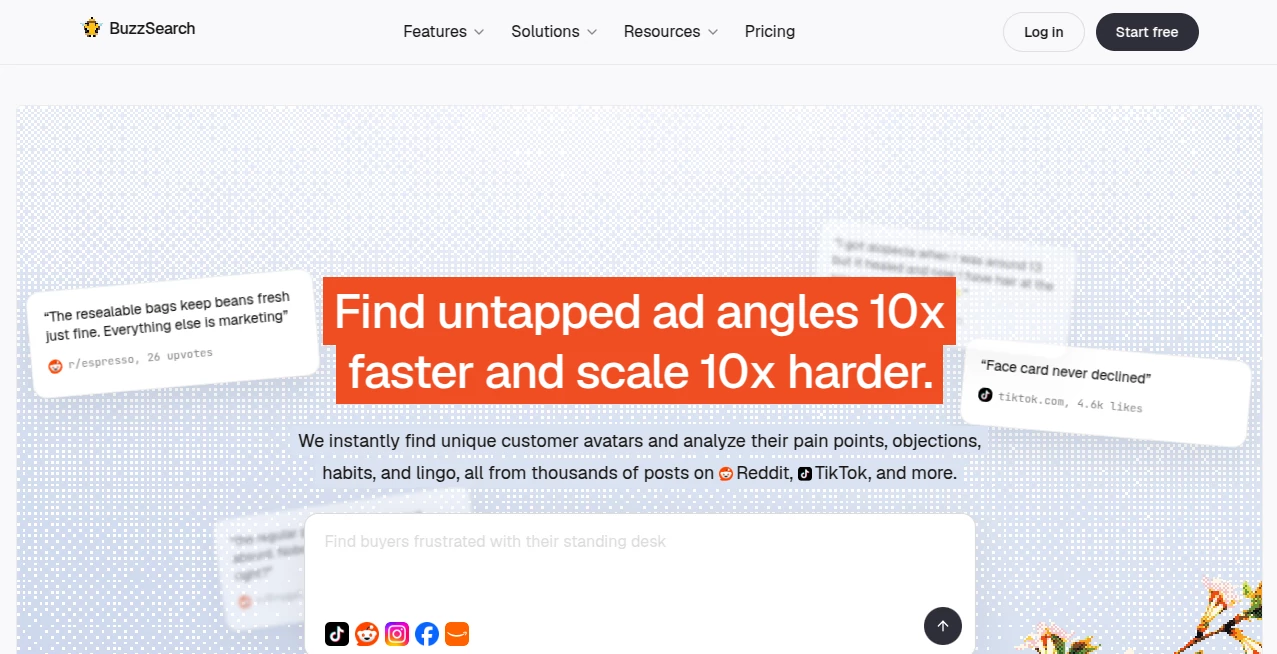
What is BuzzSearch?
Finding out what customers really think about a product is often harder than creating the product itself. Surveys can miss the emotion behind a buying decision, while generic market reports tend to smooth everything into broad trends. This platform takes a more direct route by looking at public conversations on Reddit, TikTok, reviews, and the open web, then turning those conversations into practical audience and market insights.
The main idea is simple: instead of guessing what an audience cares about, start with the words people are already using. The platform can identify customer avatars, pain points, objections, habits, recurring problems, and the language people naturally use when discussing a product or category. That makes the research especially useful for ecommerce founders, media buyers, marketers, and product teams.
One particularly useful aspect is the connection between research and advertising. Customer comments can become the raw material for hooks, ad angles, and messaging rather than remaining buried inside a research report. For anyone who has spent hours scrolling through Reddit threads or TikTok comments looking for one useful insight, that approach can save a considerable amount of time.
Key Features
- Audience research based on public Reddit and TikTok conversations.
- Customer avatar discovery based on real buyer language.
- Identification of pain points, objections, habits, failures, and desired solutions.
- Market and opportunity analysis for potential advertising angles.
- Research that can examine thousands of comments and conversations.
- Source-backed answers with links to the conversations behind the findings.
- TikTok trend and comment analysis for discovering emerging customer interests.
- Research workflows designed around plain-English questions rather than complicated dashboards.
- Deep search for more extensive analysis when a broader sample of comments is needed.
- Saved research that can be revisited for future campaigns and product decisions.
User Interface
The interface is built around asking questions in ordinary language. Instead of configuring a large collection of filters before beginning, users can describe what they want to understand and let the research workflow investigate relevant conversations.
This conversational approach makes the experience approachable for marketers who do not want to spend their time learning a complicated research platform. A question such as what customers complain about in a particular product category can lead into a much deeper investigation of the recurring problems, language, and motivations behind those complaints.
Accuracy & Performance
The biggest strength of the research approach is its emphasis on source material. Insights are tied to public conversations rather than being presented as unsupported market claims. Users can inspect the underlying discussions and see where an observation came from.
The platform also focuses specifically on conversations and comments, which is valuable when the goal is to understand how customers actually speak. A report might tell a marketer that customers are concerned about price, but real comments can reveal whether people describe the problem as being too expensive, poor value, risky, or simply not worth changing from an existing product.
Research runs generally take a few minutes, and longer jobs can continue while the user leaves the page. Completed research remains available in the account, making it easier to return to useful findings later.
Capabilities
The platform goes beyond basic social listening by turning conversations into structured research. It can suggest promising customer avatars and examine their demand, competitive pressure, and the availability of advertising angles.
Its research can also uncover the exact language customers use around a problem. That is particularly valuable for copywriters and advertisers because customer language often makes stronger messaging than polished marketing terminology.
For example, an ecommerce company investigating a product category could use the research to discover why buyers are dissatisfied with existing solutions, what alternatives they have tried, which objections repeatedly appear, and what kind of messaging might address those concerns.
Security & Privacy
The research is based on publicly available conversations and content rather than private customer databases. Sources can be traced back to the public discussions used for the research, which gives users an opportunity to review the original context.
As with any research service that analyzes online conversations, businesses should still avoid entering confidential customer information or sensitive internal material into research prompts. For commercial research, it is sensible to treat the platform as an external research environment and keep proprietary information out of questions unless the applicable terms and privacy policies have been reviewed.
Use Cases
One of the strongest use cases is ecommerce research. A store owner preparing to launch a product can investigate what buyers complain about in existing products, what they wish worked differently, and what causes hesitation before purchase.
Advertisers can use the same information to discover fresh creative angles. Instead of beginning with generic phrases such as high quality or easy to use, they can build messaging around genuine customer frustrations and the language associated with them.
Product teams can use the research to validate ideas before investing heavily in development. Repeated complaints can reveal opportunities, while a lack of meaningful demand may suggest that an idea needs more work.
It can also help marketers researching competitors, emerging TikTok trends, audience segments, product positioning, and potential customer objections. The ability to ask follow-up questions makes it useful when initial research uncovers something that deserves a closer look.
Pros and Cons
Pros
- Uses real public conversations as research material.
- Provides source-backed insights rather than relying entirely on generic summaries.
- Strong focus on Reddit and TikTok conversations.
- Useful for customer avatar and pain-point discovery.
- Can turn research findings into practical advertising angles.
- Plain-English questions make research accessible.
- Offers a free starting option without requiring a paid plan immediately.
Cons
- The quality of findings can depend on the availability of relevant public conversations.
- It is focused on research and listening rather than being a complete social media management suite.
- Users who need traditional publishing, scheduling, or social inbox features will need other software.
- Large-scale research can consume credits quickly depending on research depth.
Pricing Plans
A free option provides 100 credits for initial research, with no credit card required. It is designed to let users experience the research workflow before committing to a subscription.
The Plus plan costs $30 per month and includes 3,500 credits, more than 11 hours of agent time, and approximately 75 searches. It is positioned for businesses researching one brand or market on a regular basis.
The Pro plan costs $100 per month and includes 13,000 credits, more than 43 hours of agent time, and approximately 285 searches. It is aimed at operators who conduct research frequently and need a larger monthly allowance.
The Max plan costs $200 per month and includes 30,000 credits, more than 100 hours of agent time, and approximately 665 searches. This option is intended for agencies and teams with a heavier research workload.
Subscribers can also use credit top-ups, with purchased credits designed to remain available rather than expiring at the end of a billing period.
How to Use the Platform
Start by describing the market, product, customer group, or problem you want to investigate. A specific question usually produces a more useful research direction than a broad request.
Next, let the research run across the available public conversations. The system can examine Reddit posts and comments, TikTok videos and comments, reviews, and other open-web sources depending on the research request.
Review the findings and pay particular attention to repeated pain points, objections, customer language, and examples that appear across multiple conversations. When an interesting pattern appears, ask a follow-up question rather than starting a completely separate research project.
Finally, turn the strongest findings into something practical: an advertising hook, customer avatar, product positioning idea, landing-page angle, content topic, or new research question. This is where the research becomes useful beyond simply collecting information.
Comparison with Similar Tools
Traditional social listening platforms often focus on monitoring mentions, tracking accounts, publishing content, or managing engagement. This platform takes a narrower research-oriented approach. Its purpose is to understand the conversations behind a market rather than provide a complete social media management suite.
It also differs from general-purpose AI assistants. A conventional AI assistant may combine its existing knowledge with web results, while this research workflow is specifically designed around public conversations and their underlying comments. That distinction matters when the goal is to understand how people currently describe a problem in their own words.
Compared with manual Reddit and TikTok research, the main advantage is organization and speed. Instead of opening dozens of threads, collecting comments, identifying recurring themes, and writing conclusions manually, users can ask a focused question and receive a structured research result with supporting sources.
Conclusion
For marketers and founders, the most valuable customer research is often hiding in plain sight. People openly explain what frustrates them, what they have tried, what they dislike about competing products, and what would make them buy. The challenge is finding those conversations and turning them into something useful.
This platform does that job with a strong focus on Reddit and TikTok, combining conversational research with customer-avatar discovery, pain-point analysis, market validation, and advertising insights. The result is particularly appealing to ecommerce operators and performance marketers who want customer language they can actually use.
If your research process currently involves hours of scrolling through social platforms looking for patterns, this approach offers a much more focused way to get from scattered conversations to actionable marketing ideas.
Frequently Asked Questions (FAQ)
What is this platform used for?
It is an AI research assistant for audience, market, product, and customer research. It analyzes public online conversations and turns them into sourced insights.
Does it analyze Reddit?
Yes. Reddit posts, comments, and discussion threads are a major part of its research workflow.
Can it analyze TikTok?
Yes. It can research TikTok videos and comment sections, including questions about trends and customer conversations.
Can it create customer avatars?
Yes. Customer avatars can be built from recurring pain points, objections, habits, attempted solutions, and the language used by people discussing a product or problem.
Is there a free plan?
Yes. New users can start with 100 free credits and use the initial research experience without entering a credit card.
What is the cheapest paid plan?
The Plus plan starts at $30 per month and provides 3,500 credits along with additional research capabilities.
Is it a social media management tool?
Not in the traditional sense. Its primary purpose is research and social listening. It is not designed to replace publishing, scheduling, or social inbox platforms.
How long does research take?
Research runs generally take a few minutes, although the exact duration depends on the depth and scope of the request.
Can research be saved?
Yes. Completed research can remain available in the user's account, making it possible to return to previous findings and continue investigating a market.
Who can benefit most from it?
Ecommerce founders, media buyers, marketers, product teams, agencies, and anyone who needs to understand customer conversations before creating a product, campaign, or positioning strategy can benefit from this research approach.
Marketing , AI Tiktok Assistant , AI Research Tool , AI Analytics Assistant .
These classifications represent its core capabilities and areas of application. For related tools, explore the linked categories above.

BuzzSearch Alternatives Product

Toonifyit

Hirescope.te…

SciSpace

Schema Synth

AI Entity

AIInLink

Friendify

ttanonviewer

LocaFlow