
















Catalyst Healthspan Audit
Verified Blue CheckMark
Verified Blue CheckMark products are featured above free or unverified listings.
This badge indicates authenticity and builds trust, giving your product higher visibility across the platform.
Upgrade to get verified
Verified Blue CheckMark products are featured above free or unverified listings. This badge indicates authenticity and builds trust, giving your product higher visibility across the platform.
Upgrade to get verified
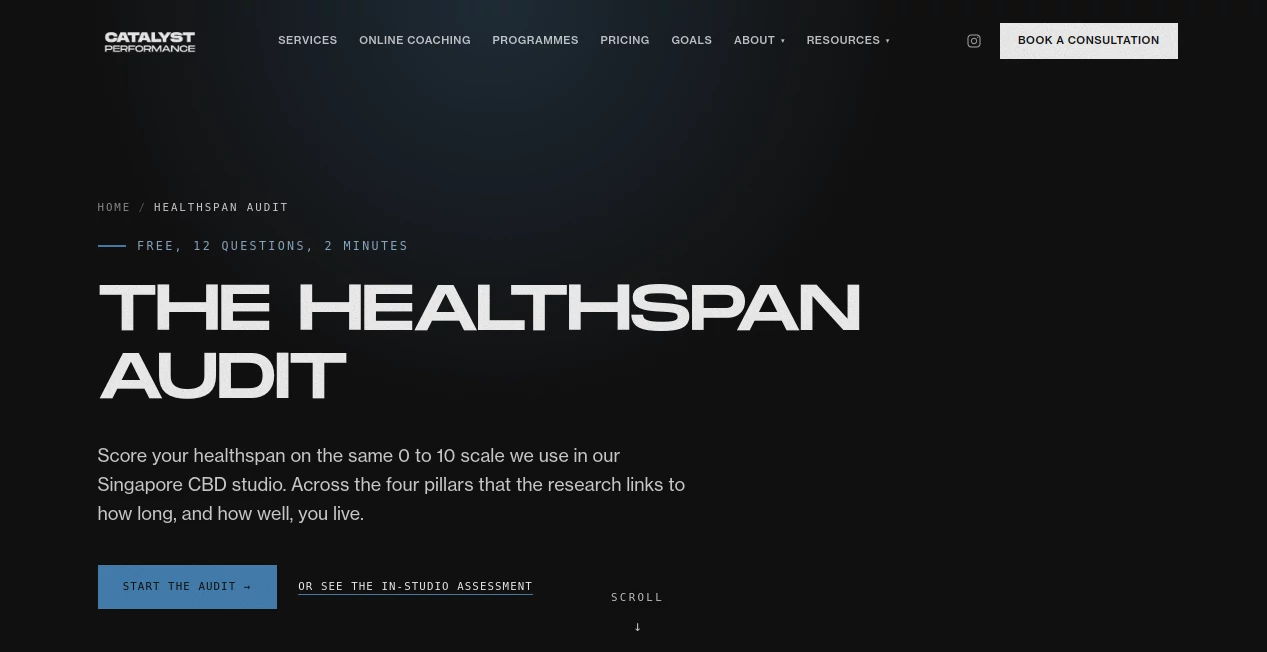
What is Catalyst Healthspan Audit?
Health is not only about how many years you live. It is also about how many of those years you can spend moving well, staying strong, maintaining stability, and feeling capable in everyday life. Healthspan Audit takes a practical approach to that idea by turning several important aspects of physical health into a simple score that anyone can understand.
The free self-assessment uses 12 questions and takes roughly two to three minutes to complete on a phone. Instead of focusing on a single measurement, it looks at four areas: body composition, cardiorespiratory fitness, stability, and strength. The result is a directional score from 0 to 10, along with a breakdown showing where your strongest and weakest areas may be.
That makes it particularly useful for someone who exercises regularly but has never really stopped to ask whether their training covers the areas that matter for long-term physical function. It can also be a helpful starting point for people over 35 who have noticed changes in recovery, strength, mobility, or general fitness.
Key Features
- Free 12-question healthspan self-assessment.
- A composite Healthspan Score on a 0 to 10 scale.
- Assessment across body composition, cardiorespiratory fitness, stability, and strength.
- Optional precision mode for users with wearable data.
- Personalised pillar breakdown and identification of the weakest area.
- Personalised next steps delivered by email.
- Downloadable PDF report.
- Mobile-friendly experience with no measuring equipment required.
User Interface
The experience is deliberately straightforward. Questions are presented in a mobile-friendly format, allowing users to complete the assessment without setting up equipment or navigating a complicated dashboard. You do not need a measuring tape, smartwatch, or gym equipment to get started.
For people who already track their health, the optional precision mode can make use of information such as resting heart rate, VO2 max, and movement-related inputs from devices such as Apple Watch, Garmin, or Oura. That gives experienced fitness trackers a way to add more useful information without making the standard assessment difficult for everyone else.
Accuracy & Performance
The score is designed as a directional estimate rather than a clinical measurement. Its questions use self-reported information, while the full in-studio assessment uses equipment and physical testing that cannot realistically be replicated on a phone.
The four-pillar structure gives the assessment an advantage over tools that concentrate exclusively on weight, body fat, or cardiovascular fitness. A person might feel very fit because they run regularly while overlooking strength or stability. Looking at several areas together can reveal that kind of blind spot.
The published methodology also makes an important distinction: the online result is not intended to diagnose a medical condition. It is better viewed as a starting point for understanding where further attention or professional assessment may be worthwhile.
Capabilities
The assessment produces more than a single number. It places the result into one of five score bands: Elite, Strong, Developing, At Risk, or Critical. More importantly, it shows which of the four pillars is pulling the overall result down.
The report is designed to turn that information into something actionable. For example, someone who already has good cardiovascular fitness may discover that strength or stability deserves more attention. Instead of simply saying “exercise more,” the assessment gives the user a clearer idea of what to look at next.
Recent first-party data published by the team shows that more than 1,000 people have completed the assessment, with a reported median score of 5.2 out of 10. The company also reports that people who reported more weekly strength-training sessions tended to have higher scores. These figures are observational and self-selected rather than a representative clinical study, but they provide an interesting real-world perspective on the framework.
Security & Privacy
The assessment is completed online and the full report is delivered to the user's inbox after submission. Because health-related information can be personal, users should treat the result as private information and review the site's privacy terms before submitting any information they are uncomfortable sharing.
It is also worth keeping the purpose of the assessment in perspective. The score is educational and non-diagnostic. Anyone with existing cardiovascular, musculoskeletal, or balance concerns should speak with an appropriate medical professional before beginning a new exercise programme.
Use Cases
The assessment works well as a quick health and fitness check-in for people who want a broader picture than a bathroom scale can provide.
- Adults over 35: A useful starting point for people noticing slower recovery, reduced strength, or changes in mobility.
- Regular gym-goers: Helps identify whether training is balanced across strength, stability, cardiovascular fitness, and body composition.
- Longevity-focused users: Provides a simple way to think about physical capability in terms of healthspan rather than appearance alone.
- Wearable users: Optional precision inputs can add existing fitness data to the assessment.
- People returning to exercise: Can provide a baseline before deciding what areas deserve more attention.
Pros and Cons
- Pros: Free to use, quick to complete, mobile-friendly, covers four major physical pillars, provides a personalised report, and does not require specialist equipment.
- Pros: The focus on identifying the weakest pillar makes the result more useful than a single generic fitness score.
- Pros: Optional precision mode gives experienced users the ability to include wearable information.
- Cons: The online assessment relies partly on self-reported information.
- Cons: It cannot replace physical measurements such as BIA, dynamometer testing, Y Balance testing, or loaded movement assessment.
- Cons: The result should not be interpreted as a medical diagnosis.
Pricing Plans
The online assessment is completely free, with no booking required to complete it. After answering the questions, users receive their score, pillar breakdown, personalised next steps, and a downloadable PDF report by email.
There is also a complimentary 60-minute in-studio assessment for people who want a more detailed measurement using professional equipment. The online version therefore works well as an accessible first step, while the in-person option provides a more comprehensive assessment.
How to Use Healthspan Audit
Start by opening the assessment on a phone or computer and answer the questions as honestly as possible. There is no need to prepare equipment or visit a gym. The standard version is designed to take only a few minutes.
If you already use a compatible wearable and have reliable fitness data, you can use the optional precision mode to provide additional inputs. Once the questions are complete, submit the assessment and check your inbox for the full report.
Pay particular attention to the weakest pillar rather than becoming overly focused on the overall number. For example, a reasonable cardio score does not necessarily mean strength and stability are equally developed. That distinction is one of the most useful parts of the assessment.
Comparison with Similar Tools
Many health and fitness tools concentrate on one measurable area. A body composition scanner focuses on body composition, while a VO2 max test concentrates on cardiovascular capacity. Those measurements can be valuable, but they answer narrower questions.
This assessment takes a different route by combining four pillars into one framework. The advantage is context. Instead of seeing only body fat or cardiovascular fitness, users can consider how several aspects of physical capability fit together.
It is important, however, not to confuse breadth with clinical precision. A dedicated VO2 max test or professional body composition assessment can provide more detailed measurements within its specific field. The strength of this tool is its accessibility and its ability to highlight where a more detailed assessment may be worthwhile.
Conclusion
Healthspan Audit is a refreshing alternative to fitness tools that reduce health to weight, calories, or appearance. Its biggest strength is the simplicity of its idea: look at several important aspects of physical capability, combine them into an understandable score, and identify the area that deserves the most attention.
The two-minute format makes it easy to try, while the four-pillar approach gives the result more context than a single fitness metric. For someone curious about how well their current lifestyle is supporting long-term physical function, it is a useful first checkpoint.
The most sensible way to use the result is not to obsess over reaching a perfect number. Instead, use it as a prompt to understand your weaker areas, make better training decisions, and seek professional advice when a deeper assessment is appropriate.
Frequently Asked Questions (FAQ)
What is this healthspan assessment?
It is a free 12-question online self-assessment that estimates healthspan across body composition, cardiorespiratory fitness, stability, and strength.
How long does it take?
The assessment is designed to take approximately two to three minutes and can be completed on a phone.
Do I need an Apple Watch or another wearable?
No. The standard assessment can be completed using self-reported information. Users with Apple Watch, Garmin, Oura, Whoop, or similar data can use the optional precision mode.
What does the score mean?
The result is a score from 0 to 10. The published bands range from Critical and At Risk through Developing and Strong to Elite. The weakest pillar can be more informative than the overall number.
Is the score a medical diagnosis?
No. It is an educational, directional self-assessment rather than a medical assessment or diagnosis. People with relevant health concerns should consult a qualified medical professional before starting a new exercise programme.
Can the online result replace an in-person assessment?
No. The online version is intended as a starting point. A full in-person assessment can use equipment and physical testing methods that provide more direct measurements.
What do I receive after completing it?
The report includes the overall score, a breakdown of the four pillars, an indication of the weakest area, personalised next steps, and a downloadable PDF.
Is the assessment free?
Yes. The online self-assessment is available free of charge and does not require a studio appointment to complete.