
Competiflow
What is Competiflow?
Keeping track of competitors is one of the hardest parts of running a modern SaaS business. Pricing updates, product launches, feature releases, documentation changes, and positioning shifts can happen overnight. Missing even one important change may leave sales, marketing, and product teams reacting too late.
This platform was created to solve exactly that challenge. Instead of overwhelming users with endless notifications or pixel-based page comparisons, it focuses on meaningful business changes. Every detected update includes evidence, context, and a plain-language explanation, making it much easier to understand what actually changed and why it deserves attention. The result is a cleaner workflow that helps teams make smarter decisions without spending hours manually checking competitor websites. :contentReference[oaicite:0]{index=0}
Key Features
User Interface
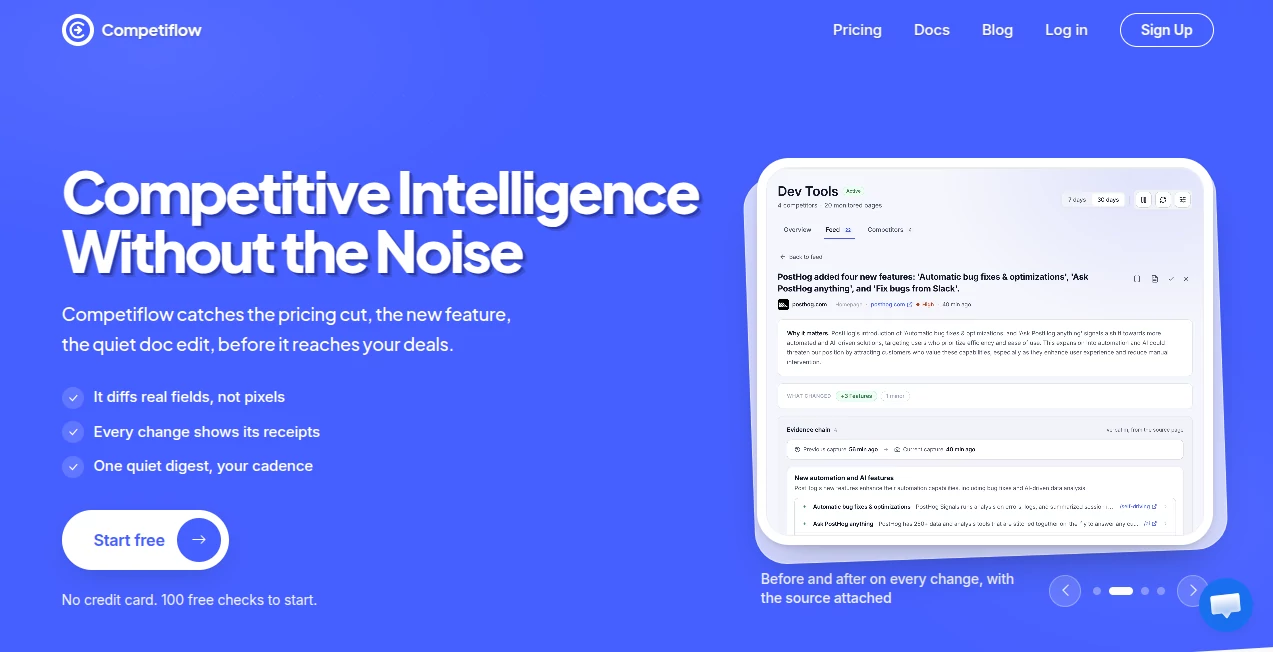
The dashboard is designed around simplicity rather than information overload. Competitors are organized into workspaces, allowing different products or markets to be monitored independently. Important changes appear in an easy-to-review feed, while summaries and evidence are attached to every alert, reducing the time needed to investigate each update. :contentReference[oaicite:1]{index=1}
Accuracy & Performance
Unlike traditional website monitoring solutions that compare screenshots or raw HTML, this solution analyzes structured fields such as pricing, product information, changelogs, documentation, and homepage messaging. This significantly reduces false alerts caused by layout changes or cosmetic updates and delivers notifications that are actually useful. :contentReference[oaicite:2]{index=2}
Capabilities
Users can monitor pricing pages, blogs, changelogs, documentation, homepages, and other important business pages from competing companies. AI-generated summaries explain why a detected change matters, while evidence is preserved so teams can verify every modification. The platform also provides API access and an MCP server, enabling AI assistants to retrieve competitor updates automatically inside compatible development environments. :contentReference[oaicite:3]{index=3}
Security & Privacy
API authentication is handled through secure API keys, while integrations are designed around authenticated access. Documentation encourages safe credential management and supports structured API workflows suitable for business environments. :contentReference[oaicite:4]{index=4}
Use Cases
Product managers can monitor feature releases from competing products before planning roadmaps. Marketing teams stay informed about positioning changes and messaging updates. Sales teams receive fresh competitive insights for battle cards before customer meetings. Founders gain an efficient overview of market activity without manually reviewing dozens of websites every week. Revenue operations teams can also monitor pricing adjustments and subscription changes across competitors with minimal effort. :contentReference[oaicite:5]{index=5}
Pros and Cons
Pros
- Detects meaningful field-level changes instead of noisy visual differences.
- Provides AI-generated summaries explaining why changes matter.
- Evidence is attached to every detected update.
- Supports API integration and AI agent workflows.
- Organized workspaces simplify monitoring multiple markets.
- Reduces unnecessary alerts compared with traditional monitoring tools.
Cons
- Designed primarily for competitive intelligence rather than full market research.
- Advanced monitoring capacity depends on paid plans.
- Best suited for SaaS businesses instead of every industry.
Pricing Plans
A free trial is available and includes monitoring for one competitor with a limited number of monthly checks. Paid subscriptions increase monitoring capacity, check limits, monitoring frequency, and additional business features, making the platform suitable for both startups and growing SaaS teams. :contentReference[oaicite:6]{index=6}
How to Use Competiflow
Create a workspace and add the homepage of a competitor. The system automatically discovers important pages such as pricing, documentation, blogs, and changelogs. After the initial discovery process, scheduled monitoring begins. Whenever significant changes are detected, users receive structured summaries together with supporting evidence, allowing teams to quickly review updates and take action where necessary. AI agents can also retrieve these updates through the available API and MCP integration. :contentReference[oaicite:7]{index=7}
Comparison with Similar Tools
Many website monitoring products focus on screenshots or HTML differences, often producing large numbers of irrelevant notifications. Enterprise competitive intelligence platforms can provide deeper analysis but are frequently more expensive and complex. This solution occupies a practical middle ground by emphasizing structured business data, concise AI summaries, evidence-backed alerts, and integrations that fit naturally into modern SaaS workflows. Teams spend less time filtering noise and more time responding to meaningful competitive movements. :contentReference[oaicite:8]{index=8}
Conclusion
Competitive intelligence becomes much more valuable when information arrives at the right moment and in a format that is easy to understand. Rather than generating endless alerts, this platform highlights meaningful changes, explains their significance, and provides clear evidence for every update. Businesses that rely on fast market awareness, pricing intelligence, and competitor tracking will appreciate the combination of automation, AI interpretation, and structured monitoring that keeps important developments visible without creating unnecessary distractions.
Frequently Asked Questions (FAQ)
What types of competitor pages can be monitored?
The platform can monitor pricing pages, homepages, documentation, blogs, changelogs, and several other business-critical pages. :contentReference[oaicite:9]{index=9}
Does it reduce false alerts?
Yes. By comparing structured fields instead of page screenshots or raw HTML, the system significantly reduces unnecessary notifications. :contentReference[oaicite:10]{index=10}
Can AI assistants access competitor updates?
Yes. API access and MCP integration allow compatible AI agents to retrieve monitoring results programmatically. :contentReference[oaicite:11]{index=11}
Is there a free version?
A free trial is available, allowing users to monitor one competitor before upgrading to larger plans. :contentReference[oaicite:12]{index=12}
Who benefits the most from this platform?
It is especially valuable for SaaS founders, product managers, marketing teams, sales organizations, and revenue operations professionals who need reliable competitor intelligence.
AI Sales Assistant , AI Productivity Tools , AI Research Tool , AI Analytics Assistant .
These classifications represent its core capabilities and areas of application. For related tools, explore the linked categories above.

Competiflow Alternatives Product

Airtable AI …

ttanonviewer

Crawlly AI

Sparqo AI

GPT Image 2 …

AllInOneTools

IntoTheBlock

Yorph AI

TruthSpine