


















ConceptSeek
What is ConceptSeek?
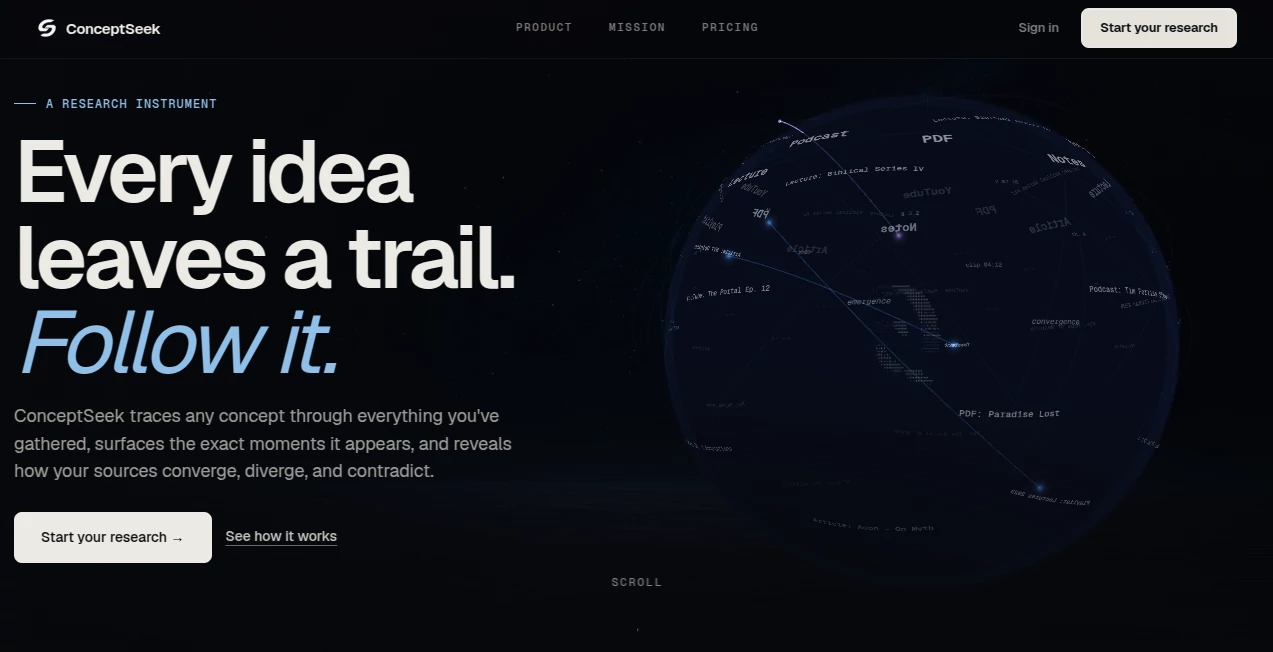
ConceptSeek is a modern AI-powered research platform designed for people who work with large collections of videos, podcasts, PDFs, transcripts, lectures, and research documents. Instead of relying on exact keyword matching, it understands concepts, themes, and ideas, making it much easier to locate valuable information hidden inside long-form content.
Whether you are conducting academic research, preparing a report, creating educational content, or simply organizing your knowledge library, this platform transforms scattered resources into a searchable research environment. Rather than generating generic AI summaries, it points users directly to original passages, timestamps, and evidence, allowing every conclusion to remain grounded in authentic source material.
One of the most impressive aspects is its philosophy of supporting human thinking instead of replacing it. Researchers stay in control of interpretation while the platform removes the tedious work of manually searching through hours of content. This balance between AI assistance and source transparency makes it particularly valuable for professionals who care about accuracy and verifiable information.
Key Features
User Interface
The interface is thoughtfully organized around research libraries that can contain videos, podcasts, documents, transcripts, and other reference materials. Everything is presented in a clean dashboard where searches, saved projects, concept maps, and source collections remain easy to navigate. The learning curve is minimal, allowing users to begin productive research almost immediately.
Accuracy & Performance
Instead of producing speculative AI-generated answers, the platform retrieves exact passages and matching timestamps from trusted sources. Concept-based searching enables users to discover relevant information even when specific keywords are missing. Results remain connected to the original material, making verification straightforward and significantly improving research confidence.
Capabilities
The platform offers concept search across multiple libraries, intelligent relationship mapping between sources, transcript analysis, synchronized video navigation, reusable research libraries, saved searches, cross-library exploration, evidence comparison, and visual connection mapping through its Threads feature. Users can quickly identify where different sources agree, disagree, complement one another, or provide unique perspectives.
Security & Privacy
Research materials remain organized within personal libraries, allowing users to maintain control over their own collections. Since findings always reference original documents and timestamps instead of fabricated summaries, researchers benefit from improved transparency and traceability throughout their workflow.
Use Cases
Researchers can compare academic papers across multiple topics without reading every page repeatedly. Students are able to revisit lectures and educational videos by jumping directly to important explanations. Journalists can verify claims using exact quotations and timestamps before publishing stories. Content creators may locate memorable discussions inside lengthy podcasts, while business analysts can organize interviews, reports, and presentations into searchable knowledge bases. Legal professionals and consultants can also benefit from finding supporting evidence across extensive document collections within seconds.
Pros and Cons
Pros
Concept-based search goes beyond simple keyword matching. Original passages and timestamps improve source verification. Multiple research libraries can be searched simultaneously. Relationship mapping helps visualize agreements and contradictions between sources. The interface is clean, intuitive, and designed specifically for serious research workflows.
Cons
No permanent free plan is currently available. The platform focuses primarily on research rather than AI-generated writing or content creation. Users working with extremely large libraries may require higher subscription plans to unlock additional storage and credits.
Pricing Plans
The platform offers three paid subscription tiers along with a seven-day free trial. The Starter plan is intended for personal research projects, the Pro plan targets students, researchers, analysts, and journalists with expanded library capacity, while the Max plan supports intensive professional workflows with unlimited libraries, larger source limits, priority processing, and higher monthly credits.
How to Use ConceptSeek
Create an account and start a new research library.
Upload or connect videos, podcasts, transcripts, PDFs, and other supported materials.
Enter a concept, theme, question, or research idea instead of relying on exact keywords.
Review the retrieved passages, timestamps, and related sources.
Explore the visual relationship map to understand how different sources connect, agree, or contradict one another.
Save searches for future work and continue expanding your knowledge library over time.
Comparison with Similar Tools
Unlike many AI research assistants that primarily generate summaries, this platform emphasizes evidence-first research. Every insight remains linked to the original source material, helping users validate information independently. Compared with traditional document search systems, concept-based retrieval produces more meaningful results for abstract ideas and themes. It also differs from standard note-taking applications by focusing on deep source exploration, relationship mapping, and precise retrieval across multiple content formats.
Conclusion
For anyone who regularly works with long-form educational content, research papers, podcasts, lectures, or extensive document collections, this platform delivers an outstanding research experience. Its ability to search by meaning instead of exact wording dramatically reduces the time spent locating valuable information while preserving complete transparency back to the original source. The combination of concept search, relationship mapping, timestamp navigation, and evidence-based analysis makes it an excellent solution for researchers, students, analysts, educators, journalists, and knowledge professionals who demand accuracy without sacrificing productivity.
Frequently Asked Questions (FAQ)
What types of content can be searched?
Videos, podcasts, PDFs, research papers, transcripts, lectures, and other long-form documents can all be organized into searchable libraries.
Does it search by keywords only?
No. It primarily searches by concepts, themes, claims, and ideas, allowing users to discover relevant passages even when exact wording differs.
Can I verify every result?
Yes. Results include original passages, timestamps, and direct links back to the source material for easy verification.
Is there a free trial?
Yes. Every subscription includes a seven-day free trial for new users.
Who benefits the most from this platform?
Researchers, students, journalists, educators, analysts, consultants, and anyone managing large collections of knowledge resources will gain the greatest value.
AI Knowledge Management , AI Education Assistant , AI Research Tool , AI Search Engine .
These classifications represent its core capabilities and areas of application. For related tools, explore the linked categories above.

ConceptSeek Alternatives Product

Manus

MidJourney

ukamiru
TranscribeYT

Beamtrace

Sourcetable

Dialogues wi…

eesel AI
Surmado
