


















conw.ai
What is conw.ai?
Conw is a conversational AI built around a simple but unusual idea: useful conversations should help the assistant become more useful, but learning should not happen blindly. Instead of treating every message as training material, it lets users correct replies, teach new meanings, and provide feedback. Confirmed lessons can be remembered immediately, while potential model improvements go through a separate review process.
That approach makes the service particularly interesting for people who want an AI assistant that can adapt to the way they communicate. A correction can become part of private memory during the same conversation, while sensitive, unsafe, invented, poorly formatted, or down-rated information is kept away from the learning pipeline.
The underlying Conway-Omega model is a compact 188M-parameter model trained from scratch and served independently through MLX rather than forwarding questions to an external answer API. The current setup runs on a single 16GB iMac, which is also part of the product's deliberately lightweight approach.
Key Features
- Interactive teaching through corrections, ratings, and explanations.
- Private vocabulary and memory that can work immediately.
- A guarded learning loop that filters potentially harmful or low-quality examples.
- Reviewed learning candidates rather than automatic live model changes.
- Independently served inference without forwarding questions to an external answer API.
- A compact 188M model trained from scratch.
- Local MLX inference running on dedicated hardware.
- Response limits designed to reduce unnecessary token generation.
- Background learning that pauses when live conversations need the available computing resources.
- Chat history, pinning, and search.
- A learning dashboard showing whether learning candidates pass or fail checks.
- No advertising and no selling of user data.
User Interface
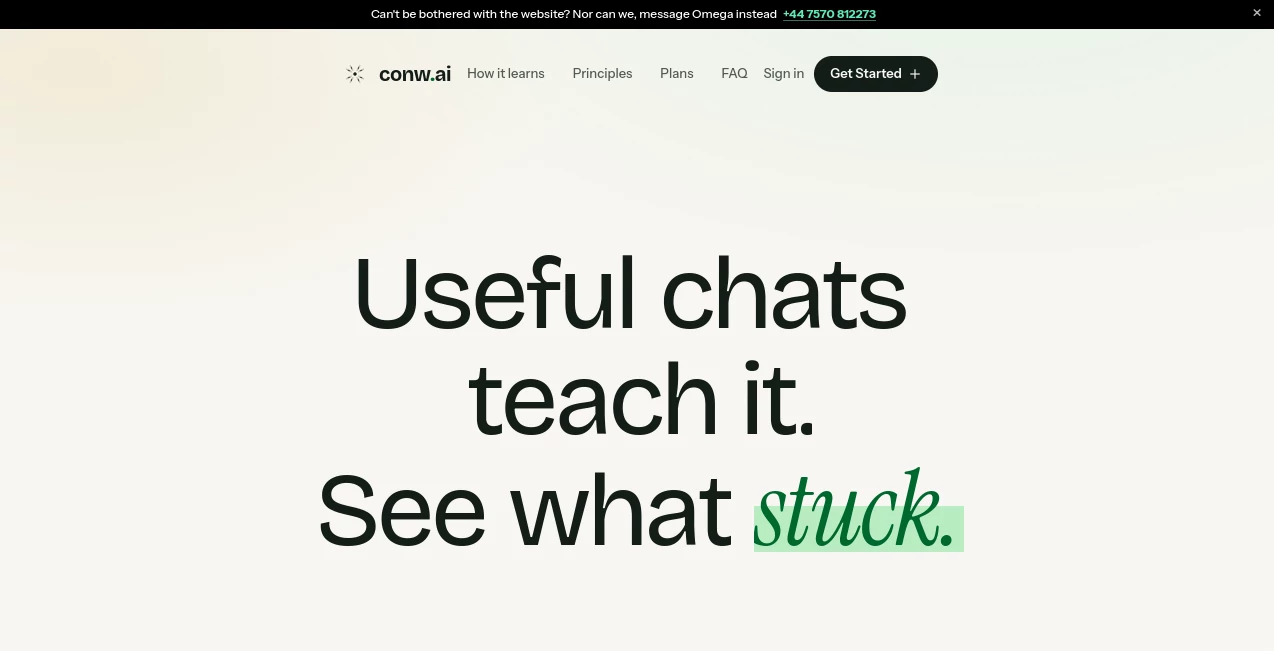
The interface takes a straightforward conversational approach. Rather than surrounding the chat experience with a complicated collection of controls, the product puts the conversation and learning process at the center. Users can correct an answer, explain a word, or provide a rating, making the interaction feel closer to teaching an assistant than simply sending prompts to a chatbot.
The learning dashboard is another useful touch. It gives users visibility into the learning process instead of presenting adaptation as something mysterious happening somewhere in the background. Chat history, search, and pinning also make it easier to return to useful conversations.
Accuracy & Performance
The service is transparent about the limitations of its model. A compact 188M model is not positioned as a replacement for the largest frontier systems, particularly for broad trivia or complex knowledge tasks. Its strength lies elsewhere: the ability to incorporate confirmed information into memory quickly and use verified learning candidates to improve over time.
Performance is also shaped by its lightweight infrastructure. The current serving environment uses a single 16GB iMac, while output limits and repetition controls help prevent unnecessary generation. Background learning yields to live inference, so training activity is not supposed to take priority over an active conversation.
Capabilities
The assistant is designed for general conversational work, but its most distinctive capability is adaptation. Users can teach it a preferred meaning, correct an answer, or introduce terminology. Confirmed information can immediately become part of private memory, allowing it to influence the conversation without waiting for a model update.
There is also a distinction between memory and model learning. A useful lesson may be remembered without becoming a permanent change to the underlying model. Potential weight updates are collected as candidates and must pass additional checks before they can affect the live system. This separation gives the learning process a useful layer of protection.
Security & Privacy
Privacy is closely tied to the product's learning design. Conversations are stored because eligible portions may be considered for the guarded learning process. However, the system states that sensitive, unsafe, invented, badly formatted, and down-rated lessons are kept out of that process.
The service also states that it does not run advertisements or sell user data. Users who want their account and conversations removed can request deletion. The separation between immediate private memory and reviewed model-learning candidates also provides an additional safeguard against a single problematic conversation directly changing the live model.
Use Cases
- Personal AI assistance: Keep useful terminology and corrections available during ongoing conversations.
- Specialized vocabulary: Teach the assistant words, meanings, or terminology that are important to a particular workflow.
- Writing and brainstorming: Use the conversational interface for drafting ideas, exploring topics, and refining responses.
- Learning through interaction: Correct answers and explain concepts rather than repeatedly giving the same instruction.
- Longer conversations: Use private memory and conversation history to make repeated interactions more practical.
- Experimenting with adaptive AI: Explore a different approach to AI personalization where feedback and verification are part of the product itself.
- Privacy-conscious experimentation: Try an independently served AI assistant without relying on an external answer API.
Pros and Cons
Pros
- Confirmed teaching can take effect immediately through private memory.
- The learning process is visible rather than completely hidden.
- Potential model updates go through checks before promotion.
- Uses a model trained from scratch instead of simply forwarding questions to another AI API.
- Lightweight infrastructure keeps the project deliberately compact.
- No advertisements and no sale of user data.
- Free tier available without requiring a payment card.
Cons
- The compact model does not match frontier AI systems in breadth or general knowledge.
- Weekly token allowances may be restrictive for heavy users on the free plan.
- The learning process is more experimental than the mature personalization systems found in some larger AI platforms.
- The current infrastructure is relatively small compared with large-scale AI services.
- Users looking primarily for advanced image, video, or multimodal generation will need a more specialized platform.
Pricing Plans
The service offers three plans with the same underlying model and answers. The main difference is how much conversation each plan allows per week.
- Free: £0 forever with 25,000 tokens per week. No credit card is required.
- Pro: £15 per month with 500,000 tokens per week, giving users 20 times the allowance of the Free plan.
- Max: £30 per month with 2 million tokens per week, providing four times the Pro allowance and 80 times the Free allowance.
All plans include the full Conway-Omega model, private vocabulary memory, verified per-user adapter candidates, the learning dashboard, chat history, pinning, and search. The service also states that paid plans can be cancelled at any time while access remains available until renewal.
How to Use the AI Assistant
- Create an account and start a conversation.
- Ask questions or describe the task you want help with.
- Correct an answer when something is inaccurate or explain a preferred meaning.
- Use ratings and feedback to identify useful or poor responses.
- Check the learning dashboard to see how submitted learning candidates are handled.
- Continue using the assistant and allow confirmed information to become part of its private memory.
The most interesting way to use it is not simply to ask a question and leave. Give it useful corrections when needed. For example, if your work uses a particular term with a meaning that differs from common usage, explaining that meaning can make future conversations more relevant.
Comparison with Similar Tools
Many conversational AI services focus primarily on the size of their models, the breadth of their knowledge, or the number of integrations they offer. This product takes a different route. Its central feature is the learning loop itself.
Compared with a conventional chatbot, the assistant makes user teaching a visible part of the experience. Compared with systems that automatically learn from conversations, it puts more emphasis on filtering, verification, and separating immediate memory from possible model changes. And compared with AI products built around external model APIs, it controls its own serving stack and uses a model trained from scratch.
That does not make it the best choice for every task. Someone looking for the strongest possible performance on difficult reasoning, extensive research, or broad factual questions may prefer a much larger model. For users interested in an AI that can be taught, monitored, and developed around a guarded learning process, however, the approach is considerably more distinctive.
Conclusion
This is an appealing project for anyone curious about what a more transparent learning AI could look like. Instead of claiming that every conversation should automatically make the model smarter, it separates useful memory from deeper model changes and puts several checks between a user's feedback and a potential update.
The compact model and modest hardware setup are also part of its character. It is not trying to win by throwing massive computing resources at every request. Its appeal comes from the interaction model: teach it, see what sticks, and let only suitable learning candidates move further through the process.
For casual users, the free plan offers an easy way to explore the concept. More frequent users can move to Pro or Max for substantially larger weekly allowances. Overall, it is a particularly interesting option for people who want to experiment with conversational AI that treats learning as something that should be visible, guarded, and earned rather than automatic.
Frequently Asked Questions (FAQ)
Does the AI actually learn from conversations?
Yes, but not by blindly training on every conversation. Confirmed teaching can enter private memory immediately. Potential model-learning candidates are filtered and checked before they can be considered for a future model update.
What model does it use?
The service uses Conway-Omega, a compact 188M-parameter model trained from scratch and served independently through MLX.
Is there a free plan?
Yes. The Free plan costs £0 forever and includes 25,000 tokens per week. A payment card is not required to start.
Does it sell user data?
The service states that it does not sell user data and does not run advertisements. Conversations are stored because eligible information can participate in its guarded learning process.
Can users teach it new words or meanings?
Yes. Users can explain a new word or correct a meaning. Confirmed meanings can be added to private memory immediately, while dictionary-verified vocabulary may be eligible for broader learning under the product's verification process.
Is it a wrapper around another AI model?
No. The service states that it does not forward questions to an external answer API. Its Conway-Omega model was trained from scratch and is served through its own infrastructure.
Which plan is best for frequent users?
The Pro plan provides 500,000 tokens per week and is positioned for daily users. Max provides 2 million tokens per week for people who need considerably more room for conversations.
AI Knowledge Management , AI Productivity Tools , Large Language Models (LLMs) , AI Chatbot .
These classifications represent its core capabilities and areas of application. For related tools, explore the linked categories above.

conw.ai Alternatives Product

Chrome Sidek…

Sourcetable

Manus

Weekly Brief

Magpie

MidJourney

CapyQR

Odysseus AI
YT Video Sum…
