














What is CrawlReady?
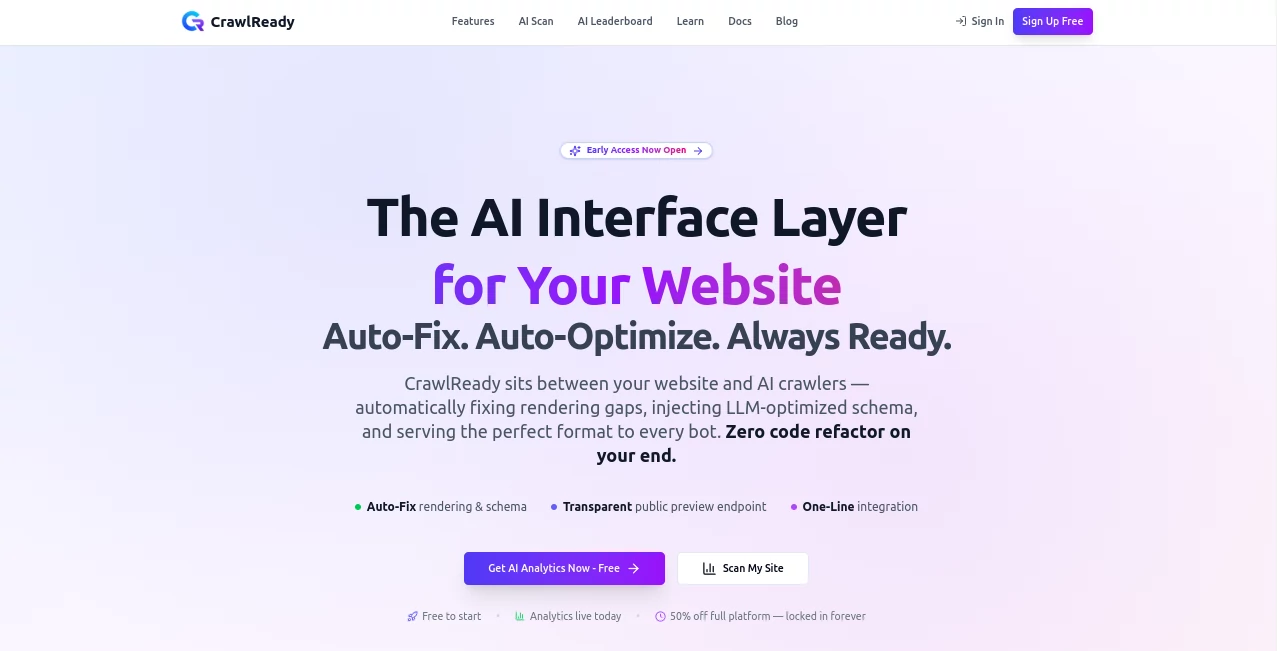
CrawlReady is built for a problem that many modern websites quietly struggle with: being visible to AI crawlers. A website can look perfect in Chrome and still deliver very little useful content to an AI crawler, especially when the site relies heavily on JavaScript.
The platform analyzes how AI crawlers experience a website, measures its AI readiness, and helps developers understand where content is being lost. It is particularly useful for React, Vue, Angular, Next.js, and other JavaScript-heavy websites where traditional crawling may not tell the whole story.
Instead of treating AI visibility as another vague SEO metric, the service breaks it down into practical areas such as crawlability, agent readiness, and agent interaction. This makes it easier to identify technical problems before they become a serious visibility issue.
Key Features
- AI Readiness Score: Scan a URL and receive a score from 0 to 100 showing how prepared the website is for AI crawlers.
- AI Crawler Analytics: Monitor visits from crawlers such as GPTBot, PerplexityBot, and ClaudeBot and see which pages they access.
- Content Parity Analysis: Identify differences between what a normal browser receives and what AI crawlers can actually access.
- Schema Analysis: Find problems with structured data that may make it harder for automated systems to understand pages.
- Public Score Pages: Share an AI readiness result through a public URL without requiring visitors to create an account.
- Simple Integration: Analytics can be connected through a script tag or a small amount of middleware code.
- Developer Integrations: Support is available for environments including Next.js, Express, Cloudflare Workers, and Vercel Edge Middleware.
- MCP Support: Developers can connect the platform with compatible AI clients and query scans, visual differences, and recommendations directly from their agent environment.
User Interface
The interface focuses on diagnostics rather than unnecessary complexity. A website owner can start with a URL scan and quickly see an overall readiness score together with individual areas that require attention.
The analytics side is equally practical. Instead of simply reporting that a bot visited a website, the dashboard can show which AI crawler arrived, which pages it requested, how frequently it returned, and what content was delivered.
This approach makes the product especially useful for developers who want evidence rather than assumptions. For example, if a React application looks completely normal to a human visitor but an AI crawler receives an almost empty HTML document, the problem becomes immediately visible.
Accuracy & Performance
The platform measures AI readiness across multiple technical dimensions instead of reducing website visibility to a single traditional SEO score. Its scoring system considers crawlability, agent readiness, and agent interaction, giving developers a more focused view of how automated AI systems experience their websites.
Server-side analytics are another strong point. Because crawler activity is captured through middleware, it can record visits from bots that do not execute JavaScript in the same way a normal browser does.
The service is also designed to avoid unnecessary changes to the existing frontend architecture. This is particularly valuable for teams that have invested heavily in a JavaScript application and do not want to rebuild it simply to improve machine accessibility.
Capabilities
The most useful capability is the ability to see the difference between the website humans experience and the version available to AI crawlers. This can expose empty containers, missing content, incomplete rendering, or weak structured data that may otherwise remain unnoticed.
The platform also provides tools for monitoring AI crawler activity over time. Developers can use these insights to determine whether important pages are being discovered and accessed by major AI crawlers.
For teams working with AI search optimization, this creates a more technical layer underneath content and marketing efforts. Instead of immediately rewriting articles or adding more keywords, they can first verify that the underlying website is actually accessible to the systems they want to reach.
An MCP server is also available for compatible AI development environments. It can expose scanning and diagnostic functions so developers can work with website readiness information directly from an AI coding or assistant workflow.
Security & Privacy
The platform is designed as an infrastructure and diagnostics layer rather than a replacement for a website's existing content management system. Integration options allow developers to add the required functionality without rebuilding their application architecture.
Because implementation can involve middleware and website request handling, businesses should review the service documentation and their own privacy requirements before deployment, particularly when operating websites that handle sensitive or regulated information.
For development teams, the ability to keep the existing application while adding a focused AI visibility layer can also reduce the operational risk associated with a large SEO or rendering migration.
Use Cases
JavaScript-heavy SaaS platforms: React, Vue, Angular, and similar applications can use the service to determine whether important product and feature pages are accessible to AI crawlers.
E-commerce websites: Headless stores and dynamic product catalogs can benefit from checking whether product information and structured data are available to automated systems.
Technical publishers: Documentation websites, developer blogs, and knowledge bases can use crawler analytics to understand whether their technical content is actually reaching AI systems.
Enterprise knowledge bases: Large portals can monitor automated access to support documentation and other information that customers may increasingly discover through AI assistants.
SEO and GEO teams: Teams working on generative engine optimization can use the readiness score and crawler data as a technical foundation for improving AI search visibility.
Pros and Cons
Pros
- Designed specifically around AI crawler visibility.
- Useful for JavaScript-heavy websites and single-page applications.
- Provides a measurable AI readiness score from 0 to 100.
- Tracks activity from major AI crawlers.
- Offers visual and technical diagnostics instead of relying only on general SEO reports.
- Can be integrated without a complete frontend rewrite.
- Includes developer-focused integrations and MCP support.
- Provides a free URL scan without requiring an account.
Cons
- The full automated AI interface layer is still being developed.
- Some advanced functionality is more relevant to developers than casual website owners.
- Teams with simple, server-rendered websites may not need every feature.
- Understanding crawler behavior and rendering diagnostics may require basic technical knowledge.
Pricing Plans
The current pricing structure is based on fresh crawls, while cached responses remain unlimited across the available plans. This means the crawl allowance primarily matters when fresh information is required rather than every repeated request.
Starter – $29/month: Includes 500 fresh crawls per month, unlimited cached responses, optimized HTML, Markdown output for AI agents, sitemap-wide coverage, deployment webhooks, and crawlability score trends.
Pro – $49/month: Includes 2,500 fresh crawls per month and adds dynamic Schema.org injection, ETag change detection, cache freshness alerts, API access, and an embeddable badge.
Business – $199/month: Designed for higher-traffic websites with 10,000 fresh crawls per month, an edge SSR fast path, custom bot rules, three team seats, advanced analytics, and an agent readiness API.
Annual billing currently provides a 20% discount. The pricing page also states that there is no credit card requirement to start and that plans can be cancelled at any time.
How to Use It
Start by scanning a website URL to generate an AI Readiness Score. The result provides a breakdown of the site's crawlability, agent readiness, and related technical signals.
Next, review the areas where AI crawlers may be receiving incomplete or poorly structured information. For a JavaScript-heavy application, pay particular attention to content that depends on client-side rendering.
After the initial audit, connect the analytics layer using the available integration method for your technology stack. Once active, the dashboard can begin collecting information about AI crawler visits and the pages they request.
Developers who use compatible AI clients can also configure the MCP integration and query website readiness information directly from their preferred AI development environment.
The result is a practical workflow: scan the site, identify the visibility gap, monitor crawler behavior, make technical improvements, and measure the result over time.
Comparison with Similar Tools
Many SEO platforms concentrate on rankings, backlinks, keywords, content optimization, or AI citation tracking. This service takes a narrower technical approach by focusing on the layer between a website and AI crawlers.
That distinction matters for JavaScript-heavy websites. If the primary problem is that an AI crawler cannot properly render or understand the page, adding more content or tracking more keywords will not necessarily solve it.
Traditional server-side rendering and static generation can also solve many rendering problems, but adopting them may require substantial architectural changes. A dedicated crawler-facing layer can be attractive when a business wants to preserve an existing application while addressing a specific visibility problem.
For a simple server-rendered website with clean HTML and well-implemented structured data, the additional infrastructure may provide less value. For a large SPA, headless store, SaaS platform, or dynamic knowledge base, the technical diagnostics can be considerably more useful.
Conclusion
AI search visibility is not only a content problem. A beautifully written page is of little use to an AI assistant if the crawler cannot access the content, understand the structure, or retrieve the information correctly.
CrawlReady approaches that problem from the technical side. Its readiness scoring, crawler analytics, rendering diagnostics, and developer integrations give website teams a clearer picture of what automated AI systems actually receive.
For developers managing JavaScript-heavy websites, this can be a valuable addition to an SEO and GEO workflow. Rather than guessing whether AI crawlers can see the site, teams can inspect the evidence, locate the weak points, and monitor changes over time.
Frequently Asked Questions (FAQ)
What is CrawlReady used for?
It is used to measure and improve a website's readiness for AI crawlers and AI-powered search experiences, with a particular focus on crawlability, rendering, structured data, and crawler activity.
Does it work with JavaScript websites?
Yes. JavaScript-heavy websites such as React, Vue, Angular, and similar applications are among the primary use cases because these sites can sometimes deliver incomplete content to crawlers that do not execute JavaScript like a normal browser.
Can I check my website without creating an account?
Yes. The AI readiness checker can scan a URL and provide a readiness score without requiring an account.
Which AI crawlers can it monitor?
The platform currently highlights crawlers including GPTBot, PerplexityBot, and ClaudeBot, allowing website owners to see which automated systems are visiting their pages.
Do I need to rebuild my website?
No complete rebuild is required for the current analytics integration. Depending on the technology stack, integration can be done through a script tag or a small middleware implementation.
Does the platform automatically fix JavaScript rendering problems?
The automated AI interface layer, including automatic JavaScript rendering and schema optimization, is listed as an upcoming capability. The current live functionality focuses on analytics, readiness scoring, and diagnostics.
Does it provide an API?
API access is included with the Pro plan, while the Business plan includes an agent readiness API. An MCP server is also available for connecting compatible AI clients to scanning and diagnostic functions.
Is there a free option?
A free AI readiness scan is available, allowing website owners to check their current score before deciding whether they need the broader platform.