


















Cube
What is Cube?
Modern organizations generate massive amounts of data every day, but turning that information into reliable business decisions remains a challenge. This platform bridges the gap between raw data and meaningful insights by creating a governed semantic layer that keeps metrics consistent across dashboards, applications, and AI-powered analytics.
Instead of relying on disconnected reporting tools or manually maintained SQL queries, teams can define business logic once and reuse it everywhere. This approach reduces confusion, improves collaboration between technical and non-technical teams, and enables AI assistants to provide trustworthy answers based on standardized business definitions rather than guesswork.
Whether you are building customer-facing analytics, managing internal business intelligence, or integrating AI into enterprise workflows, this solution delivers a scalable foundation that combines performance, governance, and flexibility without sacrificing developer control.
Key Features
- Unified semantic layer for consistent business metrics
- Natural language analytics powered by AI
- Embedded analytics for SaaS applications
- REST, GraphQL, SQL, and API support
- High-performance caching and pre-aggregations
- Role-based access control and row-level security
- Code-first data modeling with version control
- Support for modern cloud data warehouses
- Interactive dashboards and workbooks
- Scalable architecture for enterprise workloads
User Interface
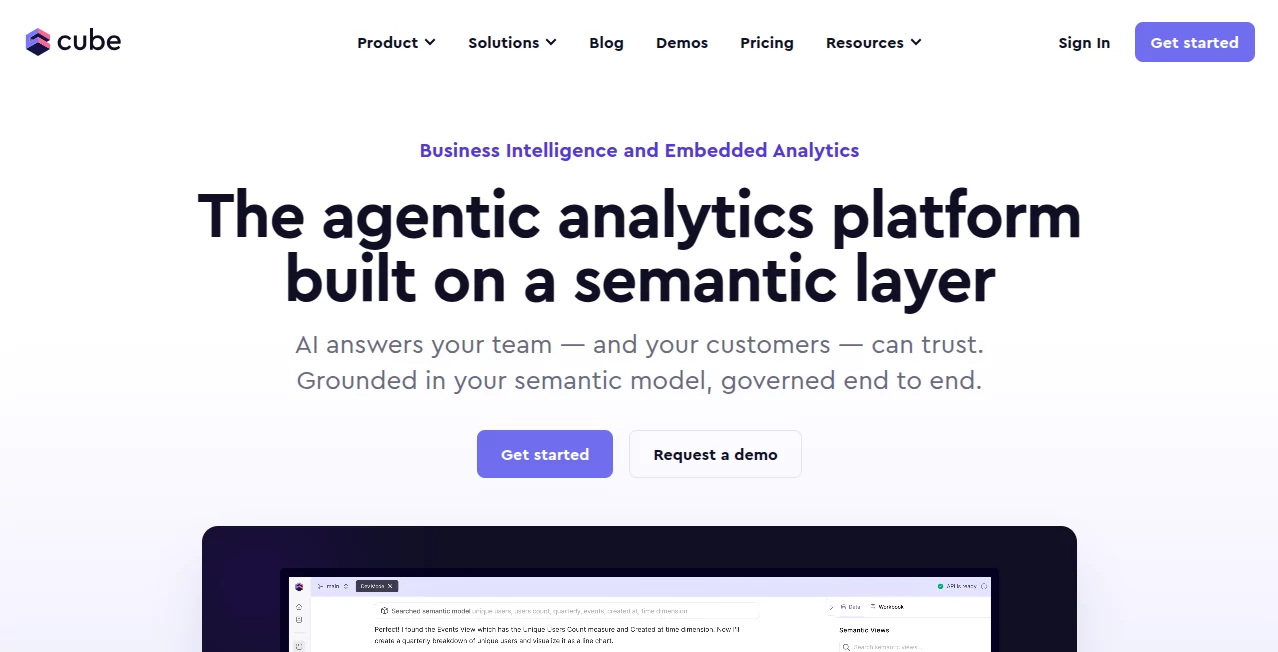
The interface is designed for both developers and business users. Data engineers can maintain semantic models through code, while analysts and decision-makers interact with intuitive dashboards, visual workbooks, and conversational analytics. Navigation feels organized, making it easy to move from data exploration to actionable insights without unnecessary complexity.
Accuracy & Performance
One of the strongest advantages is the emphasis on governed data definitions. Every query references the same centralized business logic, helping eliminate inconsistent reports across different teams. Intelligent caching and pre-aggregation technologies significantly reduce query times, allowing users to analyze large datasets with impressive speed while keeping infrastructure costs under control.
Capabilities
The platform supports business intelligence, embedded analytics, AI-powered reporting, semantic modeling, data APIs, and conversational analytics. Development teams can integrate analytics directly into their own products, while business users gain access to reliable reports through dashboards or natural language questions. This flexibility makes it suitable for startups, enterprise software vendors, and internal analytics departments alike.
Security & Privacy
Security is built into the semantic layer instead of being added afterward. Centralized access policies, row-level permissions, authentication controls, and governed data models help ensure that users only access the information they are authorized to see. Organizations handling sensitive business data benefit from consistent governance across every application and AI workflow.
Use Cases
- Building embedded analytics for SaaS products
- Creating enterprise business intelligence dashboards
- Powering AI assistants with trusted business data
- Standardizing metrics across multiple departments
- Replacing duplicated SQL logic with reusable semantic models
- Delivering customer-facing reporting portals
- Connecting multiple BI tools to a single source of truth
- Supporting data-driven executive decision making
Pros and Cons
Pros
- Excellent semantic layer architecture
- Enterprise-grade scalability
- Developer-friendly code-first approach
- Powerful API ecosystem
- Reliable AI-driven analytics
- Strong security and governance capabilities
- Supports embedded analytics for modern applications
Cons
- Initial setup requires data engineering knowledge
- Advanced enterprise features may be unnecessary for very small projects
- Teams unfamiliar with semantic modeling may need onboarding time
Pricing Plans
A free open-source foundation is available for developers and smaller projects. Organizations requiring managed infrastructure, enterprise security, embedded analytics, collaboration features, and production-scale deployments can choose commercial cloud plans with additional capabilities. Custom enterprise pricing is also available for larger organizations with advanced requirements.
How to Use Cube
- Connect your preferred SQL database or cloud data warehouse.
- Create semantic models that define business entities and metrics.
- Configure permissions and access policies.
- Build dashboards, workbooks, or embedded analytics experiences.
- Allow users or AI assistants to explore governed business data using natural language or standard analytical queries.
- Monitor performance and optimize with caching and pre-aggregations.
Comparison with Similar Tools
Unlike traditional business intelligence platforms that focus primarily on visualization, this solution places the semantic layer at the center of the analytics workflow. That architecture provides consistent metrics across dashboards, APIs, embedded applications, and AI assistants. Compared with many reporting tools that generate SQL directly from user prompts, the governed model greatly improves reliability and reduces conflicting business definitions across teams. It also offers extensive developer APIs that make custom analytics products easier to build and maintain.
Conclusion
Organizations looking for dependable AI-powered analytics need more than attractive dashboards—they need trustworthy data foundations. This platform delivers exactly that by combining semantic modeling, enterprise governance, high-performance analytics, and flexible APIs into one cohesive ecosystem. From internal reporting to customer-facing analytics experiences, it provides the infrastructure needed to build reliable, scalable, and future-ready data products. For companies that value consistency, security, and AI-ready analytics, it represents an outstanding long-term investment.
Frequently Asked Questions (FAQ)
What is a semantic layer?
A semantic layer centralizes business definitions, metrics, relationships, and access rules so every report and application uses consistent data.
Can it be used for embedded analytics?
Yes. Developers can integrate dashboards, analytics experiences, APIs, or conversational analytics directly into their own applications.
Does it support AI-powered analytics?
Yes. Business users can ask questions in natural language while AI responses remain grounded in governed business definitions.
Who is the platform best suited for?
It is ideal for data engineering teams, SaaS companies, business intelligence departments, and organizations building AI-enabled analytics products.
Can it connect to modern data warehouses?
Yes. It is designed to work with many SQL-based databases and modern cloud data warehouse technologies through standard interfaces and APIs.
AI API Design , AI Business Ideas Generator , AI Developer Tools , AI Analytics Assistant .
These classifications represent its core capabilities and areas of application. For related tools, explore the linked categories above.

Cube Alternatives Product

Friendify

Chatref

Verne

Standard Com…

Somnio

Workik

Construction…

Needle

cznull