Dealwize
What is Dealwize?
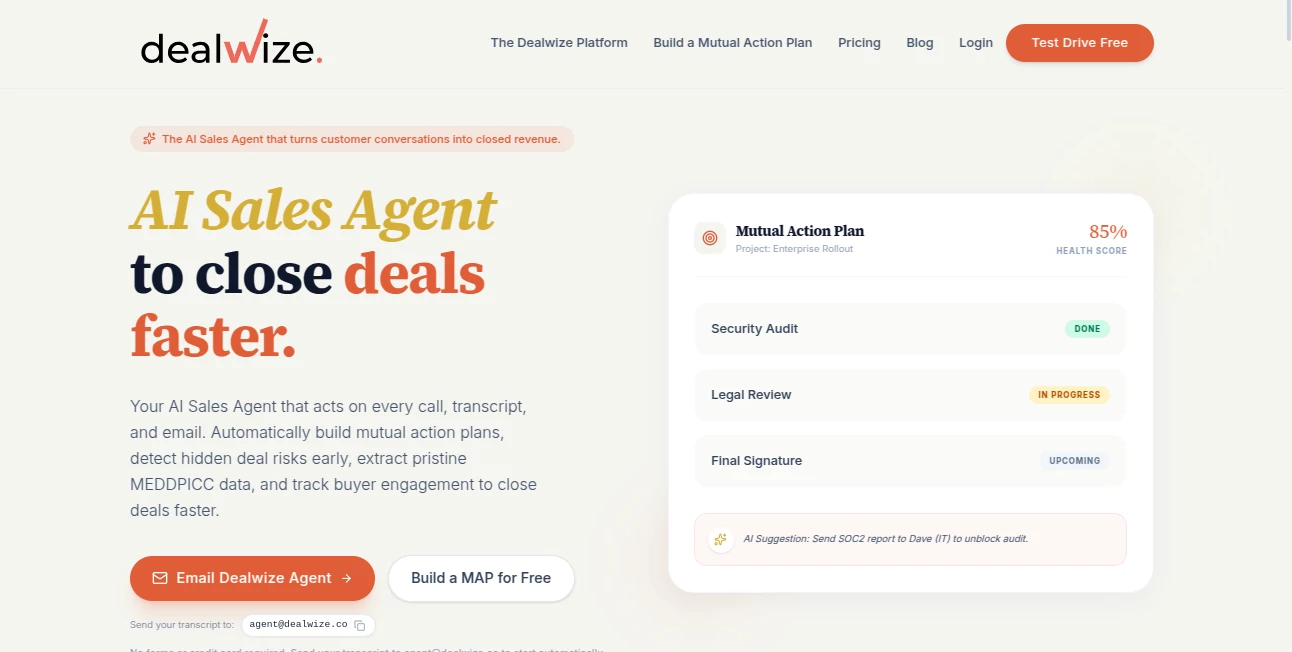
Dealwize is an AI-powered sales platform built for teams managing complex B2B opportunities. Instead of forcing sales representatives to keep spreadsheets, CRM notes, email threads, and meeting summaries in separate places, the platform brings the important parts of a deal into one shared workspace.
Its main focus is simple: turn customer conversations into useful sales actions. A call transcript, meeting note, or email thread can be analyzed to identify goals, risks, milestones, stakeholders, qualification information, and next steps. The resulting information can then be used to create and maintain a mutual action plan that both buyers and sellers can follow.
For sales teams that spend too much time updating CRM records after meetings, this approach can be particularly appealing. Rather than treating AI as another dashboard to monitor, the platform puts it directly into the workflow of moving an opportunity toward a decision.
Key Features
The platform combines several features aimed at improving sales execution rather than simply storing customer information.
- AI-generated mutual action plans from transcripts, notes, and email conversations
- AI-powered deal health scores for identifying opportunities that may be at risk
- Automated extraction of MEDDPICC, BANT, and CHAMP qualification information
- Interactive and branded deal boards for buyers and sellers
- Buyer engagement analytics showing how stakeholders interact with shared deal content
- Automatic identification of risks, missing stakeholders, blockers, and unresolved actions
- AI-generated recommendations based on deal progress and conversation data
- Stakeholder management for complex sales involving multiple decision-makers
User Interface
The interface is designed around the deal rather than around a traditional collection of CRM records. Each opportunity can have its own deal board containing the relevant content and action plan, giving sellers and buyers a shared place to understand what needs to happen next.
This structure is especially useful when several people are involved in a purchase. Instead of forwarding another spreadsheet or searching through an old email thread, stakeholders can work from the same online plan. The presentation is also designed to be buyer-friendly, which helps make the sales process feel more organized from the customer's side.
Accuracy & Performance
The platform processes sales conversations to identify practical information such as goals, risks, milestones, owners, qualification criteria, and follow-up actions. Its AI health score combines signals including strategic alignment, action-item progress, deal qualification, and risk severity to provide a 0–100 view of deal vitality.
One useful aspect is that the score is not intended to simply mirror a salesperson's optimism. If an economic buyer is missing, a critical IT blocker remains unresolved, or important qualification information is incomplete, those issues can affect the assessment. This gives sales managers and representatives another perspective when deciding which opportunities deserve attention.
Capabilities
The most interesting capability is the meeting-to-plan workflow. A seller can provide a call transcript, meeting notes, or an email thread, and the AI extracts the important details instead of requiring the representative to manually rebuild the deal plan.
It can identify pain points, metrics, champions, decision criteria, risks, milestones, and action items. The resulting information can then be applied to a mutual action plan, helping keep the board current as the opportunity develops.
Buyer engagement is another useful layer. Teams can see which parts of a deal board receive attention and use those signals when deciding how and when to follow up. For example, if a stakeholder repeatedly reviews a particular asset or section, that interaction may provide a more useful signal than simply seeing an opportunity marked as “open” in a CRM.
Security & Privacy
Because sales conversations can contain sensitive customer and commercial information, data handling is an important consideration. The platform states that deal data, including client names, transcripts, action plans, and deal-board content, is stored encrypted. Its privacy policy also states that data is stored using Supabase with encryption in transit and at rest, alongside standard API-hardening practices.
Usage information is used to operate and improve the service, while the privacy policy states that it is not sold to others. Users should still review the current privacy and security documentation before uploading confidential material, particularly when dealing with enterprise customers or regulated information.
Use Cases
This platform is primarily suited to B2B sales teams dealing with opportunities that involve multiple conversations, stakeholders, approvals, and deadlines.
- Enterprise sales: Keep complex opportunities organized when several departments and decision-makers are involved.
- Account executives: Reduce the amount of manual work required after customer meetings.
- Sales managers: Quickly identify deals that may be slipping rather than relying solely on forecast stages.
- Revenue operations: Maintain cleaner qualification information without asking representatives to spend hours entering CRM data.
- Multi-stakeholder deals: Give buyers and sellers a shared roadmap with clear owners and milestones.
- Post-meeting follow-up: Turn conversations into concrete actions while the details are still fresh.
Imagine an enterprise prospect saying that a security review must happen before the contract can be signed. Instead of leaving that detail buried in a recording, the AI can surface the blocker, connect it to the relevant milestone, and suggest the next action. That is the kind of small workflow improvement that can make a noticeable difference across dozens of opportunities.
Pros and Cons
Pros
- Designed specifically around complex B2B sales processes
- Turns transcripts and conversations into actionable plans
- AI health scoring provides an additional perspective on deal risk
- Supports MEDDPICC, BANT, and CHAMP qualification workflows
- Buyer-friendly shared deal boards
- Buyer engagement analytics can reveal useful buying signals
- 30-day free trial with no credit card required
- Can reduce repetitive post-meeting administration
Cons
- The feature set is more relevant to B2B sales than to general-purpose productivity
- Teams with very simple sales cycles may not need such a structured deal-management workflow
- AI-generated information should still be reviewed by sales professionals before important decisions are made
- Usage limits and deal-board allowances vary between plans
Pricing Plans
The pricing structure is based on licensed seats and the number of deal boards available to each seller. Every plan includes a 30-day free trial without requiring a credit card.
- Starter Seller: £9 per month, including one deal board per licensed seat, AI action-plan updates, unlimited team members and stakeholders, engagement analytics, and 1 GB of storage per deal board.
- Growth Seller: £25 per month, providing five deal boards per licensed seat alongside the collaboration, analytics, and AI features included in the Starter plan.
- Pro Seller: £79 per month, offering unlimited deal boards, unlimited manual mutual-plan updates, AI action-plan updates, team and stakeholder support, analytics, and 1 GB per deal board.
Health scores and deal analysis are included across the plans. Larger organizations with custom user or storage requirements can request an enterprise package.
How to Use Dealwize
Getting started is straightforward. A sales representative can begin by creating an account or testing the mutual action plan workflow. The platform also allows users to preview a plan before registering.
- Provide a relevant call transcript, meeting note, or email conversation.
- Let the AI identify goals, risks, milestones, stakeholders, and qualification information.
- Review the generated information and apply it to the mutual action plan.
- Assign owners and deadlines to the required actions.
- Share the deal board with relevant customer stakeholders.
- Monitor engagement and deal health as the opportunity progresses.
- Use new conversations and emails to keep the plan and deal analysis updated.
There is also a particularly convenient entry point for testing the workflow: users can send a transcript or notes to the platform's designated agent email, after which the service can automatically register the account and create the board.
Comparison with Similar Tools
Traditional CRMs remain useful for managing contacts, opportunities, forecasting, and company-wide sales records. However, they can leave representatives with considerable manual work after every customer interaction. Meeting recordings, email conversations, spreadsheets, and action plans often remain disconnected from the main opportunity record.
Generic project-management software solves a different problem as well. It can organize tasks and deadlines, but it generally does not understand the context of a sales conversation or automatically evaluate qualification frameworks and deal risks.
The approach here sits between those categories. It focuses specifically on the execution layer of complex sales: extracting useful information from conversations, building mutual action plans, evaluating deal health, and showing buyer engagement. For teams where the biggest problem is not storing leads but getting complicated deals over the finish line, that specialization can be valuable.
Conclusion
For B2B sales teams, the hardest part of a deal is often not finding information but turning scattered information into coordinated action. Customer calls, emails, internal discussions, qualification notes, and stakeholder requests can quickly become difficult to manage as an opportunity grows.
This platform takes a practical approach to that problem by using AI to transform conversations into mutual action plans, qualification data, risk signals, and deal-health insights. The shared deal-board concept also gives buyers a clearer view of the path ahead, which can make complicated purchasing processes easier to navigate.
It will not replace the relationship-building skills of a good salesperson, and AI-generated recommendations still deserve human review. But for teams spending too much time on CRM administration and spreadsheet maintenance, it offers a compelling way to shift that effort back toward selling and closing.
Frequently Asked Questions (FAQ)
What is Dealwize?
It is an AI-powered sales platform designed for complex B2B opportunities. It uses customer conversations and deal information to create mutual action plans, identify risks, analyze deal health, and track buyer engagement.
Can it create a mutual action plan from a transcript?
Yes. Users can provide a call transcript, meeting notes, or an email conversation, and the AI can extract milestones, owners, goals, risks, and next steps to help build a client-ready mutual action plan.
What sales qualification frameworks does it support?
The platform can automatically extract information associated with MEDDPICC, BANT, and CHAMP qualification frameworks from customer conversations.
What is the AI health score?
It is a dynamic 0–100 assessment of deal vitality. The score considers factors such as strategic alignment, milestone progress, qualification completeness, action items, and identified risks.
Does it offer buyer engagement analytics?
Yes. The platform tracks interactions with shared deal boards, including engagement with tabs and assets, helping sellers understand which stakeholders are actively involved.
Is there a free trial?
Yes. All listed plans include a 30-day free trial, and no credit card is required to start the trial.
Is the platform suitable for small sales teams?
Yes. The Starter Seller plan is designed for individual sellers and smaller teams, while the Growth and Pro options provide additional deal-board capacity for teams managing more opportunities.
Does it replace a CRM?
Its primary focus is deal execution rather than acting as a general-purpose CRM replacement. It is designed to complement sales workflows by turning conversations into structured plans, qualification data, and actionable deal intelligence.
How secure is sales data?
The platform states that deal data is encrypted and stored using Supabase, with encryption in transit and at rest and standard API-hardening practices. Businesses handling sensitive customer information should review the current privacy and security documentation before using the service.
Who can benefit most from this type of tool?
Enterprise account executives, sales managers, revenue operations teams, and B2B organizations handling multi-stakeholder sales are likely to benefit most from its workflow and deal-intelligence features.
AI Sales Assistant , AI Meeting Assistant , AI Team Collaboration , AI CRM Assistant .
These classifications represent its core capabilities and areas of application. For related tools, explore the linked categories above.

Dealwize Alternatives Product

Reloq

Miro

Schedpilot

TrySchedule

AIOutreach

Notion

EasyVC

Maestra

Jamy.ai | Au…