
Dearovo
What is Dearovo?
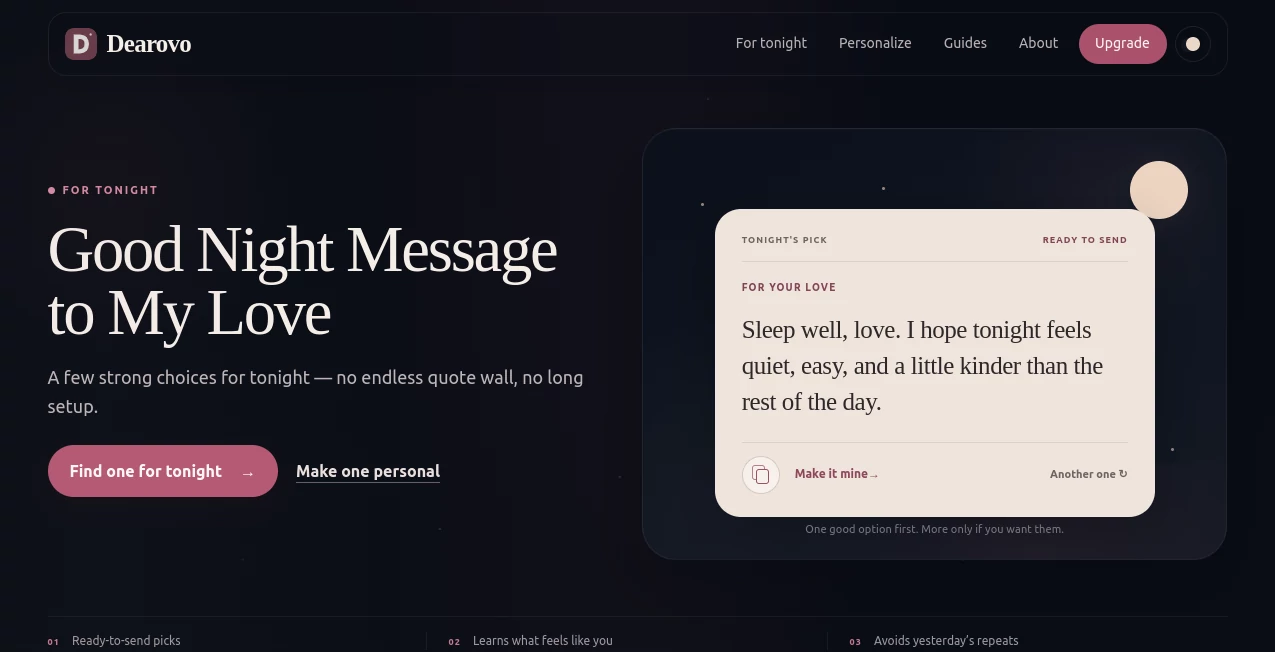
Finding the right words for someone you care about can be surprisingly difficult. You may know exactly what you feel, but turning that feeling into a message that sounds natural is another story. Dearovo is a personal communication assistant built around this everyday problem. Instead of giving users a huge collection of generic quotes, it focuses on a small selection of messages that can actually be sent, then lets users adjust them to fit the moment.
The experience is particularly useful for personal situations such as saying good night, supporting someone after a difficult day, celebrating a small win, dealing with distance, or simply letting someone know they are on your mind. The service is designed around a simple idea: the best message is not necessarily the longest or most romantic one. It is the one that sounds like something you would genuinely say.
Key Features
The main strength of the platform is its focus on context rather than one-off text generation. Users can start with several message choices and select the one that feels closest to their personality and relationship.
- Ready-to-send message suggestions for personal conversations.
- Different emotional directions such as warm, romantic, comforting, playful, and understated.
- Short and slightly longer message options.
- Personalization based on the situation and details the user provides.
- Learning from the messages users choose to help future suggestions fit their preferences.
- Options designed to avoid overly dramatic or clichéd wording.
- Support for situations such as missing someone, long-distance relationships, difficult days, celebrations, and casual affection.
User Interface
The interface is intentionally simple. Rather than asking users to write a complicated prompt, it presents clear choices for the feeling and length of a message. A user can select a direction such as warm, romantic, comforting, playful, or less cheesy and then refine the result.
The workflow feels closer to choosing and editing a message than operating a traditional AI writing system. This is a useful approach for people who do not want to spend time explaining an entire relationship to an AI before getting a usable sentence.
Accuracy & Performance
For a communication assistant, accuracy is less about factual answers and more about matching the intended mood. The platform addresses this by using context such as the situation, the relationship, and the user's previous choices when shaping suggestions.
For example, someone who wants to send a message after a difficult day can select a comforting direction instead of receiving a generic romantic paragraph. The ability to add a real detail from the evening can make the final message feel considerably more personal.
The service also keeps the selection focused. Rather than overwhelming users with dozens of interchangeable messages, it presents a smaller set of options that can be refined before sending.
Capabilities
The assistant is especially focused on personal messaging. Users can begin with a suggested message, make it their own, and provide additional context when the situation calls for something more specific.
One interesting aspect is its learning approach. The service can use what users actually choose to gradually make future suggestions more suitable to their communication style. This can include preferences around warmth, humor, affection, and the general way someone writes.
The platform also encourages users to keep genuine details in the message. Instead of replacing personal communication, it works as a writing aid that helps turn an existing thought into something easier to send.
Security & Privacy
Personal communication can contain sensitive information, so privacy deserves attention when using any writing assistant for relationship-related messages. Users should avoid entering information they would not want processed by an online service and should review the platform's current privacy terms before using it for particularly private conversations.
Another positive aspect of the product's positioning is that it does not present itself as a replacement for human communication. The user remains responsible for choosing, editing, and sending the final message.
Use Cases
The most obvious use case is a good night message. Someone may want to say something warmer than a simple good night without copying an exaggerated quote from the internet. A few suitable suggestions can make that process much faster.
It can also help after a difficult day. When someone you care about has had a stressful or disappointing day, finding a supportive sentence can be harder than it sounds. A comforting starting point gives the user something to work with without forcing the conversation into an overly emotional tone.
Long-distance relationships are another natural fit. When most of the connection happens through messages, small moments of communication become important. Having help finding a natural way to express that someone is missed can make everyday conversations easier.
It can also be useful for couples who have been together for a long time. The goal does not always need to be a dramatic romantic message. Sometimes a short, familiar sentence with one genuine detail is enough to make a routine good night feel personal.
Pros and Cons
- Pros: Focused on real communication rather than generic quote collections.
- Pros: Provides several emotional directions and length choices.
- Pros: Allows users to add real context from the current situation.
- Pros: Designed to learn from user selections and preferences.
- Pros: Useful for quick messages when the right wording is difficult to find.
- Cons: Its focus is relatively narrow compared with general-purpose AI writing platforms.
- Cons: Users who want full control over every part of a prompt may prefer a more traditional AI writing interface.
- Cons: Some advanced personalization and memory capabilities may depend on the current product plan or development stage.
Pricing Plans
The service is positioned as a freemium product, allowing users to try its core communication experience before considering additional capabilities. Available information indicates that paid functionality can include features such as cross-device access to saved people and preferences.
Because pricing and included features can change as the product develops, users should check the current plan information before subscribing. For someone who only needs occasional help with a message, the free experience may be enough, while frequent users may find additional personalization and memory features more useful.
How to Use the Assistant
Start by choosing the type of message you want to write. Select the emotional direction that best matches the moment, such as warm, romantic, comforting, playful, or understated. You can then choose whether you want something short or slightly more detailed.
Review the available suggestions and pick the one that feels closest to how you would normally speak. From there, personalize it rather than sending it blindly. Adding a small detail from the person's day, a familiar nickname, or a reference to something you discussed can make a major difference.
If the first version is too romantic, too formal, too long, or simply does not sound like you, refine it. The goal is not to send the first AI-generated sentence. The goal is to arrive at a message you would actually send.
Comparison with Similar Tools
Most general AI writing assistants begin with a blank prompt. The user explains who the recipient is, what happened, what tone they want, and what kind of message they need. That approach is flexible, but it can feel like too much work for a simple personal text.
This platform takes a narrower route. Instead of trying to solve every writing task, it concentrates on relationship-focused communication and starts users with ready-to-use options. The difference becomes especially noticeable when someone needs a quick message late at night and does not want to spend several minutes constructing a detailed prompt.
Another distinction is the emphasis on learning from actual choices. Rather than treating every request as completely independent, the product is designed around the idea that repeated use should gradually make suggestions feel more familiar to the user's communication style.
Conclusion
Good communication is often less about finding impressive words and more about finding words that feel genuine. That is where this assistant has a clear advantage. Its focused approach removes much of the friction between knowing what you want to say and actually writing it.
The product is particularly appealing for people who regularly communicate through text and sometimes struggle to make a message sound warm without becoming artificial or overly sentimental. Its combination of focused suggestions, contextual personalization, tone controls, and learning from user choices gives it a distinct place among AI writing tools.
For a simple message that needs to feel personal, natural, and ready to send, a focused communication assistant can be far more practical than opening a general-purpose AI tool and starting with a blank screen.
Frequently Asked Questions (FAQ)
What is this AI communication assistant designed for?
It is designed to help users write personal messages for people they care about, with a strong focus on everyday relationship moments such as good night messages, encouragement, affection, celebrations, and staying connected.
Can I customize the generated messages?
Yes. Users can select different tones and message lengths, provide information about the current situation, and refine a suggested message so it better matches their own communication style.
Does it only create romantic messages?
No. Although romantic and good night messages are an important part of the experience, the available situations also include comforting someone, celebrating a success, dealing with distance, missing someone, and simply thinking about them.
Can it learn my writing preferences?
The service is designed to learn from what users actually choose and use. Over time, those choices can help future suggestions better reflect preferences around tone, warmth, humor, and style.
Should I send an AI-generated message without editing it?
It is better to treat the suggestion as a starting point. Adding a genuine detail, familiar expression, or personal reference can make the final message sound much more like you.
Is the service free?
It is offered as a freemium service, with additional capabilities available through paid functionality. The exact plans and included features may change over time.
AI Reply Assistant , AI Life Assistant , AI Dating Assistant , AI Writing Assistants .
These classifications represent its core capabilities and areas of application. For related tools, explore the linked categories above.
Dearovo details
Pricing
- Freemium
Apps
- Web App
Categories

Dearovo Alternatives Product

Snow day Cal…

TClaw AI Hum…
AiZolo

UPDF AI

Middle Name …

Hall Of Tarot

WingmanX

Startup Read…

QuickPick