
















DeepBolt
What is DeepBolt?
Finding the right AI product can take almost as much time as using it. With thousands of new tools appearing across writing, development, design, productivity, marketing, education, and entertainment, browsing through endless lists is rarely an efficient way to make a decision. DeepBolt takes a more focused approach by bringing AI and creative products together in a curated discovery platform.
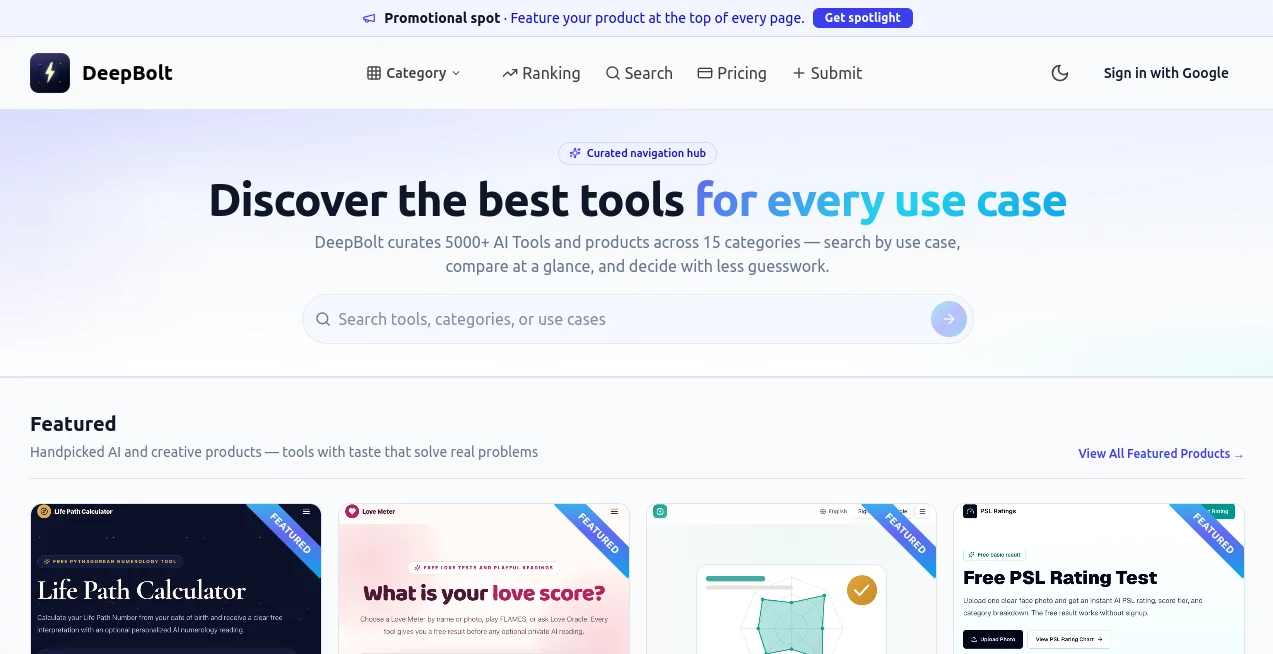
The platform currently features more than 5,000 AI tools and products, organized across a broad range of categories and use cases. Instead of simply presenting a massive database, it emphasizes discovery, comparison, and quick evaluation. Users can search for tools, browse categories, explore featured products, and look through newer additions without having to visit dozens of separate websites.
That makes it particularly useful for anyone who regularly experiments with new software. A marketer looking for a new workflow tool, a developer searching for an AI coding product, or a creator exploring new creative applications can start from the same place and narrow the options based on what they actually want to accomplish.
Key Features
- Curated directory of more than 5,000 AI and creative products.
- Search functionality for tools, categories, and specific use cases.
- Category-based browsing covering areas such as AI, analytics, automation, design, development, education, marketing, finance, health, productivity, and more.
- Featured product section for selected tools and creator products.
- Newest products section for discovering recently added applications.
- Popular products ranking based on engagement and recent activity.
- Dedicated collection of free tools.
- Premium placement for creators who want additional visibility for their products.
- Regularly updated product collection.
- Simple navigation designed around discovery rather than complicated filtering.
User Interface
The interface is built around straightforward discovery. A prominent search field lets visitors look for a tool, category, or use case, while the homepage separates products into useful sections such as Featured, Newest, Most Used, and Free Tools.
This organization is helpful when you do not have a specific product in mind. For example, someone interested in AI productivity software can browse the relevant category instead of starting with a generic web search. The result feels more like browsing a curated software shelf than navigating a traditional search engine.
Accuracy & Performance
One of the practical strengths of the platform is the way product information is presented in short, understandable descriptions. Users can quickly determine what an application does before opening it, which reduces unnecessary clicking and makes comparison easier.
The directory also separates newer additions from popular products, giving users two different ways to discover software. Someone who wants established options can look at usage-based rankings, while users who enjoy finding new projects can explore the latest additions.
Capabilities
The platform is more than a static list of links. It acts as a navigation hub for AI and creative software, helping visitors move from a broad requirement to a more relevant group of products. Its category system covers everything from developer tools and automation to design, education, marketing, finance, health, and productivity.
It is also useful for creators and independent developers. Products can receive featured or premium placement, giving makers a way to put their applications in front of people who are actively looking for new software. This creates value on both sides: users get a place to discover interesting products, while creators get another channel for product visibility.
Security & Privacy
As a discovery directory, the platform primarily serves as a navigation layer between users and third-party products. Visitors should still review the privacy policy and terms of any external application before entering sensitive information, uploading files, or connecting accounts.
The platform itself provides links to its privacy policy and terms of service, while individual products remain responsible for their own data-handling practices. This distinction is important when evaluating AI applications, especially those that process business documents, personal information, or private content.
Use Cases
- AI tool discovery: Explore a large collection of AI products without searching across multiple directories.
- Software research: Compare different products before deciding which one deserves a closer look.
- Productivity: Find applications for automation, organization, collaboration, and everyday workflows.
- Marketing: Discover tools for social media, advertising, analytics, and other marketing tasks.
- Development: Browse AI and developer-focused products for coding and technical workflows.
- Creative work: Find products covering design, image creation, video, and other creative activities.
- New product discovery: Explore recently added applications that may not yet be widely known.
- Free software research: Browse products identified as fully free according to their listed pricing model.
- AI product promotion: Independent creators can submit their products and pursue additional visibility through featured placement.
Pros and Cons
Pros
- Large collection with more than 5,000 products.
- Useful category structure for browsing by interest or use case.
- Separate sections for featured, newest, popular, and free products.
- Simple search experience.
- Useful for both everyday users and people who actively research AI software.
- Provides an additional discovery channel for independent creators.
Cons
- The large number of listed products can still make the selection process feel overwhelming in broad categories.
- Because many products lead to external websites, users may need to research individual tools further before choosing one.
- Premium placement can give selected products additional visibility, so users should consider more than placement alone when evaluating options.
Pricing Plans
Browsing the directory is available to visitors without a subscription requirement. The platform also offers premium product placement for creators who want increased visibility and faster approval for submitted products.
The exact cost of promotional placement can vary by the available plan, so creators should check the current pricing information before purchasing. For ordinary visitors who simply want to discover AI and creative products, the directory itself provides a convenient starting point without requiring a paid membership.
How to Use It
- Open the directory and start with the search field if you already know the type of product you need.
- Enter a tool type, category, or use case to narrow your discovery.
- Browse the relevant category when you are exploring rather than searching for one specific product.
- Check featured and popular products when you want established or highlighted options.
- Explore the newest section when you want to find recently submitted products.
- Use the free tools section if avoiding paid software is a priority.
- Open a product listing to learn what it offers, then visit the external product page for detailed information.
- Compare several candidates before choosing the one that best matches your workflow and requirements.
Comparison with Similar Tools
Traditional search engines can certainly help people find AI software, but they often mix product pages, advertisements, articles, reviews, and unrelated results together. A dedicated discovery directory offers a more concentrated experience because the visitor arrives specifically to explore software.
Compared with a simple list of AI tools, this platform puts more emphasis on different discovery paths. Featured products, newest additions, popular products, free tools, and category browsing give users several ways to approach the same problem.
It is especially appealing for people who enjoy discovering smaller or newer projects. Instead of relying exclusively on the most famous AI brands, visitors can encounter independent products and emerging applications that might otherwise be difficult to find.
Conclusion
For anyone who regularly searches for new AI software, having a centralized place to explore thousands of products can save a surprising amount of time. The combination of search, categories, featured listings, popularity signals, new additions, and free-tool discovery makes this platform a practical starting point for software research.
Its biggest advantage is breadth without abandoning structure. There are thousands of products to explore, yet visitors can approach them through categories and use cases rather than scrolling through one enormous list. For creators, it also offers a straightforward way to put a product in front of an audience already interested in discovering new software.
Whether you are looking for your next productivity application, researching AI software for a project, or simply curious about what independent developers are building, this directory provides an easy place to begin.
Frequently Asked Questions (FAQ)
What is DeepBolt?
It is a curated discovery directory for AI and creative products, bringing together more than 5,000 tools and applications across a wide range of categories and use cases.
Can I search for specific AI tools?
Yes. The search feature allows visitors to search for tools, categories, and use cases, making it easier to narrow down the large product collection.
Are there free AI tools available?
Yes. The platform has a dedicated Free Tools section containing products listed as fully free according to their selected pricing model.
Can developers submit their own products?
Yes. Creators can submit products for inclusion in the directory. Premium placement options are also available for creators who want additional visibility.
How often is the directory updated?
New products are added regularly, and the homepage includes a dedicated section for the latest additions so visitors can discover newer projects.