


















Elevery
What is Elevery?
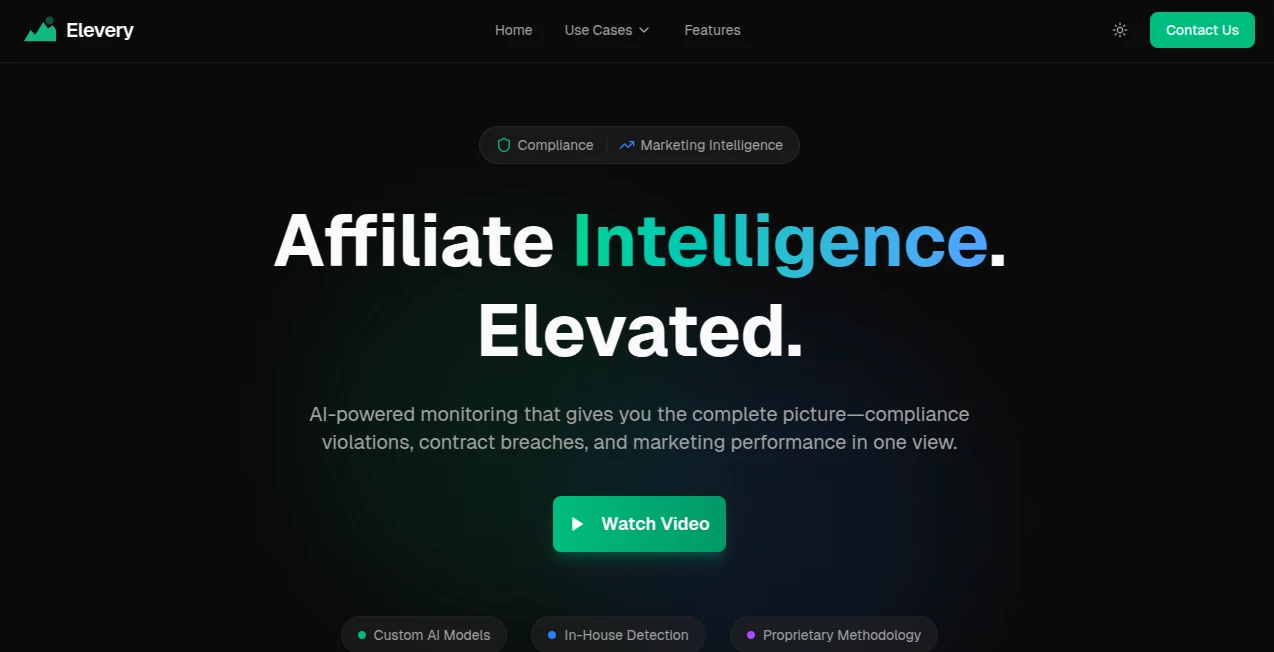
Elevery is an AI-powered affiliate monitoring platform built for gambling operators and teams that need a clearer view of what affiliates are publishing, where brands appear, and whether promotional activity follows regulatory and contractual requirements. Instead of relying on occasional manual checks, the platform continuously monitors affiliate websites and social content, helping teams identify compliance risks, positioning problems, broken links, outdated campaigns, and other issues before they become expensive problems.
The platform brings two areas together in one workflow: regulatory compliance and affiliate marketing intelligence. This is particularly useful for organizations managing large affiliate networks, where checking hundreds or thousands of pages manually can quickly become impractical. According to the company's website, its system monitors more than 5,000 affiliates daily and reports a 98% violation detection rate.
Key Features
- AI-powered monitoring of affiliate websites and promotional content
- Real-time detection of compliance violations
- Contract position monitoring for affiliate placements
- Affiliate link verification and campaign tracking
- Competitor monitoring and share-of-voice analysis
- Full-page screenshot capture for desktop and mobile
- Multi-geo auditing from 14 countries
- Compliance scoring and performance tracking
- Smart alerts for important changes and violations
- Timestamped evidence and PDF report exports
User Interface
The platform is designed around monitoring and reporting rather than complicated setup. Teams can view affiliate activity, detected issues, brand positioning, and compliance information from a centralized environment. Visual evidence is an important part of the experience, with full-page screenshots and highlighted areas helping users understand exactly where a problem was found.
This approach can be especially helpful when several departments need to work with the same information. A compliance manager may focus on regulatory warnings, while an affiliate manager can concentrate on contracted positions and campaign updates. Marketing teams can use the same information to understand brand visibility and competitor positioning.
Accuracy & Performance
Accuracy matters considerably when monitoring regulated affiliate marketing. The platform uses custom AI models, in-house detection, and its own methodology to analyze captured content. Its monitoring system is designed to identify issues such as misleading bonus claims, missing responsible gambling messages, missing age restrictions, hidden terms, and content that may appeal to minors.
Performance monitoring also extends beyond compliance. Position changes, affiliate links, campaign updates, and competitor appearances can be tracked across the network. The company states that its average time to detect issues can be around 15 minutes on its marketing intelligence offering, although actual results will depend on the network and monitoring configuration.
Capabilities
One of the strongest aspects of the platform is its dual-purpose monitoring. A single scan can examine both regulatory compliance and commercial affiliate performance. This means teams do not necessarily need separate workflows for checking whether an affiliate is compliant and whether the affiliate is delivering the placement that was agreed upon.
The system can monitor websites as well as content from Instagram, YouTube, and TikTok. It can also perform multi-geo audits using residential IPs, which is useful for identifying situations where affiliates display different content depending on the visitor's location.
For marketing teams, position monitoring can reveal when a brand that was contracted to appear in a particular position has moved lower in a comparison table. Link verification can uncover outdated or incorrect campaign URLs, while competitor tracking shows which competing brands are appearing across the affiliate network.
Security & Privacy
Because the platform is intended for compliance, marketing, and legal teams, evidence and traceability are central to its workflow. Screenshots can include timestamps and visual evidence, while reports can be exported as PDFs with highlighted areas. These records can help teams document findings during internal reviews, affiliate disputes, or regulatory inquiries.
Organizations operating in regulated markets should still review the platform's current privacy, security, GDPR, and data-handling documentation before deploying it for their specific operational requirements.
Use Cases
The platform is particularly relevant to gambling operators managing extensive affiliate networks. A compliance team can use automated scans to identify missing disclaimers, misleading promotional claims, age-restriction issues, and other regulatory concerns. Instead of discovering problems during a periodic manual audit, teams can receive alerts when issues are detected.
Affiliate managers can use the system to verify that partners are honoring contracted positions and using the correct landing pages. For example, if a brand was promised the second position in a comparison table but later appears in fifth place, position monitoring can flag the change.
Marketing directors can also benefit from competitor tracking and share-of-voice analysis. These features provide a broader picture of how frequently a brand appears across an affiliate network and how prominently it is positioned compared with competitors.
Legal and regulatory teams can use timestamped screenshots and exported reports as supporting documentation when investigating potential violations or affiliate disputes.
Pros and Cons
Pros:
- Combines compliance monitoring and affiliate marketing intelligence
- Automates monitoring that would otherwise require significant manual effort
- Supports websites, Instagram, YouTube, and TikTok content
- Provides visual evidence rather than relying only on text-based alerts
- Offers multi-geo auditing to identify location-specific differences
- Includes contract position and affiliate link verification
- Useful reporting features for compliance and legal teams
Cons:
- Primarily designed for gambling operators and regulated affiliate networks
- Pricing is customized rather than displayed as standard public plans
- The platform may be more advanced than necessary for businesses with only a small affiliate network
- Teams may need to configure monitoring rules and workflows to match their jurisdictions
Pricing Plans
No fixed public pricing plans are listed on the website. Instead, pricing is customized according to the organization's affiliate network, regulatory requirements, monitoring needs, and operational setup. Interested companies are encouraged to contact the provider to discuss their requirements and create a suitable plan.
This approach makes sense for enterprise-oriented compliance software because the workload can vary considerably between an operator monitoring a few dozen affiliates and one managing thousands of sources across several countries.
How to Use the Platform
Getting started is centered around adding the affiliate sources that need to be monitored. Organizations can provide affiliate URLs or connect their affiliate management system. The next step is configuring the relevant regulatory rulesets, including jurisdiction-specific requirements where applicable.
Once monitoring is configured, AI analyzes captured content and identifies potential compliance issues, positioning changes, link problems, and other relevant findings. Alerts are prioritized so teams can focus first on issues that require immediate attention.
For example, a compliance team might begin the morning by reviewing critical alerts and their associated screenshots. An affiliate manager can then investigate any position drops or incorrect campaign links, while marketing staff can review competitor positioning and brand visibility.
Comparison with Similar Tools
Traditional affiliate monitoring often depends on spreadsheets, manual page reviews, screenshots taken by hand, and periodic audits. General analytics platforms can provide traffic and conversion data, but they usually do not focus on visually checking the actual promotional content published by affiliates.
This platform takes a more specialized approach. Its main advantage is the combination of AI-based compliance detection with affiliate contract and marketing intelligence. Instead of simply asking how much traffic an affiliate generates, teams can investigate whether the affiliate is presenting the brand correctly, using the right links, maintaining contracted positions, and following applicable promotional requirements.
For organizations operating in highly regulated markets, that distinction can make specialized monitoring considerably more valuable than a conventional affiliate reporting dashboard.
Conclusion
Managing a large affiliate network is about more than measuring clicks and conversions. A brand can lose visibility, appear beside competitors, use an outdated promotion, or face regulatory exposure without realizing it until a manual review takes place. Automated monitoring offers a practical way to keep a much closer eye on these changes.
With compliance detection, contract verification, competitor intelligence, multi-geo auditing, visual evidence, and automated alerts in one platform, this solution is well suited to gambling operators and regulated businesses that need continuous oversight of their affiliate ecosystem. Its specialized focus may not be necessary for every company, but for organizations where affiliate compliance and placement accuracy directly affect revenue and licensing risk, it offers a compelling approach.
Frequently Asked Questions (FAQ)
What is this platform used for?
It is used to monitor affiliate marketing activity, detect compliance violations, verify contracted affiliate placements, check links and campaigns, and analyze brand and competitor positioning.
Can it monitor social media content?
Yes. The platform states that it can monitor content from Instagram, YouTube, and TikTok in addition to affiliate websites and landing pages.
Can it detect affiliate contract violations?
Yes. Position monitoring can compare contracted placements with actual positions, while other features can identify incorrect links, outdated campaigns, and competitor positioning.
Does it support multiple countries?
Yes. Its multi-geo auditing capability can scan the same URL from 14 countries using residential IPs, helping teams identify location-specific content and potential geo-cloaking.
Does it provide evidence for compliance reviews?
Yes. The platform provides timestamped screenshots and PDF reports with visual evidence and bounding boxes, which can be useful for internal audits, regulatory inquiries, and affiliate disputes.
Does it have publicly listed pricing?
No. Pricing is customized based on the affiliate network, regulatory requirements, monitoring requirements, and the organization's specific needs.
Who can benefit most from it?
Gambling operators, compliance teams, affiliate managers, marketing directors, and legal or regulatory teams are the primary audiences. It is especially relevant to organizations managing large affiliate networks in regulated markets.
Business , AI Analytics Assistant , AI Advertising Assistant .
These classifications represent its core capabilities and areas of application. For related tools, explore the linked categories above.

Elevery Alternatives Product

X Growth Eng…

zGEO Ranker

WRITELO

Read

Receipt AI

Fina Money

AI Complianc…

CitedSpy

Surmado
