
FateMaster
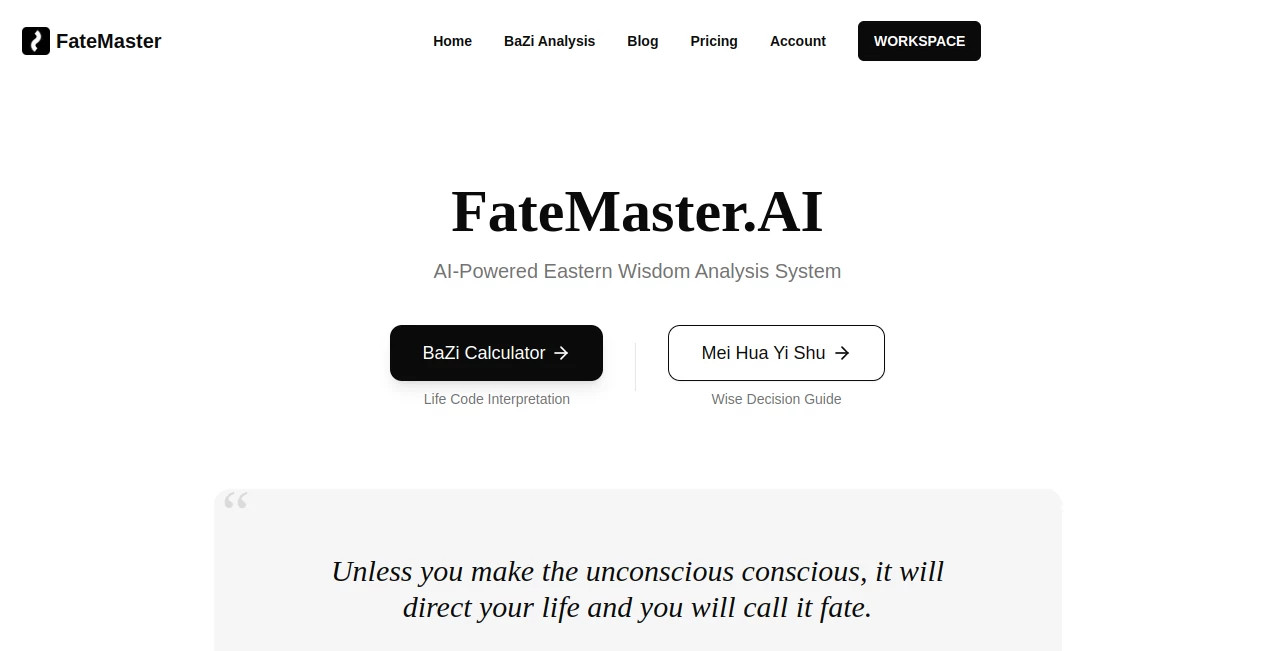
What is FateMaster?
For anyone curious about Chinese astrology, traditional divination, or the cultural ideas behind Eastern wisdom, FateMaster offers a surprisingly broad place to explore. Instead of presenting a single fortune-telling feature, the platform brings together several traditional systems and combines them with modern AI-assisted interpretation.
The experience covers BaZi, Zi Wei Dou Shu, Mei Hua Yi Shu, Liu Yao, Qi Men Dun Jia, Tarot, and the Chinese Almanac. Users can explore personal charts, relationship compatibility, daily guidance, or specific questions without needing to understand every technical detail behind the traditional systems.
One particularly interesting aspect is the platform's attempt to separate calculation from interpretation. Structured charts and divination results are generated through dedicated calculation tools, while AI is used to explain those results in more accessible language. That makes the experience feel less like asking a chatbot to invent an answer and more like exploring a digital interpretation of an established system.
Key Features
- AI-assisted BaZi and Four Pillars analysis
- Daily fortune and personal guidance
- Marriage and relationship compatibility analysis
- Business partnership and interpersonal relationship analysis
- Zi Wei Dou Shu chart generation and interpretation
- Mei Hua Yi Shu, Liu Yao, and Qi Men Dun Jia analysis
- Tarot card reference and interpretation
- Chinese Almanac and date-selection tools
- AI-powered fortune-telling agent for multi-method analysis
- Relationship networks for comparing multiple people
- Analysis history and conversational follow-up
User Interface
The interface is built around individual analysis experiences rather than forcing everything into one complicated dashboard. A visitor can choose a specific system, enter the relevant information, and move directly into the analysis.
The AI agent provides an even simpler route for beginners. Instead of deciding whether a question belongs to BaZi, Liu Yao, or another method, users can describe what they want to understand and let the system determine which available analysis method is appropriate.
This approach is useful for newcomers because traditional Chinese metaphysics can be intimidating when presented with unfamiliar terminology. The platform gradually introduces the concepts through practical use rather than requiring users to study everything first.
Accuracy & Performance
One of the more thoughtful design choices is the distinction between calculation and interpretation. The platform states that its dedicated engines calculate charts and structured results, while AI handles the explanation and conversation around those results.
For example, birth information can involve details such as lunar or solar dates, time zones, daylight-saving rules, true solar time, and the exact birth hour. These details can affect a traditional chart, so asking for clarification when important information is missing is much more sensible than simply filling in the blanks.
The interpretation itself should still be viewed as an exploratory or cultural reading rather than an objective prediction. The site's own terms make clear that its results have no scientific basis and are intended for entertainment and cultural exploration.
Capabilities
The platform goes well beyond a basic birth-chart calculator. BaZi tools can be used for personal analysis, daily readings, relationship matching, business partnerships, family relationships, friendships, and other interpersonal comparisons.
Its wider collection of systems makes it possible to approach different questions in different ways. BaZi and Zi Wei Dou Shu are suited to birth-chart analysis, while Liu Yao and Mei Hua Yi Shu can be used for specific questions. Qi Men Dun Jia focuses on timing, direction, and situational questions, while the Chinese Almanac provides traditional date-related references.
The fortune-telling AI agent is particularly useful when a user is unsure which method to choose. It can combine several supported tools, use the resulting structured information, and continue the discussion through follow-up questions.
Security & Privacy
Because many of the platform's features involve personal information such as birth dates, birth locations, and conversation history, privacy is an important consideration. The service explains that birth data and conversation content may be used to provide analysis and generate responses, with its privacy policy describing the relevant processing and data practices.
Users should also remember that traditional readings can involve personal and sensitive subjects. A sensible approach is to share only the information needed for the particular experience and to review the available privacy and memory controls when using conversational features.
Use Cases
There are several practical ways to use the platform, especially for people who enjoy traditional Chinese culture and want an interactive way to explore it.
- Personal exploration: Create a birth chart and explore traditional interpretations of personality, life patterns, and development themes.
- Relationship comparison: Compare charts for romantic partners, friends, relatives, colleagues, or business partners.
- Daily reflection: Use daily fortune and traditional divination features as a prompt for thinking about upcoming situations.
- Decision exploration: Ask a focused question and explore it through Mei Hua Yi Shu, Liu Yao, or another appropriate system.
- Timing and direction: Explore traditional Qi Men Dun Jia perspectives when considering timing, movement, negotiation, or strategy.
- Cultural learning: Browse the site's educational material covering subjects such as the Five Elements, Heavenly Stems, Earthly Branches, Four Pillars, and traditional calculation methods.
- Casual entertainment: Experiment with Tarot, compatibility readings, and other interactive experiences simply for curiosity and fun.
Pros and Cons
- Pros: Broad collection of traditional Eastern systems
- Pros: AI-assisted explanations are easier for beginners to understand
- Pros: Calculation and AI interpretation are treated as separate stages
- Pros: Supports relationship analysis across several types of relationships
- Pros: Includes educational material for users who want to learn the underlying concepts
- Pros: Offers a free way to begin exploring the platform
- Cons: Traditional metaphysical systems can be difficult to understand without some background knowledge
- Cons: AI interpretations are inherently subject to uncertainty
- Cons: Results should not be treated as scientifically validated predictions
- Cons: Some advanced experiences require more detailed personal information
Pricing Plans
The service uses a combination of free access and paid subscription options. The platform promotes free access for initial exploration, while premium plans are available for users who want access to additional BaZi analysis features and broader usage.
Available features can include daily fortune guidance, relationship matching, and other advanced analysis experiences. Since subscription limits, benefits, and pricing can change, users should check the current pricing information displayed on the platform before purchasing a plan.
For someone who is simply curious, the free experience is a useful starting point. More frequent users who want deeper analysis or additional features may find the paid options more suitable.
How to Use It
Start by choosing the type of analysis that matches your interest. For a personal reading, enter the requested birth information and make sure the date, time, location, and calendar details are correct.
If you are unsure which traditional method fits your question, use the AI agent and describe the situation naturally. For example, instead of trying to decide between several divination systems, explain what you want to explore and allow the system to determine an appropriate tool.
Once the result is generated, read the interpretation alongside the underlying chart or structured information. You can then ask follow-up questions, clarify details, or explore another perspective. Keeping the experience conversational makes it easier to understand concepts that might otherwise feel complicated.
Comparison with Similar Tools
Many AI fortune and astrology services focus on generating a quick answer from a language model. This platform takes a somewhat different approach by placing dedicated calculation systems between the user's information and the final AI explanation.
It also stands out through the number of traditional methods available in one environment. Someone interested specifically in BaZi can use the dedicated calculator, while another user can explore Zi Wei Dou Shu, I Ching-related methods, Qi Men Dun Jia, Tarot, or the Chinese Almanac without moving between unrelated services.
Another advantage is the educational side of the platform. Alongside interactive readings, users can explore explanations of traditional concepts and calculation methods. That makes it more useful for someone who wants to understand the cultural background instead of receiving a short prediction and leaving.
Conclusion
For people interested in Chinese astrology and Eastern traditional wisdom, this platform offers much more than a simple fortune generator. Its combination of structured calculation tools, AI interpretation, relationship analysis, educational resources, and conversational exploration creates a broad environment for curiosity and self-reflection.
The separation between calculation and interpretation is one of its strongest ideas. It gives users a clearer view of how an answer is produced and avoids treating every traditional calculation as something a language model should simply invent.
At the same time, the experience is best approached with a healthy degree of curiosity rather than certainty. Traditional readings can be enjoyable and culturally interesting, but they should not replace professional advice or real-world evidence when important decisions are involved.
Frequently Asked Questions (FAQ)
What types of analysis are available?
The platform supports BaZi, Zi Wei Dou Shu, Mei Hua Yi Shu, Liu Yao, Qi Men Dun Jia, Tarot, and traditional Chinese Almanac tools. It also provides an AI agent that can combine several supported methods.
Does the AI create the traditional charts itself?
The platform describes a workflow in which dedicated calculation engines generate structured charts or divination results first, while AI interprets those results and explains them in natural language.
Can I compare two or more people?
Yes. Relationship features support different types of comparisons, including romantic relationships, friendships, family relationships, and business partnerships. Multiple person profiles can be kept separate during analysis.
What information is needed for a BaZi analysis?
Depending on the analysis, you may need information such as birth date, birth time, birthplace, and calendar details. Accurate information is important because changes in time or calendar conventions can affect the resulting chart.
Can I use the service without knowing anything about Chinese astrology?
Yes. Beginners can start with a direct analysis or describe their question to the AI agent. The platform also provides educational guides for people who want to understand the terminology and concepts in greater depth.
Is there a free option?
Yes. The platform provides free access for users who want to begin exploring its analysis experiences, while paid plans provide additional features and usage options.
Can the AI agent use different traditional systems?
Yes. The agent can work with BaZi, Zi Wei Dou Shu, Liu Yao, Mei Hua Yi Shu, Qi Men Dun Jia, and Chinese Almanac tools depending on the question being asked.
Should I use the readings for important life decisions?
No. The service itself states that its analysis is for entertainment and cultural purposes and has no scientific basis. Medical, legal, financial, safety, and other high-stakes decisions should be based on appropriate professional advice and real-world evidence.
Does the AI agent currently draw Tarot cards?
No. The AI agent and the dedicated Tarot experience are treated as separate features. The agent does not claim to draw Tarot cards when it does not have the corresponding tool available.
Who is this platform best suited for?
It is a good fit for people who are curious about Chinese astrology, traditional divination, Eastern cultural systems, relationship compatibility, or AI-assisted self-reflection and want several related tools in one place.
AI Life Assistant , AI Fun Tools .
These classifications represent its core capabilities and areas of application. For related tools, explore the linked categories above.

FateMaster Alternatives Product

AI Baby Video

Romantic AI
Kirkify Al

Olabiba

Roblox The F…

MatchMyType

City Boy Meme

KalonAI
MEANINGS