


















Flint
What is Flint?
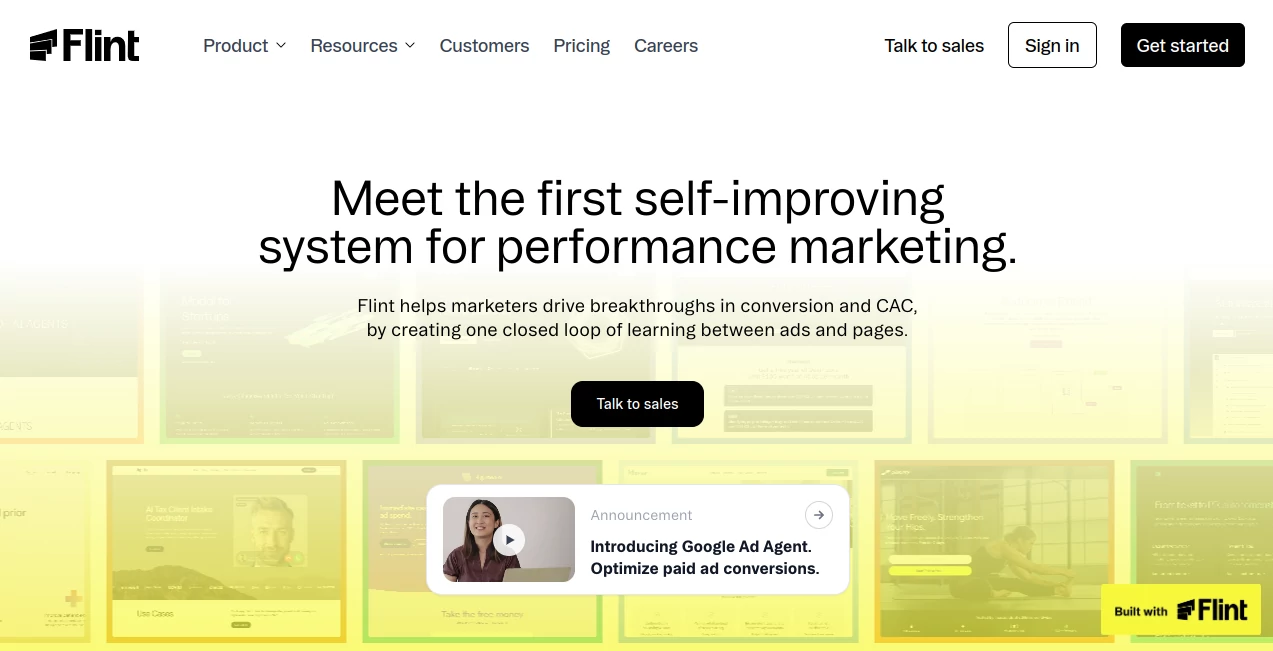
Flint is built for marketing teams that want to turn more of their advertising traffic into real business results. Instead of treating paid campaigns, landing pages, analytics, and conversion optimization as separate jobs, it brings them together into one connected workflow.
The platform analyzes a company's existing website and design system, identifies opportunities, and creates landing pages designed around specific campaigns, keywords, ad groups, or audiences. It can also work with Google Ads to surface opportunities such as wasted spend, negative keywords, and traffic being sent to the wrong pages.
That combination makes it particularly interesting for growth teams running paid acquisition at scale. A marketer can describe what needs to be built, review the recommendation, and approve it without waiting for an engineering team to create another page from scratch.
Key Features
- AI-powered landing pages: Create campaign-specific pages that match the company's existing visual identity instead of relying on generic templates.
- Google Ads optimization: The advertising agent identifies opportunities related to keywords, wasted spend, ad groups, and landing-page alignment.
- Automatic design-system capture: The platform can read an existing website and use its visual language when creating new pages.
- Conversion-focused workflows: Pages are designed around the relationship between an advertisement, the visitor, and the desired conversion.
- SEO and AI search support: Enterprise customers can use root-domain setups intended to support SEO and AI-search visibility.
- Analytics integrations: Existing analytics, tag-management, CRM, forms, and tracking infrastructure can continue working with generated pages.
- Approval-based execution: Recommendations do not automatically go live. Users review and approve proposed changes before execution.
- API and MCP access: The platform can connect with external workflows and tools, including Claude and other growth-oriented systems.
User Interface
The interface is designed around a practical marketing workflow rather than a traditional website-builder experience. Instead of forcing marketers to manually construct every section, the system works from existing brand information and the goals behind a campaign.
Recommendations can be reviewed, refined through chat, and approved before anything is published. This is a useful approach for teams where marketers need control but do not want every small landing-page change to become a development ticket.
The overall experience feels especially suited to performance marketers who care more about shipping the right page quickly than spending hours adjusting individual design elements.
Accuracy & Performance
Performance marketing depends heavily on context. Sending a visitor from a highly specific advertisement to a generic homepage often creates unnecessary friction. The platform addresses this problem by connecting the message behind an ad with the page that receives the click.
Its workflow can identify missing campaign pages and recommend new ones based on advertising and search opportunities. Approved recommendations also become part of its ongoing learning process, helping future suggestions take previous decisions into account.
The company highlights customer results including a reported 50% reduction in customer acquisition cost in one case study and a 3x conversion-rate increase in another. These figures are customer-reported results rather than guarantees, but they illustrate the type of performance improvement the product is designed to pursue.
Capabilities
The platform goes beyond simple landing-page generation. Its Pages functionality can create targeted experiences for advertising campaigns, keywords, and account-based marketing. Its advertising agent focuses on the other side of the equation by examining Google Ads activity and suggesting actions that may improve performance.
For example, a campaign may be sending traffic to a page that does not closely match the search intent behind the keyword. The system can identify that gap and recommend a more relevant page. Once approved, the page can be published and the corresponding advertising destination can be updated.
It can also operate alongside existing platforms such as Webflow, Framer, Next.js, WordPress, and other website technologies. Teams do not necessarily have to replace their main website to use it for campaign pages.
Security & Privacy
Security is particularly important when a marketing platform connects to advertising accounts, analytics systems, CRMs, and company websites. The workflow is designed around user approval, meaning recommendations are reviewed before changes are executed.
The platform also supports existing analytics and tracking setups, including Google Analytics, Google Tag Manager, HubSpot, Salesforce, and PostHog. Cookie-consent systems, forms, and header scripts can continue to operate on supported pages.
Teams should still review the provider's current security and privacy documentation before connecting sensitive business systems, especially when deploying the platform across a larger organization.
Use Cases
Paid advertising campaigns: Create landing pages that closely match individual Google Ads campaigns, ad groups, and keywords.
Conversion rate optimization: Identify opportunities to improve the relationship between advertising traffic and landing-page performance.
Account-based marketing: Build personalized pages for specific companies or groups of target accounts without manually creating every page.
SEO and AI search: Develop targeted pages around topics and opportunities that can support organic search and emerging AI-driven discovery channels.
Marketing teams without engineering support: Launch production-ready campaign pages without requiring developers to maintain every variation.
High-volume growth programs: Teams running many campaigns can use automated recommendations and page generation to expand their landing-page coverage much faster than a traditional development workflow.
Pros and Cons
- Pros: Strong focus on performance marketing and conversion optimization.
- Pros: Generates pages based on an existing brand and design system.
- Pros: Can work alongside an existing website and CMS.
- Pros: Google Ads integration connects advertising recommendations with landing-page execution.
- Pros: Approval-based workflows give marketers control over changes.
- Pros: Supports analytics, CRM, forms, and tracking integrations.
- Pros: Useful for creating large numbers of targeted campaign pages.
- Cons: The entry-level plan starts at $500 per month, making it more suitable for serious marketing teams than very small businesses.
- Cons: The current advertising integration is focused on Google Ads, while Meta and LinkedIn agents are listed as future roadmap items.
- Cons: Businesses starting without an existing website may not be a good fit because the initial workflow relies on an existing public brand presence.
Pricing Plans
The Basic plan starts at $500 per month and is intended for brands spending under $10,000 per month on advertising. It includes platform access, approximately 50 pages and 75 optimization actions per month, a basic ads agent, and landing pages based on the company's existing design system.
A 14-day free trial is available without requiring a credit card, giving teams an opportunity to evaluate the workflow before committing.
The Enterprise plan uses custom pricing and combines a software fee with a percentage of Flint-guided media spend. It includes everything in Basic, along with a dedicated account manager, an advanced ads agent, more campaign and A/B testing capabilities, continuous Figma design-system syncing, advanced business context, custom rules, and root-domain setup for SEO and AI search.
How to Use It
Start by connecting an existing website and allowing the platform to understand its design system and brand identity. Teams using the advertising functionality can also connect Google Ads through the supported authorization flow.
Next, review the recommendations for missing pages, campaign opportunities, or advertising improvements. Recommendations can be refined through the interface before approval.
Once a recommendation is approved, the system can execute the selected action. For landing pages, this may mean creating and publishing a campaign-specific page on the company's domain or subdomain. For advertising workflows, approved changes can be pushed to the connected Google Ads account.
Over time, approved and rejected recommendations contribute to the platform's memory, allowing future suggestions to take earlier decisions into consideration.
Comparison with Similar Tools
Traditional website builders are generally focused on helping users create websites and pages. Developer-oriented AI coding tools can also generate pages, but they typically require technical knowledge and ongoing engineering maintenance.
This platform takes a different position. Its main focus is the connection between advertising performance and the pages receiving that traffic. That makes it more specialized than a general AI website builder.
Compared with conversion-optimization platforms, its advantage is the ability to combine recommendations with actual page creation and deployment. Instead of simply telling a marketing team that a new landing page could improve a campaign, the workflow is designed to help produce that page and connect it to the campaign.
For a small business looking for a basic website, a conventional builder may be simpler and less expensive. For a growth team managing substantial paid acquisition and many landing-page variations, the more specialized workflow can be considerably more valuable.
Conclusion
Flint stands out because it treats performance marketing as a connected system rather than a collection of disconnected tools. Advertising generates the click, the landing page handles the visitor, analytics reveals what happened, and optimization determines what should happen next.
Its ability to analyze an existing brand, create campaign-specific pages, connect with Google Ads, and keep marketers in control of approvals makes it a compelling option for teams focused on growth and conversion performance.
The pricing means it is not aimed at casual users or businesses that only need an occasional landing page. But for companies already spending heavily on acquisition, reducing the time between identifying an opportunity and launching the right page can be worth far more than the cost of another conventional page-building tool.
Frequently Asked Questions (FAQ)
What is this platform mainly used for?
It is primarily designed for performance marketing teams that want to improve advertising results by creating better landing pages, identifying campaign opportunities, and optimizing the connection between ads and pages.
Can it create landing pages?
Yes. It can create production-ready landing pages tailored to campaigns, keywords, ad groups, and other marketing objectives while using the existing brand and design system as a reference.
Does it work with an existing website?
Yes. Teams can keep their existing website platform and use generated pages on a subdomain or other supported setup. The service can work alongside platforms such as Webflow, Framer, Next.js, and WordPress.
Does it support Google Ads?
Yes. Google Ads integration is currently available, allowing the advertising agent to identify opportunities and, after approval, make supported changes directly to the connected account.
Does it automatically make changes?
No. Recommendations require user approval before they are executed. Users can review and refine recommendations before giving permission for the action to go live.
Is there a free trial?
Yes. The Basic plan currently offers a 14-day free trial without requiring a credit card.
How much does the Basic plan cost?
The Basic plan starts at $500 per month and is intended for brands spending under $10,000 per month on advertising.
Is it suitable for companies without a website?
Not currently. The initial setup relies on an existing, publicly accessible website so the system can understand the company's brand identity and design system.
Can marketers use it without coding?
Yes. The product is specifically designed for marketing and growth teams and does not require engineering work for routine page creation and campaign workflows.
Does it support SEO?
Yes. Its pages are designed with SEO in mind, and the Enterprise offering includes root-domain setup intended for SEO and AI-search use cases.
AI Landing Page Builder , AI SEO Assistant , AI Analytics Assistant , AI Advertising Assistant .
These classifications represent its core capabilities and areas of application. For related tools, explore the linked categories above.

Flint Alternatives Product

Prelight

Meev

Ad Suite AI

Kol find

Sorank

ModelsLab

Creget

Marketbetter…

LazyLister
