

















Four-Leaf
What is Four-Leaf?
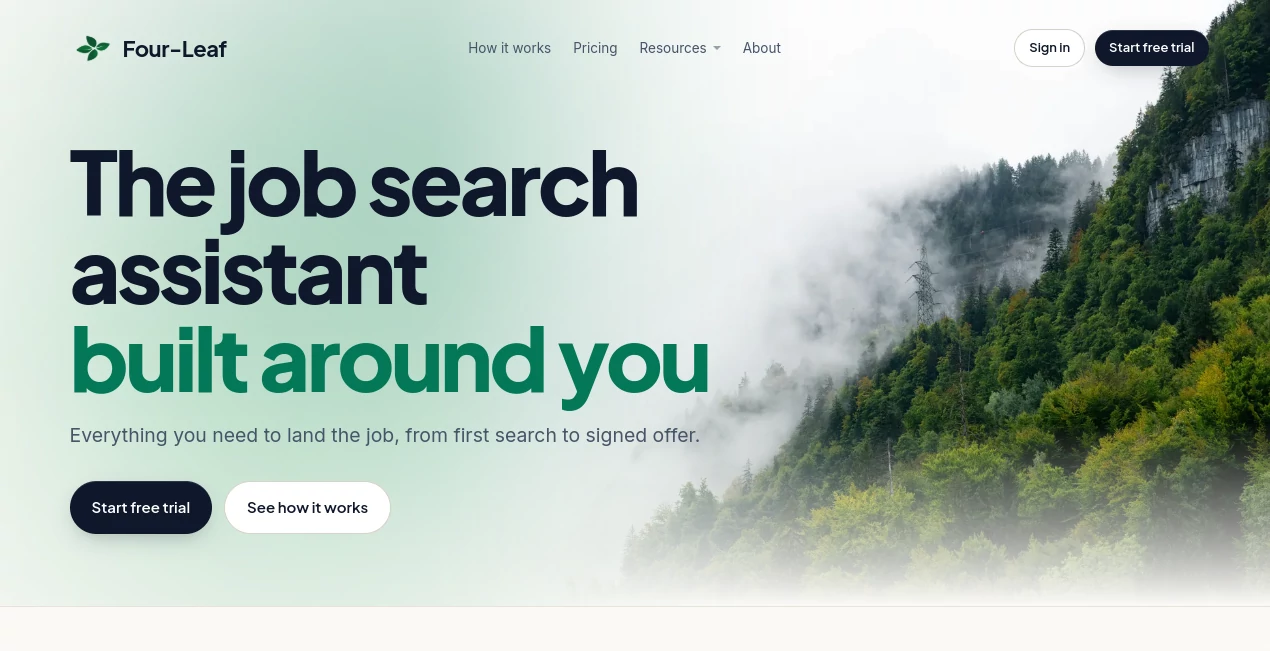
Four-Leaf is an AI-powered career platform designed for candidates who want help throughout the job search rather than another isolated resume tool. It brings job discovery, resume tailoring, LinkedIn optimization, cover letters, interview practice, recruiter communication, and offer negotiation into one workspace.
The idea is refreshingly practical: instead of applying to dozens of jobs with the same documents, candidates can identify roles that fit their background, understand why they match, prepare application materials for each position, and practice for the interview that follows. The platform currently searches more than 100,000 active jobs across over 1,100 companies, giving users a much broader starting point than manually checking career pages one by one.
What makes the experience particularly appealing is the shared context between its tools. A candidate's profile, target role, applications, and preparation work can carry from one stage to another. That makes the process feel less like juggling several unrelated AI services and more like working through a single career workspace.
Key Features
- AI-powered job search with match scoring and explanations
- Resume tailoring based on individual job descriptions
- LinkedIn profile optimization
- Cover letter generation in the user's voice
- Voice-based mock interviews with scored feedback
- Recruiter email drafting and reply assistance
- Compensation and offer negotiation coaching
- Application tracking and interview performance insights
- Ghost-job checking for suspicious or potentially inactive listings
- Weekly job-match emails based on saved searches
User Interface
The interface is built around the idea of moving from one job-search task to the next without losing context. Rather than forcing users to repeatedly paste the same resume, job description, or career information into separate tools, the platform keeps the important details connected.
The dashboard also gives candidates a place to keep track of applications and their progress. For someone managing several applications at different stages, this can be more useful than a collection of browser tabs and spreadsheets. The onboarding experience is straightforward as well, with users able to move directly toward job discovery, resume tailoring, or interview preparation.
Accuracy & Performance
The platform's job matching goes beyond simple keyword searching. It analyzes a candidate's background against job requirements and provides a match score, along with information about skills, experience, role alignment, and missing requirements.
Its resume tailoring feature follows the same principle. Instead of inventing qualifications, it works with the experience already present in the candidate's resume and adjusts the wording to better reflect the language used in the target position. The service also provides an ATS-oriented match score, helping users identify gaps before submitting an application.
The live job-search component is another practical advantage. The service says it refreshes its own job index daily and pulls listings from more than 1,100 company career pages, while its search experience also covers listings associated with major job boards. This gives candidates a useful way to investigate opportunities before spending time tailoring an application.
Capabilities
Its capabilities cover nearly the entire candidate journey. Job seekers can start by describing the type of position they want and reviewing ranked opportunities. Once they find a promising role, they can move into resume and cover-letter preparation without starting from scratch.
The interview preparation side is particularly interesting because it is voice-first. Instead of simply generating a list of questions, the mock interview experience lets candidates answer aloud and receive feedback on their responses and delivery. Follow-up questions can also make practice feel closer to an actual conversation.
There is support after the interview as well. The email assistant can help draft recruiter communications, while the compensation coach provides guidance for negotiating an offer. The result is a broader career workflow rather than a tool focused on only one part of job hunting.
Security & Privacy
Because the service works with resumes, career histories, job applications, and interview preparation, users should review its privacy policy and terms before uploading sensitive information. Candidates should also make sure that the information they provide is accurate and appropriate for the intended use.
One positive aspect of the product philosophy is its emphasis on preparation rather than interview cheating. The platform explicitly positions its AI as a way to build genuine skills and confidence, rather than secretly supplying answers while an interview is taking place. That distinction matters as employers increasingly use tools to detect artificial assistance during interviews.
Use Cases
The platform can be useful in several real-world job-search situations. Someone starting a new search can use natural-language job discovery and match scores to narrow down relevant positions instead of applying indiscriminately.
A candidate with an older resume can use the tailoring workflow to adapt existing experience to a new position. Someone preparing for an important interview can practice answers aloud and receive feedback before the actual conversation. LinkedIn optimization can help professionals improve how their profiles present their experience to recruiters.
It can also be useful for candidates managing a long search. Application tracking, saved searches, weekly job-match emails, recruiter email assistance, and offer negotiation support address problems that usually appear after the initial application is submitted.
Pros and Cons
- Pros: Covers multiple stages of the job search in one workspace.
- Pros: Job matching includes a score and an explanation rather than relying only on keywords.
- Pros: Resume tailoring is designed around the specific job description.
- Pros: Voice mock interviews provide practice that is closer to speaking than typing answers.
- Pros: Includes useful extras such as application tracking, recruiter emails, LinkedIn optimization, and negotiation coaching.
- Pros: A free trial is available without requiring a credit card.
- Cons: The strongest results depend on providing an accurate and sufficiently detailed career profile.
- Cons: Candidates who only need a basic resume editor may find the broader feature set unnecessary.
- Cons: AI-generated application materials should still be reviewed and personalized before submission.
Pricing Plans
The service offers two main ways to access its features. The 5 Day Pass costs $5 and unlocks the Pro tools for five days without automatic renewal. It includes resume tailoring, voice mock interviews, cover letters, LinkedIn optimization, compensation coaching, and email assistance.
For candidates conducting an ongoing search, the Pro plan costs $20 per month. It includes natural-language job search, LinkedIn optimization, tailored resumes, cover letters, voice mock interviews, recruiter email drafts, negotiation coaching, application tracking, interview performance information, and job match scoring.
Both options include a three-day free trial, and the service states that no credit card is required to start the trial. Pricing and included features can change, so users should confirm the current offer before subscribing.
How to Use the Job Search Assistant
- Start by creating your profile and adding your resume or relevant career information.
- Describe the type of role, location, experience level, or working arrangement you are looking for.
- Review recommended jobs and examine the match score and explanation for each opportunity.
- Choose a promising position and use the job description to tailor your resume and cover letter.
- Optimize your LinkedIn profile so your headline, experience, and skills better reflect your target roles.
- Practice for the interview using the voice mock-interview feature and pay attention to the feedback.
- Use the email assistant when communicating with recruiters or following up on applications.
- If you receive an offer, use the compensation coaching feature to prepare for the negotiation.
- Track applications and continue refining your approach based on interview and job-search feedback.
Comparison with Similar Tools
Many AI career products focus on one narrow task. Some specialize in resume writing, others concentrate on interview practice, and job boards primarily focus on listing vacancies. This platform takes a wider approach by connecting those activities.
The biggest difference is the shared workflow. A job discovered through the search experience can become the context for resume tailoring, cover-letter writing, interview preparation, recruiter communication, and eventually compensation discussions. That continuity can save considerable time for candidates who would otherwise move information manually between several services.
It is not necessarily the right choice for everyone. Someone who already has a strong resume and only wants a simple document editor may prefer a dedicated resume service. But for candidates who want an end-to-end system for an active job search, having these capabilities connected in one place is a meaningful advantage.
Conclusion
A modern job search involves much more than finding an open position. Candidates need to understand which roles fit, present their experience clearly, prepare for interviews, communicate professionally, and negotiate when an offer arrives. Bringing these stages together makes the process easier to manage.
The strongest part of this platform is its focus on continuity. Instead of treating the resume, job search, interview, and recruiter conversation as separate tasks, it connects them around the candidate and the role they are pursuing. The combination of live job discovery, match scoring, tailored application materials, voice interview practice, and career communication makes it a compelling option for people who want structured AI assistance throughout their search.
Frequently Asked Questions (FAQ)
What is this platform designed for?
It is designed for job candidates who want AI assistance across the job-search process, including finding positions, improving resumes, preparing for interviews, communicating with recruiters, and negotiating offers.
Can it tailor a resume to a specific job?
Yes. Users can provide an existing resume and a target job description. The system identifies relevant requirements and adapts the resume to better match the language and priorities of that position while keeping the candidate's experience accurate.
Does it provide AI job matching?
Yes. The job-search feature analyzes listings against a candidate's background and provides a match score with information explaining the fit.
Can I practice interviews using my voice?
Yes. The mock interview experience is voice-based and provides feedback on spoken responses. It can also generate questions relevant to the position being targeted.
Does it help with LinkedIn?
Yes. The LinkedIn optimizer can help improve the headline, about section, experience bullets, and skills so the profile is better aligned with the roles the candidate wants to attract.
Can it help write recruiter emails?
Yes. The email assistant can draft new recruiter messages and replies to existing conversations while using the surrounding job-search context.
Does it help with salary negotiation?
Yes. The compensation coach is designed to help candidates prepare for offer discussions and approach negotiations with data-backed guidance.
Is there a free trial?
Yes. The platform currently offers a three-day free trial without requiring a credit card.
Is it an interview cheating tool?
No. The service explicitly positions its interview features as preparation tools. It does not aim to whisper answers during live interviews or complete interview tasks on behalf of the candidate.
Who would benefit most from using it?
It is particularly useful for active job seekers applying to multiple roles, professionals changing careers, candidates preparing for important interviews, and anyone who wants to manage the different stages of a job search from one workspace.