
Future AGI
What is Future AGI?
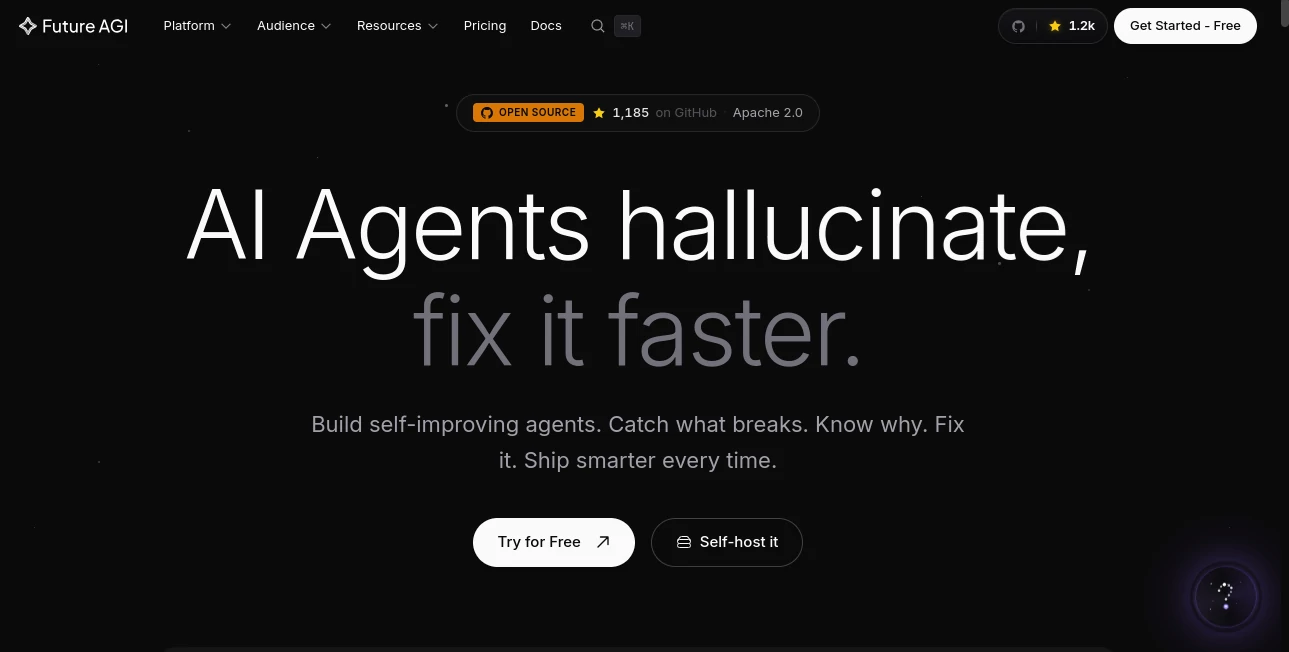
I’ve watched too many promising AI agents fall apart in production — they sound smart in demos but hallucinate at the worst moments or go off track when things get complicated. This platform feels like the missing piece that serious builders have been waiting for. It gives you the tools to simulate real scenarios, catch problems early, understand exactly why they happen, and keep improving the agent over time. The first time I saw an agent’s performance jump after one round of targeted fixes, it clicked: this isn’t just another evaluation tool — it’s a way to make agents actually reliable in the real world.
Introduction
Building AI agents that stay useful beyond the demo stage is harder than most people admit. Future AGI tackles this head-on by providing an end-to-end open-source platform for the full agent lifecycle — from early simulation and testing to production monitoring and continuous optimization. Instead of hoping your agent works, you get structured ways to find weaknesses, measure real performance, and make meaningful improvements. It’s used by teams who want agents that don’t just sound impressive but actually deliver consistent, trustworthy results. The combination of powerful evaluations, clear observability, and practical guardrails makes it feel like having an experienced AI reliability engineer on the team.
Key Features
User Interface
The interface is designed for people who actually build and run agents. You can create evaluation runs, explore detailed traces, simulate conversations, and see clear performance metrics without drowning in complexity. The agent IDE lets you iterate quickly, while dashboards show what’s breaking and why. It strikes a nice balance — powerful enough for deep analysis but approachable enough that you don’t need a PhD to get value from it.
Accuracy & Performance
The evaluation system stands out for its depth and honesty. It goes beyond simple pass/fail metrics to give you granular insights across factuality, relevance, safety, completeness, and more. Teams report catching issues they would have missed otherwise, and the ability to run thousands of simulated scenarios helps build confidence before going live. The observability layer makes it much easier to debug problems in production rather than guessing what went wrong.
Capabilities
You get comprehensive evaluations, tracing and observability, simulation environments, guardrails, a gateway for safe interactions, and tools for continuous optimization. It supports the full journey — prototyping agents, testing them rigorously, deploying with monitoring, and iterating based on real performance data. The open-source nature means you can self-host and customize as needed, while the platform’s focus on self-improving agents helps teams ship better versions faster.
Security & Privacy
Security and reliability are built into the core. Guardrails help prevent harmful outputs, while the observability tools let you catch issues before they reach users. Self-hosting options give teams full control over their data and models. For companies building customer-facing agents, that level of control and transparency is a big reason to choose this platform.
Use Cases
A support team builds a customer service agent and uses simulations to test hundreds of difficult scenarios before launch, dramatically reducing hallucinations and escalations. A product company creates internal agents for data analysis and uses ongoing evaluations to keep accuracy high as models and data evolve. Developers prototyping new agent ideas get fast feedback on weaknesses instead of discovering them after deployment. Teams running production agents monitor performance in real time and fix issues quickly rather than letting them linger. It fits anywhere you need agents that are reliable enough for real users and real consequences.
Pros and Cons
Pros:
- End-to-end platform covering simulation, evaluation, monitoring, and optimization in one place.
- Strong focus on practical reliability and reducing hallucinations.
- Open-source core with self-hosting options for full control.
- Detailed insights that actually help you improve agents, not just score them.
- Active development and community around building better agents.
Cons:
- Requires some understanding of agent architecture to get the full value.
- Advanced enterprise features and support come with paid plans.
Pricing Plans
The core platform is open-source and free to use or self-host, which is fantastic for individuals and teams who want to experiment and build. Hosted plans and enterprise features provide managed infrastructure, higher limits, priority support, and additional capabilities for production use. The pricing model respects different needs — from open experimentation to mission-critical deployments.
How to Use Future AGI
Start by exploring the open-source repository or signing up for the hosted platform. Define your agent’s goals and create evaluation scenarios that matter for your use case. Run simulations, analyze results, identify weak spots, and iterate using the IDE and optimization tools. Once confident, deploy with monitoring and guardrails in place. Use ongoing evaluations to keep improving performance over time. The workflow encourages a healthy loop of build, test, learn, and improve.
Comparison with Similar Tools
Many tools focus on either evaluation or observability, but few bring the full lifecycle together as cohesively. This platform stands out by combining rigorous testing with practical monitoring and optimization in a way that actually helps agents get better over time. It feels less like a point solution and more like a complete partner for anyone serious about shipping reliable AI agents.
Conclusion
Building AI agents that you can actually trust in production is still surprisingly difficult. This platform makes it significantly more achievable by giving you the tools to test thoroughly, understand problems deeply, and keep improving. For teams and developers who want agents that don’t just demo well but perform reliably when it counts, it’s an incredibly valuable addition to the stack. The future of useful AI agents will belong to those who can iterate and improve them effectively — and this platform helps you do exactly that.
Frequently Asked Questions (FAQ)
Is it only for large enterprises?
No — the open-source version and accessible hosted plans make it suitable for individuals, startups, and enterprises alike.
Do I need to be an AI expert to use it?
Basic usage is approachable, but getting the most value benefits from some understanding of how agents work.
Can I self-host the entire platform?
Yes — the core is open-source under Apache 2.0 and can be fully self-hosted.
How does it help reduce hallucinations?
Through comprehensive evaluations, simulations, and targeted optimization based on real failure modes.
AI App Builder , AI Developer Tools , Other .
These classifications represent its core capabilities and areas of application. For related tools, explore the linked categories above.

Future AGI Alternatives Product

Tate-A-Tate

gpt-plus.ai

freellm

Emergent

Discord ID L…

AI Complianc…

pixel flow g…

Nestify

Hall Of Tarot