


















GeoCopy
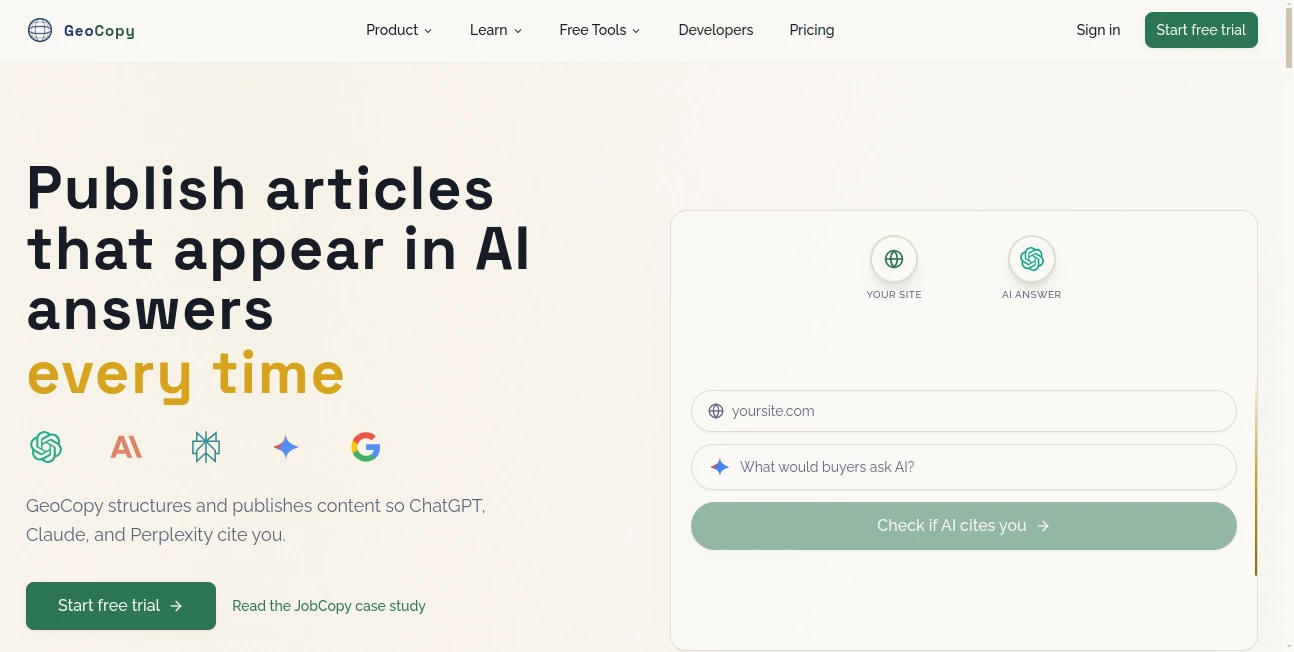
What is GeoCopy?
Getting a well-written article onto Google is no longer the whole content marketing game. People increasingly ask ChatGPT, Claude, Perplexity, Gemini, and other AI search systems for recommendations, explanations, and product comparisons. The challenge is making sure your content is structured in a way these systems can understand, extract, and cite.
GeoCopy is built around that challenge. It combines content research, article creation, SEO, Answer Engine Optimization (AEO), and Generative Engine Optimization (GEO) in one workflow. Instead of producing an article and leaving the optimization work for later, the platform checks the content before publication and can rewrite pieces that fail its quality gates.
The workflow is particularly interesting for publishers, affiliate websites, niche site owners, and content teams that need to produce a large number of useful articles without manually moving content between research, writing, optimization, and publishing tools.
Key Features
- AI-search-ready articles: Articles are structured for Google Search, Google AI Overviews, and major AI answer engines.
- SEO, AEO, and GEO checks: Each article passes dedicated optimization checks covering search structure, answer formatting, and AI citation signals.
- Live topic research: Research can incorporate user questions, studies, named experts, and sourced information before drafting begins.
- Brand voice training: The platform analyzes a website's existing content and applies its tone across new articles and campaigns.
- Multiple article formats: Standard articles, comparison posts, and listicles can be created depending on the intended search and content format.
- Direct CMS publishing: Content can be connected and published to WordPress, Webflow, Shopify, or Wix without relying on manual copy-and-paste workflows.
- REST API access: Paid plans can enable API access for teams that want to integrate article production into their own workflows.
User Interface
The platform is designed around a relatively straightforward publishing workflow. Rather than forcing users to jump between a separate research application, writing assistant, SEO checker, and CMS, the main process is handled from one environment.
Users can work with individual articles or larger campaigns, review the generated material, make edits, and then send approved content to a connected publishing platform. For someone managing a niche website with dozens of topics in the pipeline, keeping these steps together can save a surprising amount of administrative work.
Accuracy & Performance
One of the stronger aspects of the workflow is that research happens before the article is finalized. The research process can pull current topic information, user questions, studies, expert references, and data that can then be incorporated into the draft.
Content is also evaluated through separate SEO, AEO, and GEO gates. These checks look at elements such as keyword usage, heading structure, answer capsules, question-based sections, expert references, and sourced statistics. If an article does not meet the required checks, the workflow can trigger a rewrite rather than simply leaving the problem for the publisher to discover later.
That does not mean every generated article should be published without review. Human editing remains valuable, especially for sensitive subjects, first-hand experience, product claims, and content where factual precision matters.
Capabilities
The platform goes beyond basic AI article generation by focusing on the relationship between traditional search and AI-powered discovery. Its approach combines SEO optimization with AEO and GEO techniques designed to make information easier for answer engines to extract.
Answer capsules, FAQ structures, expert quotations, sourced statistics, comparison formats, and clear heading hierarchies can all help turn a general article into a more structured information resource. The system also supports direct publishing, which makes it suitable for content operations where producing and updating articles at scale is important.
For larger publishers, campaigns provide another useful layer. Instead of treating every article as an isolated assignment, teams can organize content production around a broader publishing strategy.
Security & Privacy
The service supports CMS connections through OAuth or secure API-based integrations, depending on the platform. This allows publishers to connect their websites without manually transferring every article.
As with any service that connects to a website or CMS, businesses should review the provider's privacy and terms documentation before connecting a production website, particularly when working with private content, customer information, or proprietary business material.
Use Cases
Niche websites: Publishers running focused websites can use the platform to research and produce articles around large keyword sets while keeping the content workflow centralized.
Affiliate publishers: Comparison pages, listicles, product-focused articles, and informational content can be produced in a format suitable for both conventional search and AI-driven discovery.
SEO teams: Teams can combine traditional SEO requirements with AEO and GEO checks instead of treating AI search visibility as a completely separate project.
Content agencies: Agencies managing multiple websites can benefit from brand-voice training, campaigns, multiple connected sites, and higher article limits on the larger plans.
Website owners targeting AI search: Businesses that want their content to become a potential source for ChatGPT, Claude, Perplexity, Google AI Overviews, and similar systems can use the platform to build citation-oriented content into their publishing process.
Pros and Cons
Pros
- Combines SEO, AEO, and GEO optimization in one workflow.
- Supports research-backed article creation rather than relying solely on a blank AI writing prompt.
- Can adapt content to an existing brand voice.
- Supports direct publishing to several popular CMS platforms.
- Offers standard, comparison, and listicle article formats.
- Paid plans include REST API access.
- Useful for publishers producing content at relatively high volume.
- Offers a free trial with five articles and no credit card requirement.
Cons
- The monthly cost may be higher than a basic AI writing tool for users who only need occasional articles.
- High-volume plans are more suitable for publishers and professional content teams than casual users.
- AI-generated content still benefits from human fact-checking and editorial review.
- Its strongest advantages are related to SEO and AI-search workflows, so users looking only for creative writing may not need its full feature set.
Pricing Plans
A free trial includes five articles with no credit card required, making it possible to test the workflow before paying.
Starter – $49/month: Includes up to 50 articles per month, one connected site, one team seat, GEO and SEO optimization, publishing to supported CMS platforms, and Tier 1 API throughput when enabled.
Growth – $99/month: The most popular plan provides up to 125 articles per month, two connected sites, two team seats, GEO and SEO optimization, and higher API throughput.
Pro – $199/month: Designed for heavier publishing workflows, this plan supports up to 300 articles per month, three connected sites, three team seats, higher API throughput, GEO and SEO optimization, and a monthly AI citation report.
All paid plans can enable REST API access, with the available throughput depending on the selected subscription.
How to Use It
Start by creating an account and using the free trial to test the article workflow. Choose a topic that matches the audience and search intent of your website, then provide the information needed to guide the content.
The research stage gathers relevant topic information and potential supporting sources. The article is then drafted using the configured brand voice and prepared for SEO, AEO, and GEO evaluation.
Review the finished article before publication. This is a good point to add business-specific information, personal experience, original examples, or corrections that an automated system could not know.
Once the article is ready, connect your preferred CMS and publish it directly. For publishers working on many related subjects, campaigns can be used to organize the production process more efficiently.
Comparison with Similar Tools
Traditional SEO platforms are generally strongest at keyword research, rankings, technical optimization, and search-performance analysis. General AI writing assistants, on the other hand, are often more focused on generating text from prompts.
This platform takes a different approach by connecting content generation with AI-search visibility. SEO, AEO, and GEO checks are part of the article workflow rather than an optional step after the writing is complete. Direct CMS publishing also reduces the operational gap between creating an article and putting it online.
For someone who only needs a few short pieces of copy each month, a conventional writing assistant may be sufficient. For a publisher producing dozens or hundreds of search-focused articles, the combination of research, optimization, brand voice, campaigns, and CMS publishing becomes considerably more valuable.
Conclusion
AI search is changing how websites compete for attention. Ranking on a traditional results page remains important, but being referenced inside an AI-generated answer is becoming another valuable source of visibility.
GeoCopy approaches this shift from the content-production side. Its biggest strength is not simply generating articles, but bringing research, SEO, AEO, GEO checks, brand voice, and publishing together in one workflow.
For niche publishers, affiliate websites, SEO professionals, and content teams that publish at scale, it offers a practical way to build AI-search considerations into everyday content production. The free trial also makes it relatively easy to judge the quality of the research and writing before committing to a monthly plan.
Frequently Asked Questions (FAQ)
What is this platform designed for?
It is designed for creating and publishing articles optimized for traditional search engines as well as AI answer platforms such as ChatGPT, Claude, Perplexity, and Google AI Overviews.
Does it support traditional SEO?
Yes. Articles are checked for SEO factors such as keyword usage, heading hierarchy, and links alongside AEO and GEO requirements.
Can it publish directly to a website?
Yes. It supports direct publishing to WordPress, Webflow, Shopify, and Wix through connected integrations.
Does it have a free trial?
Yes. New users can create five free articles during the trial without providing a credit card.
Can it follow my website's writing style?
Yes. The platform can analyze content from a website and use the resulting brand voice when creating new articles and campaigns.
Does it provide API access?
REST API access is available on paid plans, with different throughput levels depending on the selected plan.
Should I publish the generated articles without editing them?
It is better to review important content before publication. Automated research and optimization can accelerate production, while human review helps preserve accuracy, originality, and the specific voice of a business.
Who would benefit most from using it?
Niche site owners, affiliate publishers, SEO professionals, agencies, and content teams producing articles at scale are likely to get the most value from its combined research, optimization, and publishing workflow.
AI Blog Writer , AI Content Generator , AI SEO Assistant , AI Copywriting .
These classifications represent its core capabilities and areas of application. For related tools, explore the linked categories above.

GeoCopy Alternatives Product

Free AI Gene…

Instaposts.ai

Reddit Campa…

Restaurant S…

etsyseotools

Serplux

AI Business …

ModelsLab

Schema Synth
