
Goblyn
What is Goblyn?
Getting a startup noticed online is rarely a problem of having nothing to say. The harder part is consistently researching useful topics, producing trustworthy articles, publishing them, watching the results, and deciding what deserves another round of attention. This is where an autonomous content approach can make a real difference.
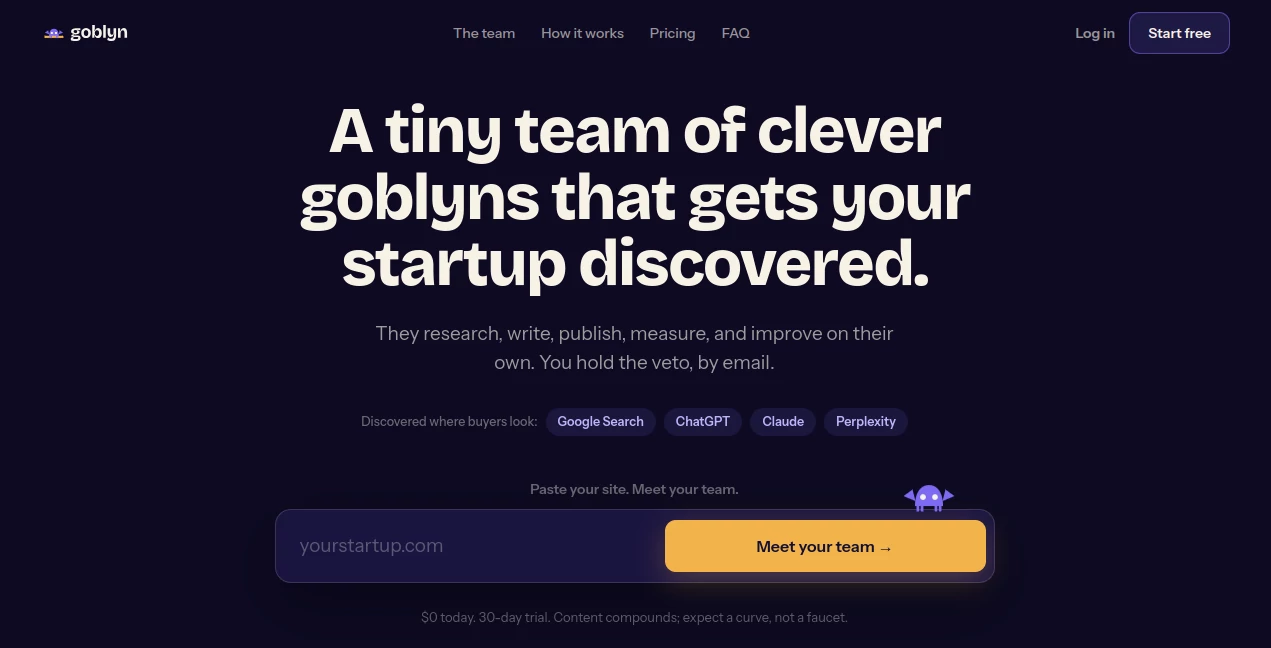
Goblyn is built around the idea of an AI content team rather than a single writing assistant. It researches a company's website and market, develops content ideas, creates grounded articles, handles publishing, measures performance, and adjusts the strategy based on what happens after publication. The platform is designed for founders and small teams that want an active content operation without spending hours every week managing one.
The workflow is particularly interesting for startups that want visibility across both traditional search and newer AI answer engines. Instead of simply producing a large pile of articles, the system follows a continuous cycle: research, write, edit, publish, measure, and adapt. That makes the product feel closer to having a small content department than using a conventional text generator.
Key Features
- Autonomous content team: A group of specialized AI agents handles different parts of the content process, from strategy and research to writing, editing, SEO, publishing, and measurement.
- Research-driven planning: The system examines the company's website, market, and questions potential buyers are asking before deciding what should be written.
- Source-grounded writing: Articles are built from research and a company-specific fact file, with claims about the business checked before publication.
- SEO and GEO support: Technical elements such as schema, sitemaps, internal linking, and llms.txt are included as part of the publishing workflow.
- Performance monitoring: Search Console and AI answer-engine activity can be monitored so future content decisions are informed by actual performance.
- Automatic adaptation: Strong articles receive more attention while weaker pieces can be rewritten rather than simply being buried under a constant stream of new posts.
- White-labeled publishing: Paid customers can publish a branded blog on their own domain using their logo and colors.
- Weekly approval workflow: A weekly email shows what is scheduled, allowing the owner to veto a post or request changes before it goes live.
User Interface
The interface is deliberately centered around simplicity rather than making the customer operate a complicated content-management system. The main interaction can happen through weekly email updates, where upcoming articles are presented for review.
That approach is useful for founders who do not want another dashboard demanding daily attention. You can look at the proposed content, make changes when necessary, or leave it alone and let the scheduled work continue. The published blog can also carry the company's own branding, which helps the content feel like part of the existing website rather than an external publishing experiment.
Accuracy & Performance
Accuracy is handled through a combination of research and a company-specific fact file. The editorial agent checks claims, numbers, and sources before an article is released, while the strategy layer looks at how published content performs over time.
That distinction matters. Publishing three articles every week is not automatically better than publishing fewer useful ones. The platform explicitly treats content as a feedback loop, giving successful topics more attention and allowing underperforming pieces to be rewritten.
There is also a sensible caveat for businesses evaluating the service: no content platform can guarantee Google rankings, AI citations, traffic, leads, or revenue. Those outcomes depend on search engines, answer engines, competitors, the website itself, and many other factors outside the platform's control. The real strength here is the process of continuously testing and improving the content strategy.
Capabilities
The system divides the content operation among several specialized roles. A strategist plans the editorial direction, research-focused agents investigate topics and market questions, dedicated writers handle formats such as guides and comparisons, a public-relations-focused role can turn launches and updates into stories, and an editor checks facts and language.
Another agent focuses specifically on search optimization and AI-oriented discoverability. During publishing, the system can handle schema, internal links, sitemaps, and llms.txt alongside the actual article.
The result is a workflow that covers much more than drafting paragraphs. It connects research with publishing and then connects publishing with measurement. For a small company, that broader coverage can be more valuable than having access to another standalone AI writer.
Security & Privacy
The service states that customer information is used to operate and improve the customer's content workflow rather than being sold for advertising. Payment card details are handled by Stripe, while connected Google data is accessed through authorization and read-only permissions.
Customers can also export their generated content and fact file. The privacy policy states that sensitive Google authorization tokens are encrypted at rest, and that the platform does not use customers' private data to train its own models.
Businesses in regulated industries should still review every article before publication. AI-generated material can contain mistakes, and the service's own terms make it clear that the customer remains responsible for the accuracy and legality of published claims.
Use Cases
Startup content marketing: Early-stage companies can maintain a regular publishing schedule without hiring a complete editorial team.
SEO growth programs: Businesses that already know content is important but struggle to research topics, optimize pages, and maintain consistency can use the automated workflow to keep those tasks moving.
AI search visibility: Companies interested in appearing in answers from AI assistants can benefit from a workflow that considers both conventional search and AI answer engines.
Founder-led businesses: A founder may have valuable knowledge but little time to turn it into articles. The system can use information about the business as a foundation for producing and organizing content.
Lean marketing teams: Small marketing departments can use automation to handle repetitive research, drafting, publishing, and reporting while keeping humans involved where judgment matters.
Pros and Cons
- Pros: Covers the complete content lifecycle rather than just writing.
- Pros: Uses specialized AI roles for research, writing, editing, SEO, and strategy.
- Pros: Supports both search optimization and AI answer-engine visibility.
- Pros: Provides a white-labeled blog on the customer's domain.
- Pros: Content is based on a business-specific fact file and researched sources.
- Pros: Weekly email approval keeps the owner's involvement lightweight.
- Pros: Customers own their generated content and can export it.
- Cons: Businesses that require complete editorial control over every step may prefer a more manual workflow.
- Cons: AI-generated content still needs human judgment, particularly for sensitive or regulated subjects.
- Cons: Search rankings and traffic cannot be guaranteed.
- Cons: The service is designed around an ongoing subscription rather than a one-time purchase.
Pricing Plans
The pricing structure is refreshingly simple. There are no multiple feature tiers or complicated seat calculations. New customers receive a 30-day free trial with no payment required upfront. During the trial, the blog remains in a private, unindexed preview environment.
When a customer chooses to publish the blog on a live domain, the monthly plan costs $99 per month. There is also an annual option at $990 per year, effectively providing two months free compared with paying monthly.
The paid plan includes the complete AI team, roughly three posts per week, a branded blog on the customer's domain, technical SEO and GEO features, Search Console and AI answer tracking, weekly reports, and an editable company fact file. The subscription can be canceled from the account settings.
How to Use It
- Start the free trial and provide the website or business information requested during onboarding.
- Allow the system to understand the company's products, audience, positioning, competitors, and preferred topics.
- Let the research and strategy agents identify content opportunities based on the market and questions potential customers are asking.
- Review the proposed articles through the weekly email report.
- Veto an article or request changes when something does not fit the brand.
- Allow approved content to be published automatically according to the schedule.
- Connect the relevant Google properties if search-performance monitoring is required.
- Review the performance reports and let the system use the results to refine future content decisions.
Comparison with Similar Tools
Traditional AI writing tools usually focus on a single moment in the process: you enter a prompt and receive text. That can be useful when you already know what you want to publish, but it leaves research, editorial planning, SEO, publishing, analytics, and ongoing optimization largely in your hands.
This approach is different because the goal is not simply to generate an article. It attempts to manage the surrounding content operation as well. The system researches before writing, checks facts before publishing, handles technical publishing tasks, watches performance afterward, and feeds those observations back into the next round of content.
For someone who only needs occasional copy, a conventional AI writing assistant may be more appropriate. For a startup that wants a persistent publishing engine and does not want to manage every step manually, the autonomous model is considerably more compelling.
Conclusion
For startups, producing good content is rarely difficult because of a lack of ideas. It is difficult because content requires consistency. Someone has to decide what matters, research it, write it, edit it, publish it, optimize it, measure the outcome, and then do the whole thing again.
This platform takes an ambitious approach to that problem by turning those responsibilities into an autonomous team. Its strongest feature is arguably not the writing itself, but the loop surrounding it: research, publication, measurement, and adaptation.
The 30-day trial also gives businesses a practical way to judge the quality before committing to a subscription. If the goal is to build a steady company blog while keeping the weekly workload close to a simple approval email, this is an unusually hands-off option worth exploring.
Frequently Asked Questions (FAQ)
Does the service write and publish content automatically?
Yes. The platform can research topics, create articles, edit them, handle publishing, and monitor performance. Customers receive a weekly email with scheduled content and can veto or request changes before publication.
Can I publish the content on my own domain?
Yes. The paid service supports a white-labeled blog on the customer's own domain, including the company's branding, logo, and colors.
Does it support SEO?
Yes. The publishing workflow includes technical elements such as schema, sitemaps, internal linking, and llms.txt, along with performance monitoring through connected search data.
Can the content be reviewed before it goes live?
Yes. A weekly report provides the upcoming publishing schedule. Customers can veto individual posts or request changes before the deadline.
Who owns the generated content?
The service's terms state that customers own the generated blog content and can export their content and fact file.
Is there a free trial?
Yes. New accounts receive a 30-day free trial with no payment required at the start. The trial content remains in a private, unindexed preview until the customer decides to go live.
Can it guarantee better Google rankings?
No. The service does not guarantee rankings, traffic, AI citations, leads, or revenue. Its approach is to improve the content strategy using research and real performance data rather than promising a fixed SEO result.
Is human review still necessary?
Yes. Automated fact checking and editorial controls can reduce mistakes, but businesses should still review important claims before publication, especially when writing about legal, medical, financial, or other regulated subjects.
AI Workflow Management , AI Blog Writer , AI Content Generator , AI SEO Assistant .
These classifications represent its core capabilities and areas of application. For related tools, explore the linked categories above.

Goblyn Alternatives Product

Claude and C…

AI Business …

Oasis

Quikauthor

Miro

genie 4

AllInOneTools

Inkfox AI

Liftburst