


















GoodVat
What is GoodVat?
GoodVat is a modern tax and compliance platform designed to make sales tax, VAT, and GST easier to manage for online sellers and developers. Instead of relying on spreadsheets, manually maintained address data, or scattered tax references, the platform brings address normalization, geocoding, tax infrastructure, and AI-assisted tax information into a more connected environment.
One of its most interesting offerings is its AI tax assistant, which can connect with AI applications such as ChatGPT, Claude, and Gemini through the Model Context Protocol. This allows users to ask tax-related questions while giving the AI assistant access to maintained information about VAT, GST, and sales tax rules.
The platform is particularly appealing to ecommerce businesses, developers, SaaS companies, and online sellers that need reliable location and tax data as part of their workflows. Its approach is practical: take complicated compliance-related information and turn it into tools and APIs that can actually be used.
Key Features
- AI-assisted tax information for VAT, GST, and sales tax questions
- Address normalization for messy or incomplete address strings
- Structured address data including house numbers, roads, districts, cities, states, and countries
- Developer-friendly REST APIs with predictable JSON responses
- Support for integrations with AI assistants through MCP
- Live EU VAT number verification through its tax assistant
- Tax guides covering online selling and international compliance topics
- Planned US geocoding and global tax calculation infrastructure
User Interface
The website has a clean, developer-oriented interface that makes its different products easy to understand. Rather than hiding everything behind complicated dashboards, the service explains what each API does and provides practical examples for developers.
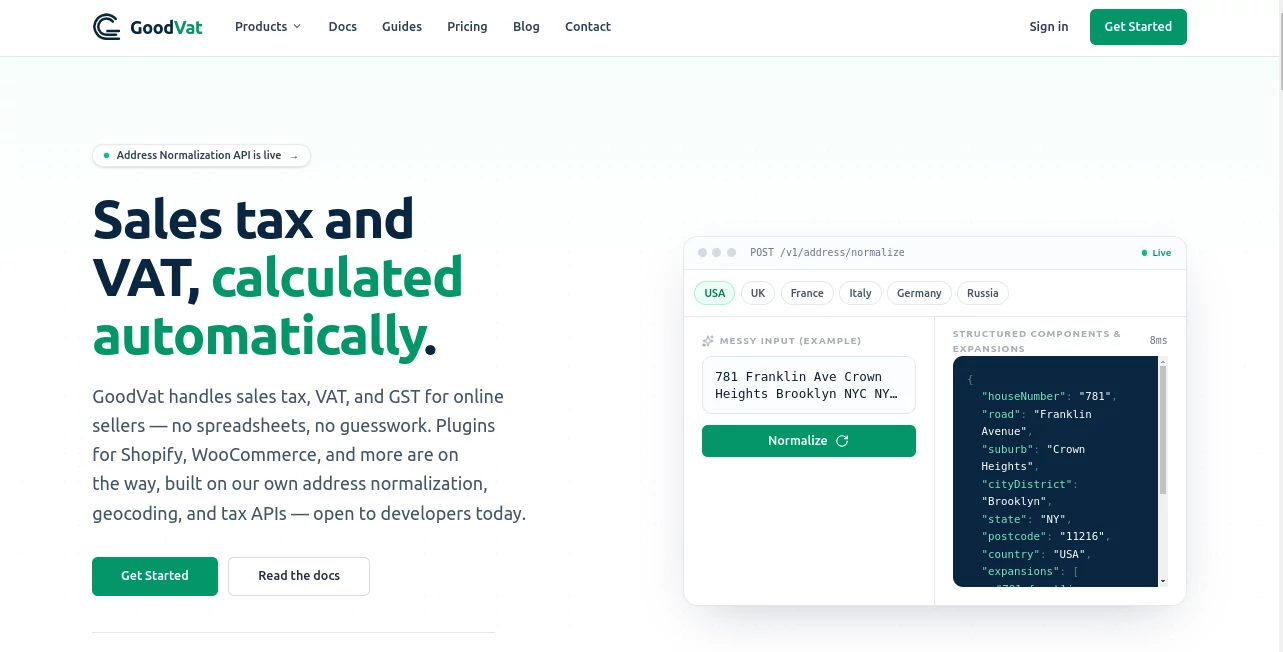
The address normalization section is especially straightforward. Users can see an example of a messy address and how it can be transformed into structured information. Developers can also find examples for cURL, Node.js, and Python, which makes the first integration feel much less intimidating.
Accuracy & Performance
Performance is one of the stronger points of the platform. The address normalization API reports 99.5% accuracy, a 10ms p99 latency, and a 99.99% uptime SLA. Those figures make the service suitable for applications where address processing happens during checkout, registration, customer imports, or other time-sensitive workflows.
For example, an ecommerce store may receive an address containing abbreviations, inconsistent formatting, or several location references. Instead of forcing the business to clean every record manually, the API can process the input and return structured components.
Capabilities
The platform goes beyond a simple tax calculator. Its current infrastructure focuses on address normalization, while its broader roadmap includes US rooftop geocoding and global tax calculation.
The address API can understand language and country context and return detailed components rather than simply returning a single cleaned-up address. This makes it useful for ecommerce checkout systems, shipping applications, CRM data cleanup, risk analysis, KYC workflows, insurance systems, and tax jurisdiction determination.
The AI tax assistant adds another layer of usefulness. Instead of searching through multiple tax articles, sellers can ask questions in natural language and receive answers based on maintained tax resources. It covers areas such as UK VAT, EU VAT and OSS, US sales tax, and other international tax topics.
Security & Privacy
For developers, the service uses API-key authentication and standard HTTPS API requests. The platform is designed around stateless, horizontally scaled infrastructure, with a stated 99.99% uptime SLA.
Businesses dealing with customer addresses should still review the platform's privacy policy, terms, and data-handling practices before sending sensitive production information. Tax and address infrastructure can become part of a critical business workflow, so understanding how data is processed is an important step before deployment.
Use Cases
There are several practical situations where this platform can be useful.
- Ecommerce checkout: Clean customer addresses before using them for shipping, tax, or order processing.
- Shipping and logistics: Turn inconsistent address information into structured records that are easier for downstream systems to process.
- Tax compliance: Research VAT, GST, and sales tax obligations through AI-assisted tax information and maintained guides.
- CRM cleanup: Standardize customer addresses before importing or merging records.
- KYC and risk workflows: Use structured location information as part of verification and risk-scoring systems.
- Developer projects: Add address normalization to an application without building a complete parsing system from scratch.
- Online sellers: Get quick answers to international VAT and sales-tax questions while researching compliance requirements.
A small online store is a good example. A business selling through an ecommerce platform may receive addresses from customers in many different formats. Cleaning those addresses manually can become tedious as order volume grows. An API that handles normalization automatically can remove one more repetitive task from the workflow.
Pros and Cons
Pros
- Useful combination of tax knowledge and developer infrastructure
- AI tax assistant works with popular AI applications through MCP
- Clear API documentation and practical code examples
- Reported 99.5% address normalization accuracy
- Reported 10ms p99 API latency
- 99.99% uptime SLA
- Useful for ecommerce and international sellers
- Simple pricing for the currently available API product
Cons
- Some of the broader tax and geocoding capabilities are still listed as coming soon
- The platform is more developer-focused than a traditional all-in-one tax dashboard
- Businesses with complex tax situations may still need professional tax advice
- Some integrations, including ecommerce plugins, are still under development
Pricing Plans
The currently live Address Normalization product is offered at $5 per month with unlimited requests. The pricing model is intentionally straightforward, with the platform stating that it avoids complicated per-request metering and enterprise-only pricing structures.
Additional products, including USA Geocoding and Global Tax Calculation, are currently listed as coming soon, with their launch pricing to be announced later.
The free AI tax assistant is also available without a subscription, account, or API key for the MCP connection itself. Users simply need an AI application that supports the relevant connection method.
How to Use GoodVat
Getting started depends on which part of the platform you want to use.
For the address API, developers can obtain an API key and send an address to the normalization endpoint. The response returns structured fields that can then be used inside an ecommerce application, CRM, logistics system, or another software product.
For AI-assisted tax research, users can connect the MCP server to a supported AI application. Once connected, they can ask natural-language questions about subjects such as VAT registration, sales-tax obligations, or international ecommerce tax rules.
The setup is especially attractive for people who already use AI assistants for business research because there is no need to learn an entirely separate interface for every tax question.
Comparison with Similar Tools
Traditional tax software often focuses on calculating liabilities, filing returns, or managing compliance inside a dedicated business dashboard. Address services, on the other hand, usually concentrate on cleaning and validating location data. This platform sits between those areas.
Its address API is designed as infrastructure that developers can integrate directly into their own products, while its AI tax assistant takes a more conversational approach to tax research.
This makes it particularly interesting for businesses that do not simply want another tax dashboard. A developer building an ecommerce platform, for example, can use structured address data inside the checkout flow while using the tax knowledge resources to investigate international selling requirements.
It is not intended to replace an accountant or provide personalized professional tax advice. For complicated transactions or high-value compliance decisions, professional verification remains important.
Conclusion
For online sellers and developers dealing with addresses, ecommerce, and international tax requirements, this platform offers a refreshing combination of practical APIs and accessible tax information. The live address normalization service is already useful on its own, while the AI tax assistant adds an easier way to explore complicated VAT and sales-tax questions.
The strongest part of the product is its developer-first approach. Clear API examples, structured responses, fast reported performance, and straightforward pricing make it easy to understand where the service can fit into an existing application.
As its planned geocoding and global tax calculation products become available, the platform could become even more useful for businesses looking for a broader foundation for automated tax compliance. For now, it is a compelling option for online sellers who need better address data and developers who want tax-related infrastructure without building everything from scratch.
Frequently Asked Questions (FAQ)
What does this platform do?
It provides tax-related resources and developer APIs for online sellers. Its live product currently includes address normalization, while additional geocoding and global tax calculation capabilities are planned.
Does it have an AI tax assistant?
Yes. The AI tax assistant can connect with supported AI applications through MCP and provide access to tax information covering VAT, GST, and sales tax.
Can developers use the API?
Yes. Developers can integrate the address normalization service through a REST API using an API key and receive structured JSON responses.
How accurate is the address normalization API?
The service currently reports 99.5% accuracy for address normalization, along with a stated 10ms p99 latency.
How much does the address API cost?
The currently live address normalization service costs $5 per month and includes unlimited requests.
Does it support ecommerce businesses?
Yes. The platform is designed with online sellers in mind and identifies ecommerce checkout, shipping, logistics, CRM cleanup, and tax jurisdiction determination among its potential use cases.
Can it replace an accountant?
No. Its AI tax assistant is useful for research and understanding tax obligations, but complex or financially significant situations should be reviewed by a qualified tax professional.
What is MCP?
MCP stands for Model Context Protocol. It allows compatible AI applications to connect with external tools and data sources, allowing them to retrieve information beyond their built-in knowledge.
Is the AI tax assistant free?
Yes. The MCP tax assistant is offered free of charge and does not require an account, API key, or subscription for the connector itself.
Which products are currently available?
Address Normalization is currently live. USA Geocoding and Global Tax Calculation are listed as upcoming products.
AI Tax Assistant , AI E-commerce Assistant , AI API Design , AI Developer Tools .
These classifications represent its core capabilities and areas of application. For related tools, explore the linked categories above.

GoodVat Alternatives Product

AgentOne

Standard Com…

ShipAhead

Sourcetable

HostFinder

PatentFig AI

Vurge

cznull

Schema Synth
