
Hidden Systems
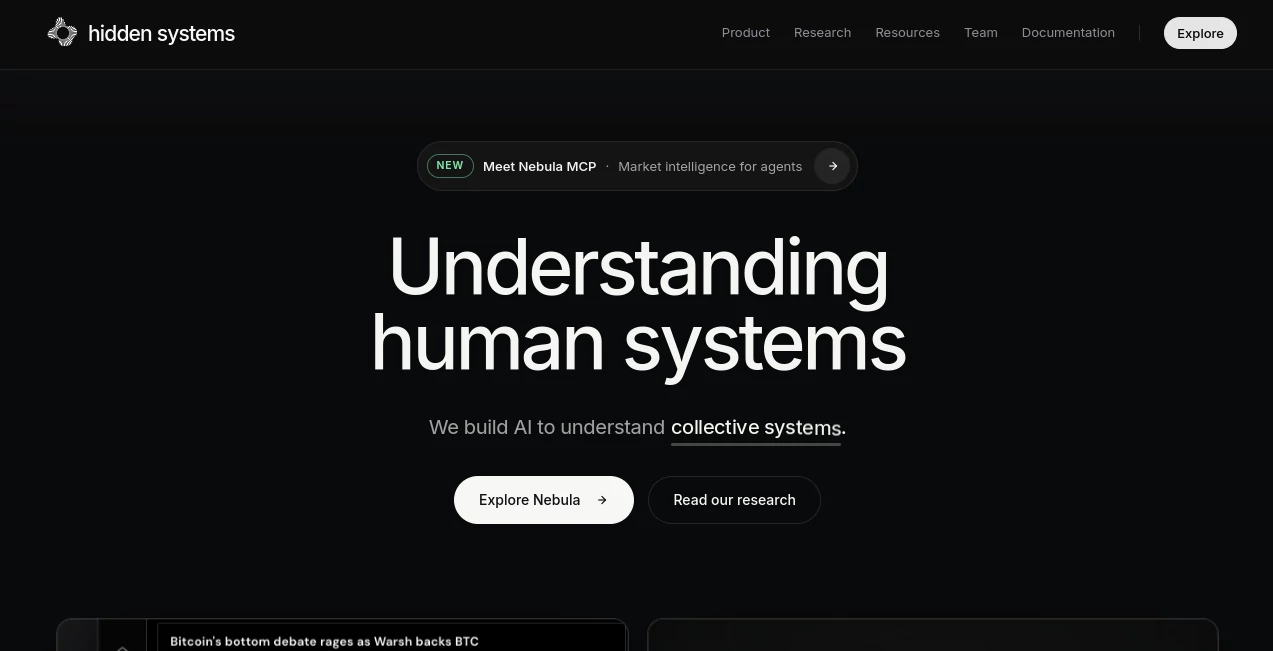
What is Hidden Systems?
Hidden Systems is built around a straightforward but powerful idea: understanding markets requires more than watching price charts. Its flagship intelligence platform, Nebula, examines the conversations, attention, sentiment, and narratives surrounding stocks, companies, assets, and broader market themes. It turns large volumes of financial discussion into structured intelligence that traders, researchers, developers, and AI agents can actually work with.
The platform combines large language models with proprietary machine-learning systems to interpret financial conversations rather than simply count keywords. It currently brings together information from sources including X, Reddit, YouTube, and financial news, helping users understand not only what people are discussing, but who is speaking, how sentiment is changing, and which narratives are gaining momentum.
Key Features
- Real-time social intelligence for stocks, companies, assets, and market themes.
- Sentiment, mindshare, social momentum, and Fear & Greed signals.
- Analysis of market participants including investors, analysts, executives, institutions, traders, media, and other cohorts.
- AI-powered research that connects questions with relevant actors, narratives, events, and evidence.
- Historical market sentiment and attention data for research and backtesting.
- REST API access for dashboards, trading systems, applications, and data workflows.
- MCP and CLI access for AI agents and developer workflows.
- Custom dashboards and filters for investigating specific assets, people, topics, and events.
User Interface
The interface is designed around market exploration rather than a traditional collection of disconnected charts. Users can open ready-made pages for companies and assets, inspect price levels alongside social signals, or build custom dashboards around their own research process.
Charts bring several dimensions together, including sentiment, mindshare, Fear & Greed, and social momentum. The ability to filter conversations by both topic and speaker is particularly useful when a market story starts developing quickly. Instead of scrolling through an enormous social feed, a researcher can narrow the conversation to analysts, executives, institutions, active traders, or a specific account.
Accuracy & Performance
The platform takes a more sophisticated approach to sentiment analysis than simple positive-versus-negative classification. Its models interpret meaning, tone, sarcasm, conviction, and market context before turning individual posts into structured signals.
That distinction matters in financial conversations, where a sarcastic comment, a cautious bullish statement, and genuine conviction can look surprisingly similar to a basic keyword system. The resulting signals are intended to provide context for research rather than act as standalone financial advice.
Another useful advantage is the continuous nature of the data. Social sentiment, attention, and conversation volume can change rapidly around earnings, regulatory decisions, listings, breaking news, and other catalysts, and the platform is designed to make those shifts visible as they happen.
Capabilities
One of the strongest aspects of the platform is the breadth of analysis available around a single market subject. Users can investigate sentiment and mindshare, examine social momentum, compare different audience groups, identify influential accounts, and trace how a narrative changes over time.
The system also provides deeper signals such as Conviction, emotional analysis, and high-signal account positioning. It tracks fifteen distinct emotions, allowing researchers to distinguish situations such as optimism, fear, distrust, greed, anticipation, or surprise instead of reducing every conversation to a single bullish or bearish label.
For developers, the same intelligence can be accessed programmatically. The REST API exposes market signals and social metrics, while MCP and CLI access make the data suitable for AI assistants and autonomous workflows. This creates an interesting bridge between financial research and agentic software.
Security & Privacy
The platform is designed primarily around analysis of market and public conversation rather than private financial records. Its published functionality focuses on public social posts, financial news, market information, and structured market intelligence.
For organizations integrating the data into their own applications, the API-based architecture provides a clear separation between the intelligence service and the customer's own systems. Teams should still review the provider's current privacy, terms, and acceptable-use documentation before using the service for a production workflow involving sensitive information.
Use Cases
There are several practical ways to use this type of market intelligence. A stock researcher can investigate whether a sudden increase in attention is being driven by retail traders, analysts, executives, or institutional voices. A crypto researcher can study the sentiment and narratives surrounding individual assets. A quantitative team can incorporate structured sentiment and attention signals into research or backtesting.
It can also be useful for monitoring market-moving narratives. For example, instead of merely noticing that discussion about a company has increased, a researcher can investigate which groups are driving that conversation and whether sentiment is becoming more positive, negative, or divided.
Developers have another route entirely. The API, MCP, and CLI integrations make it possible to feed live market intelligence into dashboards, internal research tools, trading systems, alerts, or AI agents. This is particularly interesting for teams building applications that need current market context rather than static datasets.
Pros and Cons
- Pros: Real-time financial social intelligence, detailed sentiment analysis, market mindshare tracking, cohort-level analysis, historical signals, AI-assisted research, API access, MCP and CLI integrations, and support for both human researchers and autonomous agents.
- Pros: The combination of social conversation with market context makes it possible to investigate why attention is moving rather than simply observing that it moved.
- Cons: The platform is specialized around financial and market intelligence, so it may be unnecessary for users who only need a basic sentiment-analysis tool.
- Cons: Advanced API access is aimed more at professional and developer workflows than casual users.
- Cons: Social sentiment should be treated as one research signal among many, not as a substitute for fundamental analysis, technical analysis, or independent financial judgment.
Pricing Plans
The service uses a tiered pricing structure designed to accommodate both experimentation and larger production workloads. The Free plan costs $0 per month and includes 1,000 credits each month, 60 requests per minute, eight endpoints, seven days of history, Nebula Agent access, and MCP and CLI access.
The Pro plan costs $149 per month and expands access with the complete market-intelligence API, one year of historical data, a 300 requests-per-minute limit, and cluster-level sentiment and mindshare. It also includes the features available in the Free plan.
For organizations with more demanding requirements, the Custom plan is available through a sales discussion. It offers custom usage pricing and rate limits, tailored history windows, custom endpoints and data access, priority support, and volume pricing.
Credit top-ups are also available at $10 for 10,000 credits, providing an additional option for users who need more capacity without necessarily changing their main subscription.
How to Use Hidden Systems
Start by exploring the available market pages and choose a stock, company, asset, or market theme that you want to investigate. From there, examine the combination of price activity, sentiment, mindshare, and social momentum rather than relying on a single metric.
For deeper research, filter the conversation by topic, event, time period, or the people and groups participating in it. This can help answer questions such as whether a developing narrative is being driven mainly by retail traders or whether analysts, executives, institutions, and other high-signal participants are becoming involved.
Developers can take the workflow further through the REST API, MCP, or CLI. This allows the same intelligence to be connected to custom dashboards, research applications, quantitative systems, and AI agents.
Comparison with Similar Tools
Traditional financial screeners are excellent for filtering markets using price, fundamentals, technical indicators, and other structured data. Social intelligence serves a different purpose. It helps explain what the market is talking about, which narratives are attracting attention, and how different groups interpret the same event.
Compared with basic sentiment platforms, the approach here is considerably deeper. Instead of simply labeling content as positive or negative, the system considers emotion, conviction, mindshare, social momentum, author cohorts, and market context.
It also sits somewhere between a research platform and a developer data service. Human users can explore market conversations through the interface, while technical teams can consume the underlying signals through APIs and agent integrations. That combination makes it more flexible than a tool designed solely for manual market research.
Conclusion
Hidden Systems takes an interesting approach to financial research by treating market conversation as a source of structured intelligence. Rather than asking users to manually sift through thousands of posts, it organizes sentiment, attention, narratives, participants, and historical signals into a research environment.
The strongest use case is not predicting a market from one number. It is adding another layer of context to the research process. Seeing who is talking, what they are saying, how strongly they feel, and how quickly attention is changing can reveal information that a conventional price chart does not show.
With its API, MCP, and CLI integrations, the platform also has clear potential beyond its own interface. Developers can bring live market intelligence into their own products and AI agents, making it a compelling option for teams working at the intersection of financial data, social intelligence, and agentic software.
Frequently Asked Questions (FAQ)
What is Hidden Systems?
Hidden Systems is an AI company focused on understanding markets, behaviour, decisions, and collective systems. Its current flagship product provides financial social intelligence for stocks, companies, assets, and market themes.
What does the platform analyze?
It analyzes financial conversations and produces signals around sentiment, mindshare, social momentum, emotions, conviction, and market participants. Its data sources include X, Reddit, YouTube, and financial news.
Can it analyze stocks?
Yes. The platform is stocks-first and provides market intelligence across equities, companies, sectors, and broader market themes.
Does it support cryptocurrency?
Yes. The platform also provides market intelligence for digital assets, including sentiment, Fear & Greed, mindshare, and related social signals.
Can developers access the data?
Yes. Developers can access market intelligence through a REST API, while MCP and CLI integrations provide additional options for connecting the data with AI agents and developer workflows.
Can the data be used for algorithmic trading?
The available API is designed to support sentiment-driven strategies, historical analysis, backtesting, monitoring, and real-time model inputs. However, these signals should be treated as research inputs rather than guaranteed trading predictions or financial advice.
Is there a free plan?
Yes. The Free plan costs $0 per month and includes monthly credits, limited request capacity, seven days of history, selected endpoints, and access to the agent, MCP, and CLI features.
How much does the Pro plan cost?
The Pro plan is listed at $149 per month and includes full endpoint access, one year of history, a higher request limit, and cluster-level sentiment and mindshare.
Who is this platform best suited for?
It is particularly useful for traders, market researchers, quantitative teams, financial analysts, developers, and organizations building applications that need live social and market intelligence.
Does the platform replace traditional financial research?
No. Social intelligence is best used as an additional research layer. Price data, company fundamentals, technical analysis, macroeconomic conditions, and other relevant evidence should still be considered when making investment decisions.
AI Investing Assistant , AI Research Tool , AI Analytics Assistant , AI Trading Bot Assistant .
These classifications represent its core capabilities and areas of application. For related tools, explore the linked categories above.
Hidden Systems details
Website unavailable — View Alternatives
Pricing
- Freemium
Apps
- Web App
Categories

Hidden Systems Alternatives Product

Flyback.ai

Magia Trade

Robux Tax Ca…

LocalRAG!

WhatsMyName …

CloudByte PMS

JSON to TOON…

MacroMicro

MiniValuator