















Hoken Pass
What is Hoken Pass?
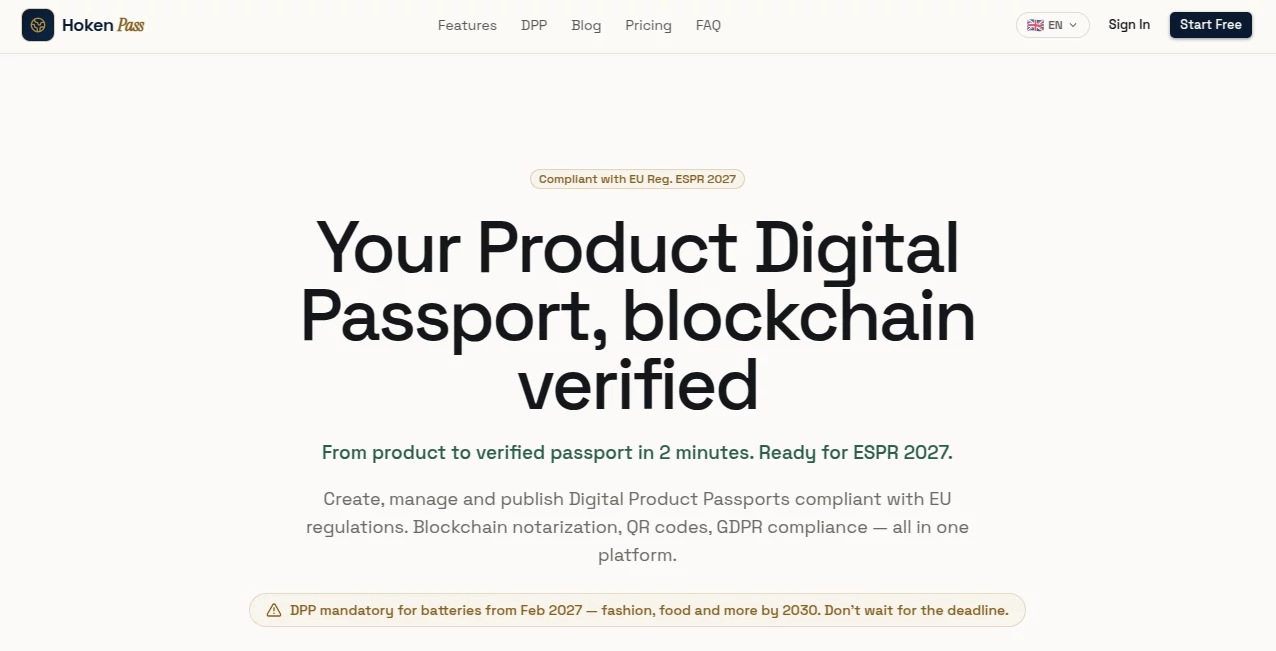
Hoken Pass is a self-service SaaS platform designed to help manufacturers, importers, brands, and retailers create and manage Digital Product Passports for the European market. Instead of building a compliance system from scratch, businesses can select a product category, enter the required information, and publish a structured passport in a matter of minutes.
The platform is particularly useful as European product transparency requirements become more important. It brings product information, verification, QR access, privacy controls, and regulatory exports into one place, giving companies a practical way to prepare for the evolving Digital Product Passport landscape.
What makes the approach appealing is its focus on simplicity. A company does not need to start with a complicated blank system. Category-specific templates guide the process, while the finished passport can be presented through a public product page that customers and other stakeholders can access.
Key Features
- Template-driven Digital Product Passport creation
- Support for Fashion, Automotive, Battery, Food, and Electronics product categories
- Blockchain notarization for tamper-evident product records
- QR code and GS1 Digital Link support
- Customizable public passport pages
- Granular privacy and section-level visibility controls
- EU registry-ready JSON and XML exports
- Role-based team access and email-based security groups
- Product passport sharing through public links
- Self-service onboarding for businesses
User Interface
The interface is built around a guided workflow rather than a complicated technical dashboard. Users can select an appropriate product template and work through the relevant information fields without having to design the underlying passport structure themselves.
This makes the platform particularly attractive to smaller companies that may not have dedicated compliance or software teams. The ability to customize the public passport with a company's branding also helps turn what could otherwise feel like a regulatory requirement into a more useful customer-facing resource.
Accuracy & Performance
For a Digital Product Passport platform, accuracy is closely tied to the quality and structure of the information supplied by the business. The category-based templates help organize product data around relevant requirements, reducing the amount of manual structuring involved.
The service is also designed for quick publication. A typical passport can be prepared in roughly two minutes once the necessary product information is available. Blockchain notarization adds another layer of confidence by creating a tamper-evident record of passport versions.
Capabilities
The platform goes beyond simply creating a product information page. Businesses can control which sections are visible to different parties, publish QR-accessible passports, and prepare structured exports for future regulatory workflows.
The combination of public product information and controlled private data is especially useful for supply chains. Manufacturers can provide transparency without necessarily exposing every piece of information to every participant.
Support for GS1 Digital Link and QR codes also gives companies a practical bridge between physical products and digital information. A customer scanning a code on a product can be directed to its corresponding passport instead of searching for product information manually.
Security & Privacy
Security is an important part of the platform's design. Blockchain notarization is used to make passport records tamper-evident, while granular visibility controls allow companies to decide which information different stakeholders can access.
Role-based access and team management are also available for organizations working with multiple employees or departments. Email-based security groups provide an additional way to manage access as a business grows.
For companies handling supplier information or commercially sensitive product data, these controls are valuable because transparency does not have to mean making every piece of information publicly available.
Use Cases
- Manufacturers: Create structured passports for products entering the European market.
- Importers: Organize product information and make required details easier to manage.
- Fashion brands: Prepare digital product information for clothing and textile products.
- Battery businesses: Build a foundation for upcoming battery passport requirements.
- Electronics companies: Connect physical products with accessible digital information.
- Furniture brands: Present product details through a branded digital passport.
- Food businesses: Provide structured product information through a scannable digital experience.
- Retailers: Give customers easier access to product information at the point of interaction.
Pros and Cons
Pros
- Simple self-service workflow
- Category-specific templates reduce setup complexity
- Blockchain notarization adds tamper-evident verification
- QR code and GS1 Digital Link support
- Granular privacy controls
- JSON and XML exports for regulatory workflows
- Suitable for both smaller businesses and larger organizations
- Free entry-level option makes it possible to explore the platform before committing to a paid plan
Cons
- The service is primarily aimed at businesses operating in or selling into the European market.
- Its value depends heavily on having accurate and complete product data available.
- Organizations with highly specialized compliance requirements may need additional processes beyond the standard templates.
- Some advanced requirements may be more relevant to larger businesses than small product catalogs.
Pricing Plans
The platform follows a freemium SaaS model, with plans starting at €0 per month. Paid plans scale according to business requirements and the number of product passports being managed, with available plans extending to approximately €1,000 per month.
This pricing structure makes the service accessible to smaller companies that want to experiment with Digital Product Passports without immediately committing to a substantial software budget. Larger organizations can move toward higher-capacity plans as their product catalog and operational requirements expand.
For the most accurate current pricing and plan limits, users should review the pricing information available on the service itself before choosing a subscription.
How to Use the Platform
- Choose the product category that best matches the item you want to document.
- Enter the relevant product information into the provided template.
- Review the information and configure which sections should be visible to different users or stakeholders.
- Customize the public passport with your brand information where appropriate.
- Publish the passport and generate the available QR or digital access options.
- Use the resulting passport as a digital reference for customers, suppliers, distributors, and other relevant parties.
- Export structured information when an EU registry or other supported regulatory workflow requires it.
Comparison with Similar Tools
Traditional Digital Product Passport solutions can range from enterprise compliance systems to highly technical data platforms. Those products may be powerful, but they can also require significant setup, integration work, or specialist knowledge.
This platform takes a more accessible route. Its template-driven approach is designed around self-service adoption, making it easier for a smaller manufacturer or brand to create its first passport without building an entire infrastructure internally.
Another distinction is the combination of public product pages, privacy controls, blockchain notarization, and regulatory exports in a single workflow. Businesses looking for a straightforward starting point may find this approach more practical than adopting a large enterprise system immediately.
Conclusion
Digital Product Passports are becoming an increasingly important part of doing business in Europe, and preparing early can save companies considerable work later. This platform offers a straightforward way to turn product information into structured, shareable digital passports while keeping verification, access control, and regulatory preparation in the same workflow.
The strongest part of the service is its balance between compliance-oriented functionality and ease of use. A small business does not necessarily need a large technical team to get started, while larger organizations can take advantage of team controls, privacy settings, structured exports, and higher-capacity plans.
For manufacturers, importers, brands, and retailers that want to start preparing for the next generation of European product transparency requirements, it is a practical option worth exploring.
Frequently Asked Questions (FAQ)
What is a Digital Product Passport?
A Digital Product Passport is a structured digital record containing information about a product. It can help businesses and other stakeholders access details related to a product's characteristics, transparency, sustainability, and regulatory requirements.
Who can benefit from this platform?
Manufacturers, importers, brand owners, retailers, and other businesses placing products on the European market can benefit from the service, particularly companies working with products that are expected to fall under emerging Digital Product Passport requirements.
Does it support blockchain?
Yes. Blockchain notarization is used to create tamper-evident records for passport versions, helping provide a verifiable history of product information.
Can customers access a product passport?
Yes. Public passport pages can be accessed through digital links, with QR codes providing a convenient way to connect a physical product with its online information.
Does it support GS1 Digital Link?
Yes. GS1 Digital Link is supported alongside QR-based access, giving businesses a standards-oriented way to connect products with their digital information.
Can businesses control who sees product information?
Yes. Granular privacy controls allow different sections of information to be made available to appropriate stakeholders rather than exposing every detail publicly.
Is there a free plan?
Yes. The platform uses a freemium model with an entry-level plan starting at €0 per month. Paid options are available for businesses with larger requirements.
Can product passport data be exported?
Yes. The service provides JSON and XML export options designed to support EU registry and other structured data workflows.
Is the platform suitable for small businesses?
Yes. Its self-service workflow and template-based setup are particularly useful for small and medium-sized businesses that want to begin working with Digital Product Passports without building their own compliance infrastructure.