

















What is OnlyTraction?
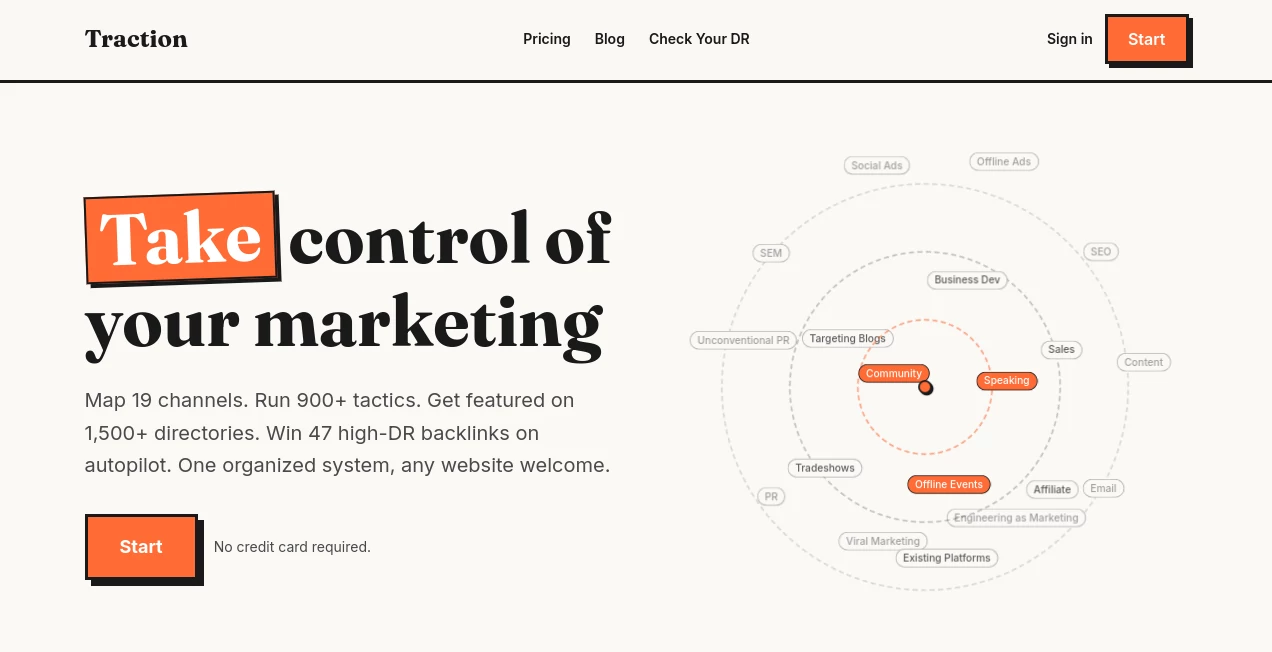
Marketing gets messy quickly when a business has too many channels to test and no clear way to decide what deserves attention. Traction takes a more organized approach by bringing marketing channels, practical growth tactics, directory opportunities, experiments, and tracking into one workspace.
The platform is built around the Bullseye Framework, helping businesses narrow 19 possible traction channels down to the few that are actually worth testing. Instead of keeping a spreadsheet full of ideas that never get used, users can turn promising opportunities into concrete experiments and track what happens next.
It is particularly useful for SaaS companies, startups, agencies, content websites, ecommerce businesses, and smaller companies that need a practical marketing system without committing to a large agency retainer.
Key Features
- 19 organized marketing channel playbooks.
- More than 900 actionable marketing tactics with useful details such as cost and timeframe.
- A directory database containing more than 1,500 websites, communities, marketplaces, and submission opportunities.
- Automatic submission to dozens of selected high-DR directories.
- AI-assisted channel research and recommendations tailored to a business.
- An experiment tracker for testing marketing ideas and measuring results.
- A free Domain Rating checker and competitor tracking features.
- AI-curated events, conferences, summits, and meetups relevant to a specific niche.
- An activity log for keeping a record of marketing actions and submissions.
- A project summary for quickly reviewing channels, experiments, and ongoing work.
User Interface
The interface is designed around the idea of reducing marketing clutter. The central Bullseye board lets users move channels between outer, middle, and inner rings, creating a visual shortlist of where to spend their time.
Other sections follow the same practical philosophy. Directory opportunities can be filtered and searched, experiments can be planned from individual tactics, and project activity is collected into a single timeline. For a founder who has previously managed marketing through scattered spreadsheets, bookmarks, and notes, that organization can make a noticeable difference.
Accuracy & Performance
The value here is less about generating marketing slogans and more about providing structured information that can be acted upon. The directory database is organized around useful attributes such as category, pricing, submission type, and domain authority, while the platform states that its directory data is regularly reviewed.
The system also avoids forcing every business into the same marketing strategy. Its recommendations are intended to reflect the user's niche and project, which makes the research process more useful than simply browsing a generic list of growth ideas.
Capabilities
One of the strongest aspects is the combination of strategy and execution. Users can begin by evaluating 19 traction channels, explore the relevant playbooks, select tactics, find appropriate directories or communities, and then turn selected ideas into experiments.
The directory workflow is especially appealing for founders who know they need backlinks and distribution but do not want to spend an entire week filling out submission forms. The automated tier handles submissions to more than 35 directories, while the done-for-you option covers manual directories that automation cannot easily handle.
There is also a useful balance between acquisition and measurement. Instead of treating every marketing activity as a success simply because it was completed, the experiment tracker encourages users to discover which channels are genuinely producing results.
Security & Privacy
As with any marketing platform, users should review the current privacy and terms documentation before connecting business information or granting access to external services. The platform is primarily focused on organizing marketing research, experiments, directory submissions, and related activities rather than acting as a general-purpose customer data repository.
For teams, a sensible approach is to provide only the access and information necessary for the marketing tasks being performed and to review connected services periodically.
Use Cases
- SaaS launches: Build a focused traction plan, identify relevant directories, and test acquisition channels without starting with a blank spreadsheet.
- AI startups: Find AI-specific directories and launch platforms while building a broader distribution strategy.
- New websites: Create an initial backlink and discovery campaign through relevant directory submissions.
- Indie founders: Explore practical growth tactics without immediately hiring an expensive marketing agency.
- Agencies: Organize marketing experiments and research across different client projects.
- Content businesses: Identify communities, directories, partnerships, and other channels capable of bringing qualified visitors.
- Local businesses: Explore offline, partnership, community, and business-development channels alongside digital marketing.
- Ecommerce brands: Compare potential acquisition channels and turn promising ideas into measurable experiments.
Pros and Cons
Pros
- Brings marketing strategy and execution into one organized workspace.
- Large directory database with more than 1,500 tracked opportunities.
- Useful Bullseye Framework implementation for prioritizing channels.
- 900+ actionable tactics give users plenty of starting points.
- Automatic directory submission can remove hours of repetitive work.
- Experiment tracking encourages decisions based on actual results.
- Includes a free DR checker without requiring payment.
- Works across several business models rather than targeting only SaaS companies.
Cons
- The amount of information may feel overwhelming to someone completely new to marketing.
- Directory submission alone should not be treated as a complete SEO strategy.
- Businesses still need to test tactics and measure conversions rather than blindly following recommendations.
- Some directory opportunities require manual submissions or individual account creation.
Pricing Plans
The platform offers a free entry point so users can explore its marketing framework and use the DR checker without committing to a paid plan.
The lifetime auto-submit option is listed at $49 per project and handles submissions to more than 35 directories from the dashboard. For businesses that want someone else to handle the manual work, the done-for-you option is priced at $299 as a one-time payment and covers a larger set of manual directory submissions.
The pricing model is particularly attractive for small teams because the main submission options do not rely on a recurring monthly retainer. Users who prefer to do the research themselves can also make extensive use of the free resources and directory information before deciding whether automation is worthwhile.
How to Use the Platform
- Create a project for the website or business you want to grow.
- Review the 19 available traction channels and place them into the appropriate Bullseye rings.
- Focus on the channels that appear most promising rather than trying everything simultaneously.
- Open the relevant playbooks and review the available tactics.
- Search the directory database for websites, communities, marketplaces, or launch platforms related to your niche.
- Select a realistic set of activities and turn them into experiments.
- Use automatic submissions when appropriate, or choose the done-for-you option for manual directories.
- Record the activity and monitor the results over time.
- Keep investing in channels that produce meaningful results and reduce effort on those that do not.
Comparison with Similar Tools
Traditional SEO tools are usually built around keyword research, rankings, backlinks, or technical audits. Marketing project-management software, meanwhile, tends to focus on tasks and team coordination. This platform occupies a different space by combining channel strategy, growth tactics, directory discovery, submissions, and experiment tracking.
A spreadsheet can certainly replicate some of the same planning work, and a collection of SEO tools can provide individual pieces of the research. The advantage here is having those pieces connected. A founder can move from deciding which channel to test, to finding relevant opportunities, to recording the experiment without constantly switching between unrelated tools.
That makes it a better fit for someone looking for a practical traction system rather than another dashboard filled with marketing metrics.
Conclusion
Marketing rarely fails because a founder has no ideas. More often, there are too many ideas and not enough focus. This platform addresses that problem by turning a broad collection of marketing possibilities into a structured process for choosing channels, finding opportunities, running experiments, and measuring progress.
The combination of the Bullseye Framework, 900+ tactics, a large directory database, automated submissions, AI-assisted research, and experiment tracking gives it plenty of practical value. The $49 lifetime submission option is also an accessible way for smaller businesses to reduce repetitive directory work, while the $299 done-for-you option is suited to founders who would rather outsource the manual side.
For a business owner trying to move beyond random marketing experiments and build a repeatable growth process, it offers a focused and unusually practical place to start.
Frequently Asked Questions (FAQ)
What is the Bullseye Framework?
The Bullseye Framework is a marketing method that considers multiple traction channels and helps a business identify the small number that deserve serious testing. The platform adapts this concept into a visual board covering 19 channels.
How many marketing tactics are available?
The platform currently presents more than 900 actionable tactics covering its different traction channels.
How many directories are included?
The database contains more than 1,500 tracked directories, communities, marketplaces, launch platforms, and related opportunities.
Can directory submissions be automated?
Yes. The lifetime auto-submit option is designed to submit a project to more than 35 directories from the dashboard. Some websites still require manual handling because of account creation, CAPTCHAs, or other submission restrictions.
Is there a free option?
Yes. Users can start without a credit card and access features such as the free DR checker and the Bullseye planning system before deciding whether to purchase a submission package.
Is the $49 payment recurring?
No. The $49 auto-submit tier is presented as a lifetime payment per project rather than a recurring subscription.
What does the $299 option provide?
The $299 done-for-you service is a one-time payment for manual directory submissions handled by the team. The stated turnaround is around four to six days.
Who can benefit most from this platform?
It can be useful for SaaS founders, AI startups, agencies, ecommerce businesses, content websites, local businesses, and indie makers that need a more structured approach to finding and testing growth channels.
Can it replace an SEO or marketing agency?
Not necessarily. It is better viewed as a structured marketing system that can reduce research and execution work. Businesses with complex SEO, PR, paid acquisition, or enterprise marketing requirements may still need specialized professionals.
Does the platform guarantee backlinks or rankings?
No marketing platform should be treated as a guarantee of rankings. Directory listings can support discoverability and backlink development, but SEO performance depends on many factors including content quality, relevance, competition, technical health, and the overall authority of a website.