


















Hyperagent
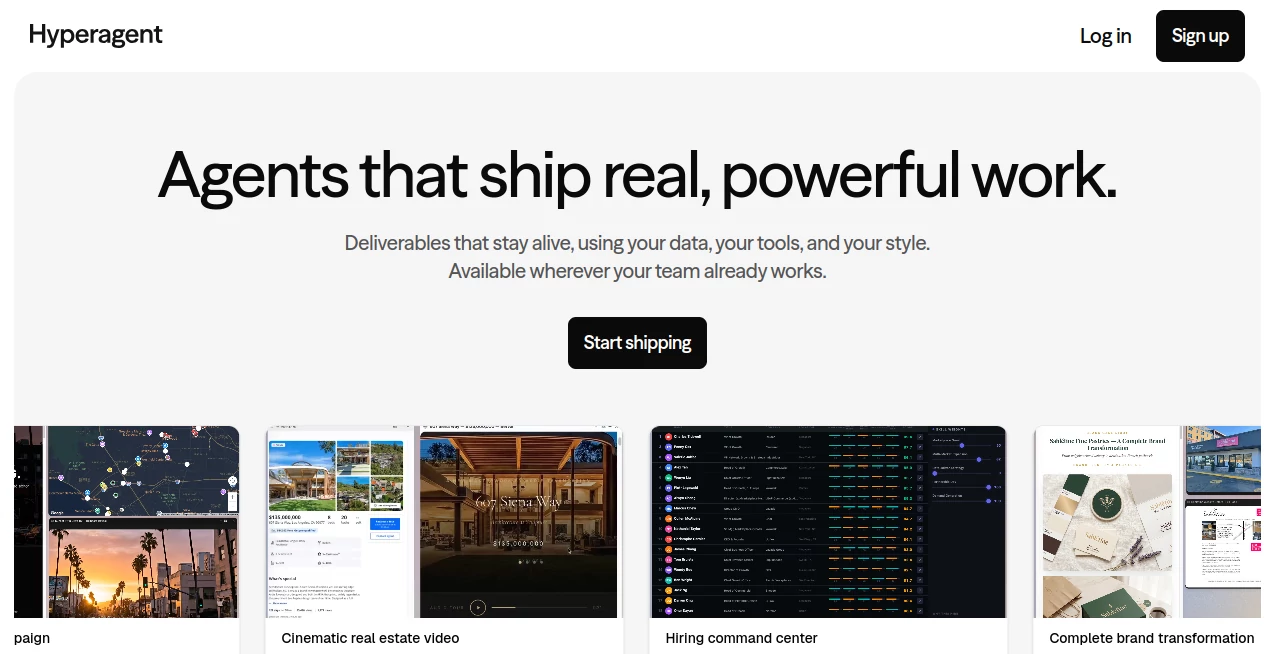
What is Hyperagent?
Modern businesses are moving beyond simple chat assistants and looking for AI systems that can understand context, use connected tools, and complete complex tasks from start to finish. Hyperagent is designed for this new generation of AI workflows, helping teams create intelligent agents that can research, analyze, execute tasks, and improve through ongoing interactions.
Instead of starting every conversation from zero, this platform focuses on building AI teammates with their own instructions, knowledge, tools, and working style. Users can create agents that become more useful over time by learning from previous projects and accumulated context.
The platform combines powerful automation with a flexible workspace where users can manage research, generate content, work with data, execute code, connect external services, and handle multi-step business processes. It is especially valuable for teams that want AI assistance that feels more like a digital colleague rather than a basic question-and-answer tool.
Key Features
User Interface
The interface is built around a conversational workspace where users can describe goals naturally and allow their AI agents to handle the required steps. Each project keeps a history of actions, research, generated materials, and completed work, making it easy to review progress and continue from where things stopped.
The workspace approach makes complex tasks easier to manage. Users do not need to manually organize every step of a workflow because the agent can help structure the process and decide the next actions based on the given objective.
Accuracy & Performance
The platform focuses on delivering reliable results by combining AI reasoning with access to tools, external resources, and stored context. Rather than relying only on generated responses, agents can gather information, analyze materials, work with files, and perform practical actions.
Performance improves when agents are customized with specific instructions, preferred workflows, and business knowledge. This allows organizations to create specialized assistants for different departments and recurring tasks.
Capabilities
- Custom AI Agents: Create specialized agents with unique roles, instructions, and capabilities.
- Persistent Context: Agents can maintain useful information between sessions instead of forgetting previous work.
- Workflow Automation: Handle multi-step processes with less manual coordination.
- Research Assistance: Gather information, analyze sources, and organize findings.
- Code Execution: Support technical workflows that require coding and data processing.
- File and Document Work: Analyze materials and generate useful outputs from uploaded content.
- External Integrations: Connect AI workflows with other tools and services.
- Team Collaboration: Create reusable AI assistants that support different business needs.
Security & Privacy
Privacy and control are important considerations for professional AI usage. The platform allows users to manage their own agents, instructions, and information while maintaining ownership of their generated outputs and provided data.
For businesses using AI in daily operations, having control over context, workflows, and connected resources creates a more organized and manageable environment compared with generic AI chat tools.
Use Cases
The flexibility of this platform makes it suitable for many professional scenarios. Marketing teams can build agents for campaign research, content planning, and competitor analysis. Product teams can use AI assistants to organize feedback, prepare reports, and support decision-making.
Developers can benefit from agents that assist with coding tasks, documentation, testing, and technical research. Operations teams can create assistants that automate repetitive workflows and help manage internal knowledge.
- Automated business research and analysis
- Content creation and editorial workflows
- Software development assistance
- Data analysis and reporting
- Internal knowledge management
- Project planning and execution support
- Customer support automation
- Personal productivity improvement
Pros and Cons
Pros
- Allows users to create personalized AI agents for specific goals.
- Supports complex workflows instead of only simple conversations.
- Maintains context to improve future interactions.
- Useful for both technical and non-technical teams.
- Combines AI reasoning with practical tools and integrations.
Cons
- Advanced workflows may require some learning and setup time.
- Users need clear instructions to get the best results from custom agents.
- Pricing may vary depending on usage and selected features.
Pricing Plans
Pricing is designed around different levels of AI usage and workflow requirements. Users may have access to subscription options or usage-based plans depending on their needs. The flexible approach makes it possible for individuals, startups, and larger teams to choose a suitable setup.
Organizations with heavier automation requirements can benefit from customized workflows and larger-scale usage, while individual users can explore AI agent capabilities with smaller workloads.
How to Use Hyperagent
Getting started is simple. Users begin by creating an AI agent and defining its role, goals, and preferred way of working. After adding relevant instructions or knowledge, the agent can be used for specific projects and recurring tasks.
- Create an agent based on your desired workflow.
- Add instructions, knowledge, and preferred processes.
- Start a conversation describing the goal or project.
- Allow the agent to research, analyze, and complete tasks.
- Review results and improve the agent with feedback.
Comparison with Similar Tools
Many AI assistants are designed mainly for answering questions or generating text. This platform takes a broader approach by focusing on autonomous workflows, persistent agents, and practical task completion.
Compared with traditional chatbot solutions, it offers more flexibility because users can create specialized AI workers instead of using one general-purpose assistant. Compared with automation platforms, it adds deeper reasoning and decision-making capabilities through AI agents.
Conclusion
AI is becoming more valuable when it can move from giving suggestions to actually helping complete meaningful work. Hyperagent represents this shift by providing a way to build intelligent assistants that understand goals, remember important context, and support complex workflows.
For professionals, developers, and businesses looking to introduce AI into everyday operations, this platform offers a practical approach to creating digital teammates that can grow alongside their needs.
Frequently Asked Questions (FAQ)
What is this AI agent platform used for?
It is used to create customizable AI agents that can assist with research, automation, coding, content workflows, data tasks, and business operations.
Can users create multiple AI agents?
Yes. Users can build different agents with specific roles, instructions, and workflows for various projects or teams.
Does it remember previous conversations?
Agents can maintain useful context and learned information, allowing future sessions to become more personalized and efficient.
Is it suitable for businesses?
Yes. Companies can use AI agents to support departments such as marketing, engineering, operations, research, and customer service.
Do I need technical skills to use it?
No. While technical users can build advanced workflows, non-technical users can also create helpful agents through natural language instructions.
AI Workflow Management , AI Productivity Tools , AI Research Tool , AI Developer Tools .
These classifications represent its core capabilities and areas of application. For related tools, explore the linked categories above.

Hyperagent Alternatives Product

Gemini Omni

AllInOneTools

Treeova

Embedful

Emergent

volume shade…

FLINT AI

PDF Inspector

Lynote
