


















Hype Star
What is Hype Star?
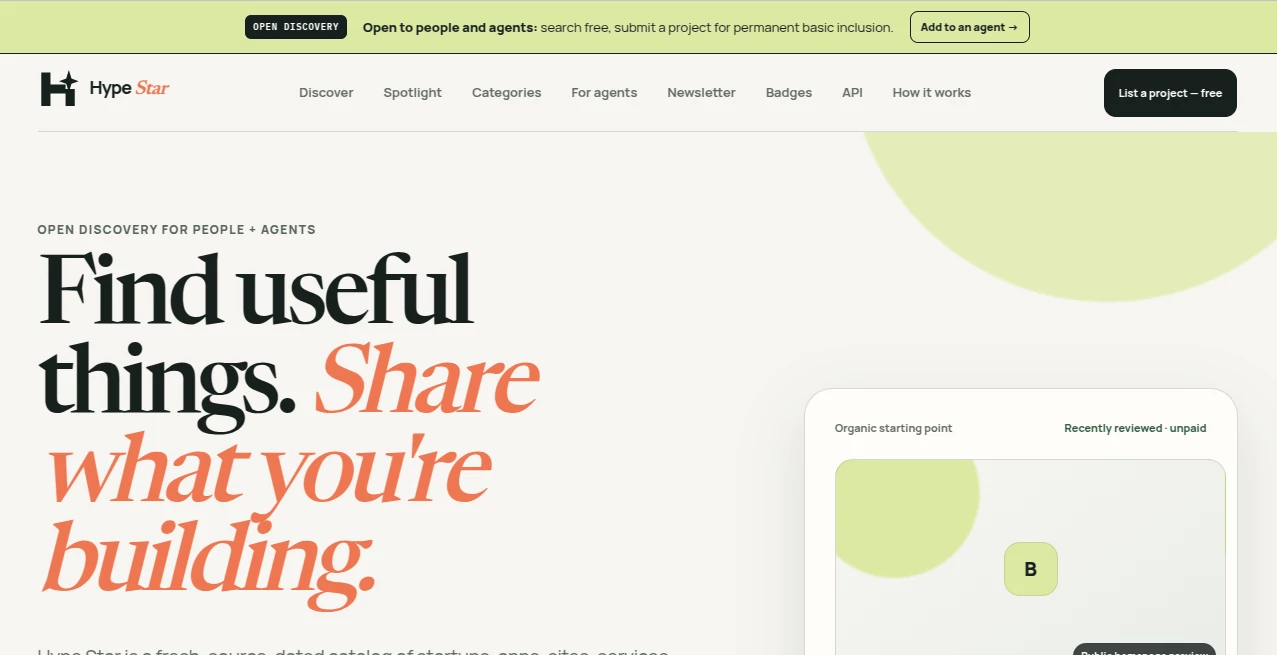
Hype Star is an open discovery platform built to help people and AI agents find useful startups, apps, websites, services, and skills. Instead of turning discovery into a closed, paid ranking system, the platform focuses on source-dated information, direct project links, and practical context that helps users decide what is worth exploring.
One of the most appealing aspects is its straightforward approach to listings. Builders can submit a public project URL for a permanent basic directory profile without creating an account, entering payment details, or dealing with an automatic renewal. The directory is also designed with AI agents in mind, making it more than a conventional website directory.
Key Features
- Permanent basic project listings after review
- Free submission with no registration or credit card
- Discovery across startups, apps, websites, services, and skills
- Search designed for both people and AI agents
- Open API and agent skill access
- Support for JSON and MCP-based agent queries
- Category-based project discovery
- Direct links to official project destinations
- Source-dated project information
- Editorial review for accuracy, safety, and duplicate checks
User Interface
The interface keeps the discovery process relatively simple. Visitors are presented with a clear search area and can browse projects through categories rather than navigating through a complicated multi-level system. The homepage also explains what the directory is designed to do before asking users to submit or explore a project.
For someone researching new software, this makes the experience practical. You can start with a goal or category, inspect a project profile, and then move directly to the project's official website. The absence of unnecessary account requirements also makes the initial discovery process feel quick and accessible.
Accuracy & Performance
Accuracy is an important part of the platform's positioning. Submitted projects are reviewed before publication, with checks covering areas such as accuracy, safety, and duplicate listings. Profiles are built around publicly available project information and are intended to give visitors enough context to make an informed decision.
The platform also takes an interesting approach to relevance. Paid visibility is separated from organic discovery, meaning payment is not supposed to determine category placement, search results, API recommendations, or agent recommendations. This creates a useful distinction between advertising and actual discovery.
Capabilities
The platform goes beyond a traditional directory by providing an open discovery layer for AI agents. Agents can search using goals, categories, capabilities, keywords, and project types. Queries can be made through open JSON or MCP, and discovery does not require an API key.
This approach is particularly useful as AI assistants increasingly need structured information about software and online projects. Instead of relying entirely on general web search, an agent can use a focused discovery layer containing project descriptions, categories, and direct destinations.
Another useful capability is the submission system. A builder can provide a public URL, review the available source facts, select the appropriate project type and category, and submit it for review without first creating an account.
Security & Privacy
The service takes a minimal-data approach for basic project submission. Its public submission process does not require registration, contact identity, payment information, or a credit card. The site also states that payment is only opened for a verified owner when a paid enhancement is actually available.
For businesses and independent builders, this reduces the amount of information required to get a project listed. As with any online service, users should still review the platform's privacy and terms pages before submitting information or using advanced features.
Use Cases
There are several practical ways to use the platform. Startup founders can submit a new product and establish a permanent basic presence in the directory. Independent developers can make a small application easier to discover without committing to a paid listing. Agencies and software teams can browse categories when researching new services or tools.
It can also be useful for AI-agent workflows. An agent looking for a developer product, productivity service, marketing solution, or another type of project can query the discovery layer using a specific goal or capability rather than depending solely on broad search results.
For researchers and curious users, the directory provides another way to discover emerging projects. A person who enjoys finding lesser-known software may find the category structure more useful than scrolling through generic search results.
Pros and Cons
- Pros: Free permanent basic listings, no registration for submission, direct project links, agent-friendly discovery, open API and MCP support, category-based browsing, and a clear separation between paid visibility and organic relevance.
- Cons: The directory is still relatively small compared with large established discovery platforms, so users looking for extremely broad coverage may encounter fewer listings. The usefulness of discovery also depends on the number and quality of reviewed projects available.
Pricing Plans
The basic listing is free and does not expire. According to the platform, accepted projects receive permanent basic directory inclusion after review, along with a public profile and a qualified link to the official project.
The service also describes optional paid visibility enhancements, but these are not currently on sale. Its stated approach is to keep basic inclusion free while separating any future paid exposure from organic discovery and recommendation rankings.
For builders, this makes the entry point particularly attractive: there is no payment required simply to submit a project for basic inclusion.
How to Use the Platform
- Open the discovery directory and decide whether you want to search for a project or submit your own.
- For discovery, search by a goal, category, capability, keyword, or project type.
- Open a project profile to review its description and available context.
- Follow the direct project link when you want to explore the official destination.
- To submit a project, provide its public URL and follow the review process.
- Select the appropriate project type and category, then submit it for review.
Comparison with Similar Tools
Traditional software directories often concentrate primarily on human visitors, while search engines provide a much broader but less specialized discovery experience. This platform takes a different route by combining a public directory with an agent-oriented discovery layer.
The open API and MCP support are particularly notable. They make the directory usable not only as a destination for people but also as a structured source that AI agents can query. Another difference is the stated separation between relevance and paid exposure. Instead of allowing sponsorship to determine organic recommendations, the service keeps paid enhancements distinct from its discovery mechanisms.
For users who simply want a large catalog, established software directories may still offer greater scale. For users interested in transparent discovery, direct destinations, and AI-compatible project search, this approach offers a more focused alternative.
Conclusion
Hype Star presents a refreshing take on online project discovery by combining a human-friendly directory with infrastructure designed for AI agents. Its permanent free basic listing, direct project links, review process, and open discovery capabilities make it appealing to both builders and people searching for useful software.
The most interesting part is arguably the agent layer. As AI assistants become a larger part of how people discover products and services, structured project discovery can become increasingly valuable. By supporting open JSON and MCP queries without requiring an API key for discovery, the platform is positioned to serve that emerging workflow.
For founders, developers, and curious users looking for a straightforward way to discover or showcase projects, it is a promising addition to the growing ecosystem of open web directories.
Frequently Asked Questions (FAQ)
Is the basic listing free?
Yes. Basic project inclusion is free and, after review and acceptance, is described as permanent with no expiry or automatic renewal.
Do I need an account to submit a project?
No. The submission process is designed without requiring users to create an account, and the site states that no registration or contact identity is required for submission.
Can AI agents use the directory?
Yes. The discovery system is designed for both people and AI agents, with support for searching by goals, categories, capabilities, keywords, and project types.
Does discovery require an API key?
No. The platform states that discovery is available without an API key and can be accessed through open JSON or MCP.
Does payment affect organic rankings?
No. The platform states that paid visibility does not change organic discovery order, category placement, API recommendations, or agent recommendations.
What types of projects can be submitted?
Startups, apps, websites, services, and skills can be submitted for consideration, provided they meet the platform's review requirements.
Are submitted projects reviewed?
Yes. The submission process includes review for factors such as accuracy, safety, and duplicate projects before publication.
Are paid plans currently available?
The platform describes optional paid visibility enhancements, but states that paid enhancements are not currently on sale. The free basic listing remains available.
These classifications represent its core capabilities and areas of application. For related tools, explore the linked categories above.

Hype Star Alternatives Product

Geekflare AI

aitoolslistt…

ATOZAITOOLS

Aigosearch

AIverse

NewTool.site

PopWave

Newsletter S…

Saas Vault
