


















Infron AI
What is Infron AI?
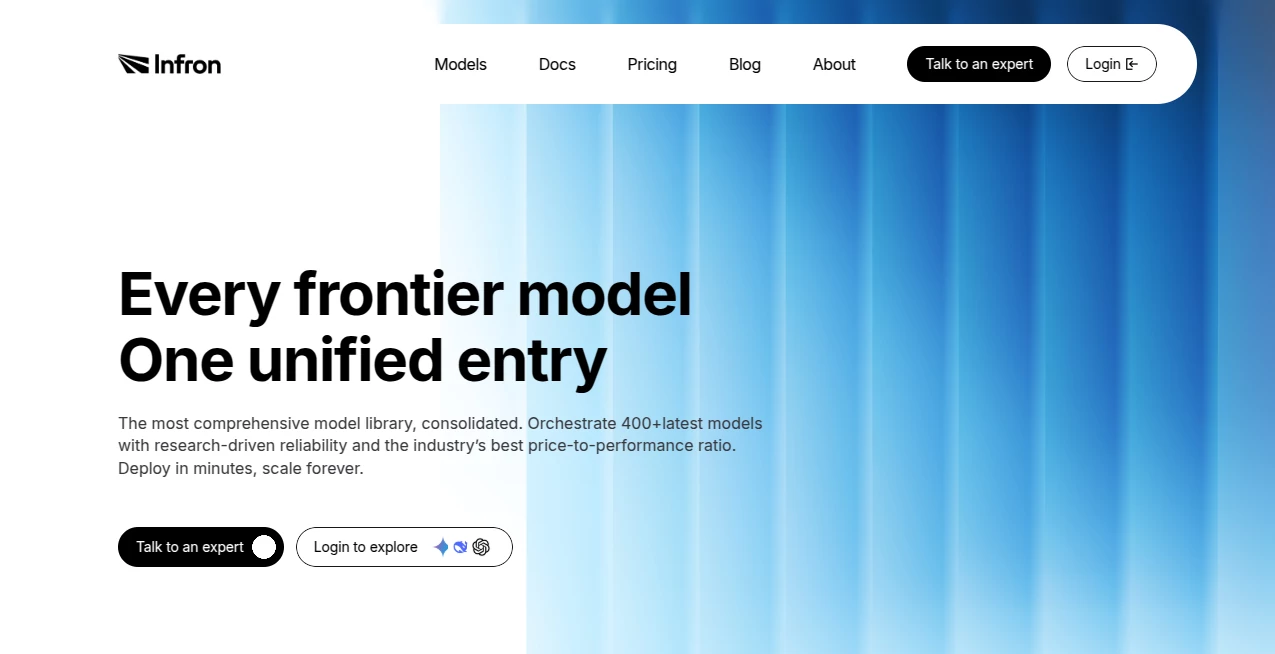
Modern AI development often involves juggling multiple providers, different APIs, changing pricing models, and reliability concerns. This platform simplifies that complexity by bringing hundreds of cutting-edge AI models into a single infrastructure layer. Instead of managing separate integrations, teams can access a vast ecosystem of language, media, search, and multimodal models through one unified interface.
Designed for startups, developers, and enterprise organizations, the solution focuses on flexibility, performance, and operational efficiency. Whether a company is experimenting with new AI capabilities or scaling production workloads to millions of users, the platform provides a centralized environment for model access, monitoring, governance, and cost control.
One of the most appealing aspects is its ability to remove vendor lock-in. Teams can adopt the best available model for each task without repeatedly rebuilding their infrastructure. This creates a smoother path from prototype to production while helping organizations remain adaptable in a rapidly evolving AI landscape.
Key Features
User Interface
The platform offers a clean and developer-focused experience. Model discovery, usage monitoring, billing management, and API access are organized in a straightforward manner. Teams can quickly browse available models, review pricing information, generate API keys, and monitor usage metrics without navigating multiple vendor dashboards.
Accuracy & Performance
Reliability is a major strength. Intelligent routing, automatic failover mechanisms, and infrastructure optimization help maintain consistent performance even when individual providers experience outages or latency issues. Organizations benefit from high availability while continuing to access the latest AI innovations.
Capabilities
The platform supports hundreds of AI models across numerous categories. Users can work with large language models, image generation systems, media creation tools, search technologies, embeddings, rerankers, and multimodal intelligence services through a single integration layer.
- Access to hundreds of AI models from numerous providers
- Unified API for simplified development workflows
- Provider routing and automatic failover
- Centralized billing and analytics
- Support for language, image, search, and media models
- Cost optimization through intelligent infrastructure management
- Enterprise-grade deployment capabilities
Security & Privacy
Security receives significant attention. The platform includes privacy-focused controls, governance tools, and enterprise-oriented protection mechanisms. Organizations handling sensitive workloads can benefit from secure infrastructure practices, data protection measures, and compliance-focused architecture designed for professional environments.
Use Cases
The platform serves a broad range of AI-driven applications.
- Building AI-powered SaaS products with access to multiple models
- Creating intelligent chatbots and virtual assistants
- Developing multimodal applications that combine text, images, and media
- Running large-scale AI workloads without vendor lock-in
- Testing and comparing models for research and development
- Managing enterprise AI operations through a centralized environment
- Reducing infrastructure complexity for growing startups
For example, a product team launching a customer support assistant can experiment with different language models, compare quality and costs, and switch providers without rewriting large portions of code. This flexibility can significantly accelerate development cycles.
Pros and Cons
Pros
- Access to a large collection of AI models through one API
- Reduced vendor dependency
- Centralized monitoring and billing management
- Automatic failover and reliability features
- Strong scalability for production workloads
- Cost optimization opportunities
- Suitable for startups and enterprises alike
Cons
- Advanced infrastructure features may require technical knowledge
- Organizations with simple AI needs may not use all available capabilities
- Enterprise features may require direct consultation for full customization
Pricing Plans
The platform follows a flexible pricing approach designed for both individual developers and enterprise customers.
- Pay-as-you-go model for flexible usage
- Pass-through model pricing without markup on underlying providers
- Platform service fees applied during credit purchases
- Enterprise plans with volume discounts
- Custom pricing options for large-scale deployments
This structure allows organizations to start small while maintaining a clear path toward enterprise-scale adoption as demand grows.
How to Use Infron
Getting started is relatively straightforward.
- Create an account
- Add credits to the platform balance
- Generate API credentials
- Select the desired AI model or service
- Integrate the API into your application
- Monitor usage, performance, and costs through the dashboard
- Scale workloads as business requirements increase
The unified architecture helps reduce development overhead, making it easier to launch AI-powered products quickly.
Comparison with Similar Tools
Many AI infrastructure platforms focus on a limited set of providers or specialized use cases. This solution stands out by combining a broad model marketplace, centralized governance, intelligent routing, and enterprise-grade reliability in a single ecosystem.
While traditional integrations often require separate accounts, billing systems, monitoring tools, and maintenance efforts, this approach consolidates everything into one operational layer. For organizations seeking flexibility and long-term scalability, that can represent a significant advantage.
Conclusion
Managing modern AI infrastructure has become increasingly challenging as the number of available models continues to grow. This platform addresses that challenge by providing a unified gateway to a large and constantly evolving AI ecosystem.
Its combination of model diversity, operational reliability, centralized management, and cost optimization makes it a compelling choice for developers, startups, and enterprise teams. Whether the goal is experimentation, rapid product development, or large-scale deployment, the platform offers a practical foundation for building AI-powered solutions without unnecessary complexity.
Frequently Asked Questions (FAQ)
What is the primary purpose of this platform?
It provides a unified interface that allows users to access and manage hundreds of AI models from multiple providers through a single integration.
Can developers switch between models easily?
Yes. The infrastructure is designed to reduce vendor lock-in and make model switching significantly easier than traditional direct integrations.
Does it support enterprise deployments?
Yes. The platform includes scalability, governance, monitoring, reliability, and security features suitable for enterprise environments.
Can it help reduce AI infrastructure costs?
Yes. Intelligent routing, centralized management, and optimization features can help organizations improve cost efficiency.
Who should use this platform?
It is suitable for developers, AI startups, software companies, research teams, and enterprises that need flexible access to multiple AI models.
AI API Design , AI Developer Tools , AI Research Tool , Large Language Models (LLMs) .
These classifications represent its core capabilities and areas of application. For related tools, explore the linked categories above.

Infron AI Alternatives Product

Empiriolabs …

Rank++

obbylist

GEO Checker

Chrome Sidek…

Geoleaper

Aiso

Jujutsu Zero…

CoinIQ