
















Empiriolabs AI
Verified Blue CheckMark
Verified Blue CheckMark products are featured above free or unverified listings.
This badge indicates authenticity and builds trust, giving your product higher visibility across the platform.
Upgrade to get verified
Verified Blue CheckMark products are featured above free or unverified listings. This badge indicates authenticity and builds trust, giving your product higher visibility across the platform.
Upgrade to get verified
What is Empiriolabs AI?
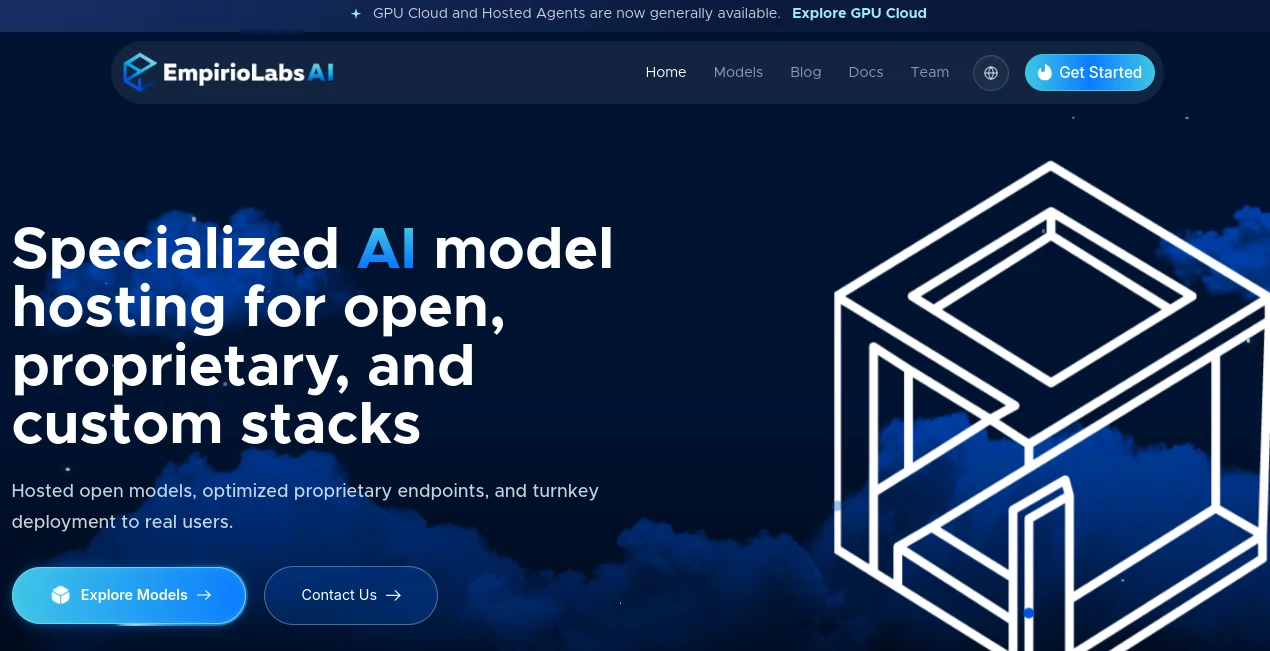
Building AI-powered products often means juggling multiple providers, inconsistent APIs, infrastructure challenges, and rising operational costs. This platform simplifies that process by bringing together hosted open-source models, optimized proprietary endpoints, GPU cloud services, and managed AI agents in one unified environment. Whether you're building a customer-facing application, an internal assistant, or an AI-powered workflow, everything is designed to reduce complexity while maintaining performance.
Instead of forcing teams to manage hardware, model deployment, and scaling on their own, the platform delivers production-ready AI infrastructure with flexible usage-based pricing, generous rate limits, and support for multimodal workloads. Developers can access APIs immediately, while non-technical users can explore capabilities directly through an intuitive dashboard.
Key Features
User Interface
The dashboard keeps advanced AI infrastructure approachable. Models are organized clearly, documentation is easy to navigate, and switching between different providers requires little effort. API access, model exploration, hosted agents, GPU instances, and pricing are presented in a clean workflow that helps users start quickly without unnecessary configuration.
Accuracy & Performance
Performance is a major strength. Open-source models run on dedicated GPU infrastructure with full context windows and optimized inference. Proprietary endpoints include performance tuning, higher usage limits, and carefully prepared templates that improve consistency for real-world production workloads. New AI models are introduced rapidly, allowing developers to adopt the latest capabilities without waiting for lengthy integrations.
Capabilities
- Hosted open-source language and multimodal models.
- Optimized proprietary AI endpoints.
- GPU cloud infrastructure for demanding workloads.
- Hosted AI agents for automation.
- Simple REST API integration.
- Support for text, image, audio, video, and 3D generation.
- High-rate API limits suitable for production.
- Pay-as-you-go billing with no mandatory subscription.
- Deployment support for custom AI models.
- Creative templates for faster implementation.
Security & Privacy
Privacy receives significant attention. User prompts, uploaded files, and generated outputs are not used for model training or sold to third parties. Stored conversations can be removed whenever needed, while generated media is automatically deleted after a limited retention period. These practices make the platform suitable for businesses handling sensitive projects and confidential information.
Use Cases
- Developing AI-powered SaaS products.
- Integrating multiple AI models through a unified API.
- Building intelligent customer support agents.
- Running large-scale content generation workflows.
- Creating multimedia applications using text, image, audio, and video models.
- Deploying proprietary AI models to production environments.
- Research projects requiring access to different foundation models.
- Rapid prototyping without maintaining GPU infrastructure.
Pros and Cons
Pros
- Large collection of AI models in one platform.
- Hosted GPU infrastructure removes deployment complexity.
- Flexible pay-as-you-go pricing.
- Higher API rate limits than many providers.
- Supports multimodal AI workloads.
- Suitable for both developers and business teams.
- Strong privacy practices.
Cons
- Advanced enterprise capabilities may require technical knowledge.
- Model availability can evolve as new providers are added.
- Usage costs depend on selected models and workload volume.
Pricing Plans
The platform follows a pay-as-you-go pricing model instead of locking users into monthly subscriptions. Costs vary according to each AI model and resource type, including tokens, generated images, audio, video, search requests, and 3D assets. Businesses with higher usage requirements may also receive customized commercial pricing options. This flexible structure allows users to pay only for the resources they actually consume.
How to Use EmpirioLabs
Create an account and browse the available AI models through the dashboard. Choose the model that best fits your project, review its documentation, and begin testing using either the web interface or the provided API. Developers can integrate endpoints into applications within minutes, while teams needing dedicated infrastructure can provision GPU cloud instances or deploy custom models for production environments.
Comparison with Similar Tools
Unlike traditional AI providers that focus on only one family of models, this solution combines hosted open-source models, commercial endpoints, managed deployments, GPU cloud resources, and hosted AI agents within a single ecosystem. The flexible pricing model, production-ready infrastructure, higher request limits, and rapid rollout of newly released models make it especially attractive for startups, AI builders, and growing enterprises looking to consolidate their AI stack.
Conclusion
For organizations seeking reliable AI infrastructure without the operational burden of maintaining GPUs or integrating multiple providers, this platform delivers an impressive balance of flexibility, performance, and scalability. Its combination of modern model hosting, deployment services, multimodal capabilities, strong privacy practices, and straightforward pricing creates a dependable foundation for both experimentation and production. From independent developers to enterprise engineering teams, it offers the tools needed to build sophisticated AI experiences with confidence.
Frequently Asked Questions (FAQ)
Is the platform suitable for beginners?
Yes. The dashboard is designed for ease of use, while APIs and documentation support more advanced development projects.
Can businesses deploy their own AI models?
Yes. Custom model deployment and managed hosting are available for organizations that want to serve their own models to production users.
Does it support multimodal AI?
Yes. The platform supports text, images, audio, video, transcription, research, search, embeddings, and 3D generation depending on the selected model.
Is user data used for AI training?
No. User prompts, uploaded files, and generated outputs are not used to train AI models according to the platform's privacy policy.
How is billing handled?
Billing is usage-based, allowing customers to pay only for the resources they consume rather than committing to fixed monthly plans.