


















InnerCanvas
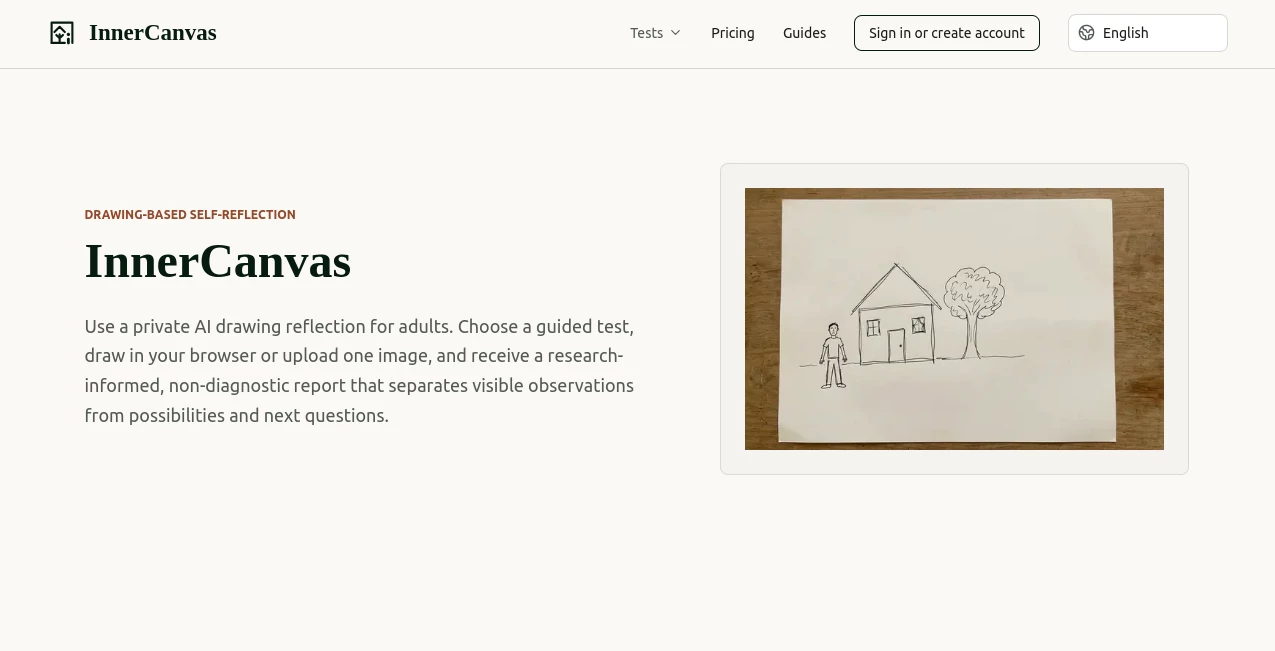
What is InnerCanvas?
Sometimes a drawing can be an easier starting point for self-reflection than a long questionnaire. InnerCanvas takes that idea and turns it into a structured online experience where adults can complete a guided drawing task and receive a private, research-informed reflection. Instead of presenting a drawing as a diagnosis or claiming to uncover hidden truths, the platform focuses on what can actually be observed and uses those observations to suggest possibilities and questions worth exploring.
The experience is built around 15 guided drawing tests covering areas such as self-reflection, relationships, stress and coping, and imagination. Users can draw directly in their browser or upload a clear image of a paper drawing, making the process accessible even for people who prefer traditional pen-and-paper sketching.
What makes the approach particularly appealing is its restraint. The service does not promise that a single symbol or visual detail can reveal someone's personality, trauma, intelligence, or mental health. Instead, it presents drawing as a personal reflection exercise with clearly stated evidence limits.
Key Features
- 15 guided drawing-based reflection tests
- Browser-based drawing workspace
- Support for JPG, PNG, and HEIC drawing uploads
- Private previews before purchasing a complete report
- Research-informed reports with visible evidence limitations
- Separate observations from possible interpretations
- Personal reflection questions to encourage further thinking
- Sample reports for exploring the experience before starting
- PDF export for complete reports
- One-time report purchases with no subscription requirement
User Interface
The interface is deliberately focused on the drawing task rather than surrounding users with unnecessary controls. A person can select a test, choose between drawing in the browser or uploading an image, complete the requested activity, and review a private preview.
The guided format is useful because each test tells the user exactly what to draw. For example, one task asks for a house, tree, and person in a single scene, while another asks the user to draw a person in the rain. This gives the experience enough structure to be meaningful without requiring artistic expertise.
Accuracy & Performance
Accuracy is approached differently here than it is in a typical personality quiz. The system does not attempt to produce a definitive psychological label from an image. Instead, the AI first identifies visible characteristics such as placement, relative size, line continuity, task completion, color where relevant, and spatial relationships.
Reports are built using a curated evidence library for each drawing test. The supporting material prioritizes sources such as systematic reviews, meta-analyses, validity and reliability studies, and traceable methodology. Conflicting findings and limitations are retained rather than being hidden behind an overly confident conclusion.
This makes the experience better suited to thoughtful self-reflection than to anyone looking for a quick personality verdict.
Capabilities
The platform supports a surprisingly broad collection of drawing exercises. Available tests include House-Tree-Person, Tree Test, Draw-a-Person, Wartegg Drawing Completion Test, Diagnostic Drawing Series, Kinetic House-Tree-Person, Family Drawing, Kinetic Family Drawing, Couple Drawing, Bird's Nest Drawing, Person-in-the-Rain, Bridge Drawing, Person Picking an Apple from a Tree, Draw-a-Story, and Silver Drawing Test.
Each test has its own focus. A family drawing can explore visible relationships, distance, shared space, and activity, while a bridge drawing can provide a structured prompt around transition, obstacles, direction, and support. The goal is not to force every drawing into the same interpretation, but to keep the reflection connected to the particular task.
Security & Privacy
Privacy is one of the strongest parts of the experience. A drawing draft remains in the browser until the user chooses to sign in and submit it. Submitted drawings, previews, and reports remain in the user's private account until they are deleted.
The service also states that customer drawings are not used to train its AI models unless the customer provides a separate, explicit and revocable opt-in. Optional analytics is consent-based and does not include drawing content or report text.
After submission, the drawing and the minimum analysis context required for the report are sent to the configured model provider. This distinction is important for anyone considering an AI service involving personal creative material.
Use Cases
This tool is particularly interesting for adults who enjoy journaling, creative self-reflection, or exploring personal themes through visual expression. Someone who finds conventional personality questionnaires restrictive may appreciate having a more open-ended starting point.
It can also be useful for people exploring questions around identity, relationships, transitions, motivation, or personal narratives. For example, completing a bridge drawing may encourage someone to think about a transition they are currently experiencing, while a draw-a-story exercise can provide a visual way to explore how they frame a particular situation.
Another practical use is simply curiosity. A user can complete a free preview, see how the report is structured, and decide whether the full reflection is worth purchasing. The experience is designed for adults and should not be used to assess children, employees, students, patients, partners, or other people.
Pros and Cons
- Pros: Private-by-default approach, 15 different guided tests, browser drawing and image upload options, research-informed reports, clear evidence limitations, free previews, sample reports, and no mandatory subscription.
- Pros: The system avoids presenting AI-generated interpretations as clinical diagnoses or definitive statements about personality.
- Pros: Complete reports can be saved as PDFs, making them convenient for personal reference.
- Cons: The service is intended for adults and is not appropriate for clinical or high-stakes psychological assessment.
- Cons: People looking for definitive personality scores or diagnostic answers may find the cautious approach less satisfying.
- Cons: A complete report requires a paid credit after the free preview stage.
Pricing Plans
The pricing model is refreshingly simple. Verified accounts receive two lifetime preview credits at no cost, allowing users to try the drawing tests and receive a limited preview before spending money.
A complete report costs $4.99 USD as a one-time purchase. The complete report includes the full reflection, permanent report history until deletion, a PDF in the report language, and an additional preview credit.
For people who expect to explore several tests, a package of 15 complete-report credits costs $39.99 USD. Unused credits remain available, and there is no recurring subscription attached to the package.
How to Use the Tool
Start by choosing one of the available drawing tests. Read the instructions carefully, since each exercise has a different purpose and drawing prompt.
Next, choose whether to draw directly in the browser or upload one clear JPG, PNG, or HEIC image. You do not need professional artistic skills; the platform specifically states that artistic ability is not evaluated.
Once the drawing is complete, submit it and review the private preview. The preview gives you an opportunity to understand the style of reflection before deciding whether to unlock the complete report.
If you purchase a complete-report credit, the full reflection can then be generated and retained in your account. The resulting report separates visible observations from more cautious possibilities and includes questions that can help you continue the reflection yourself.
Comparison with Similar Tools
Many online drawing interpretation services focus on assigning quick meanings to individual symbols, colors, objects, or drawing choices. That approach can be entertaining, but it can also make claims much stronger than the underlying evidence supports.
This platform takes a more measured route. It separates observation from interpretation and keeps research limitations visible. Instead of saying that a particular feature proves a personality characteristic, the report can describe the feature and explain whether there is enough evidence to support a cautious reflection.
It is also different from a clinical psychological assessment. A professional assessment can involve interviews, validated instruments, history, context, informed consent, and professional judgment. An online AI drawing reflection cannot replace that process, and this service explicitly positions itself as a non-diagnostic activity.
Conclusion
For adults who want to explore personal ideas through drawing, this is a thoughtful alternative to conventional AI personality quizzes. Its biggest strength is not simply that it can analyze an image, but that it places boundaries around what that analysis is allowed to claim.
The combination of guided drawing exercises, private previews, evidence-aware reporting, research references, and straightforward one-time pricing makes the experience easy to try without committing to a subscription. The 15 available tests also give users plenty of room to explore different themes rather than repeating the same type of exercise.
It should not be treated as therapy, diagnosis, or a way to make decisions about another person's psychological state. Used for what it is designed to do, however, it offers a genuinely interesting way to turn a simple drawing into a structured opportunity for personal reflection.
Frequently Asked Questions (FAQ)
Is this an AI psychological assessment?
No. The service is designed for adult self-reflection and education. It does not diagnose, screen, treat, or verify mental health conditions, personality traits, trauma, intelligence, or protected characteristics.
Do I need drawing skills?
No. Artistic ability is not evaluated. The purpose is to complete the selected drawing task and explore the resulting observations, not to judge the quality of the artwork.
Can I upload a drawing made on paper?
Yes. Users can upload one clear JPG, PNG, or HEIC image for the selected test instead of drawing directly in the browser.
How many drawing tests are available?
There are 15 guided tests covering self-reflection, relationships, stress and coping, and imagination and narrative.
Are the reports based on research?
Yes. Each drawing test has a curated evidence library containing relevant research and documented limitations. The system also keeps conflicting findings and evidence limitations visible rather than presenting every interpretation as established fact.
Are my drawings used to train AI models?
Customer drawings are not used to train the models unless the customer gives a separate, explicit and revocable opt-in. Optional analytics is consent-based and excludes drawing content and report text.
Is there a free option?
Yes. Verified accounts receive two lifetime preview credits. These previews provide a limited reflection before users decide whether they want to purchase a complete report.
Is there a subscription?
No. Complete reports are purchased through one-time credits. A single complete-report credit costs $4.99 USD, while a 15-credit package costs $39.99 USD.
Can the reports replace a psychologist?
No. The reports are intended for personal reflection and education, not clinical assessment, treatment, diagnosis, or high-stakes decisions. Anyone needing professional psychological support should consult an appropriately qualified professional.
AI Image Recognition , AI Life Assistant , Other .
These classifications represent its core capabilities and areas of application. For related tools, explore the linked categories above.
InnerCanvas details
Website unavailable — View Alternatives
Pricing
- Freemium
Apps
- Web App
Categories

InnerCanvas Alternatives Product

Where Is Thi…

YouMind

Discord ID L…

Image Descri…

Greek Numero…

Stinglo

AI Palm Read…

MediTailor -…

Smart Chicke…
