

















InterviewCue AI
What is InterviewCue AI?
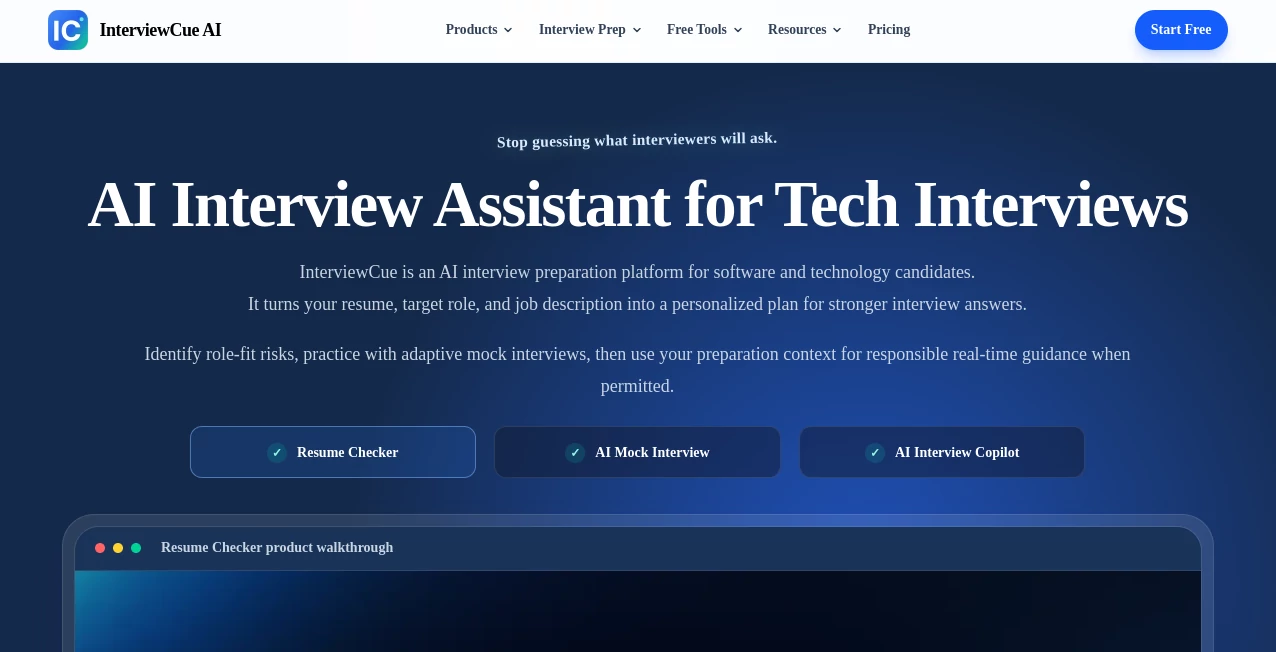
Preparing for a technical interview is rarely about knowing more facts. The harder part is knowing which parts of your experience matter, anticipating follow-up questions, and explaining your decisions clearly when the pressure is on. InterviewCue AI takes a connected approach to interview preparation by bringing resume analysis, job-description matching, mock interviews, question practice, and real-time interview guidance into one workflow.
The platform is designed primarily for candidates pursuing roles across the software and internet industry. Instead of treating interview preparation as a collection of unrelated tools, it keeps your resume, target role, job description, and practice history connected throughout the process. That makes the preparation feel more focused and relevant to the position you actually want.
Key Features
- AI Resume Checker: Reviews your resume against a target job description, including ATS alignment, role fit, potential weaknesses, and areas that could lead to difficult follow-up questions.
- AI Mock Interviews: Creates role-specific practice sessions with personalized questions, adaptive follow-ups, and feedback after your answers.
- AI Interview Copilot: Provides concise, context-aware talking points, answer structures, relevant examples from your experience, and possible follow-up areas during permitted live interviews.
- Interview Question Bank: Offers thousands of questions covering technical, behavioral, system design, product, and role-specific preparation.
- STAR Answer Generator: Helps turn real professional experiences into structured answers for behavioral interview questions.
- Connected Interview Context: Your resume, target role, job description, and practice history can inform the preparation process from analysis through practice and performance.
User Interface
The workspace is organized around a straightforward preparation journey. Candidates can upload a resume, refine it for a target position, start a mock interview, explore interview questions, and access the live copilot from the same environment.
The structure is particularly useful for someone preparing for several interview rounds at once. Rather than jumping between unrelated applications, the candidate can keep the important information surrounding a particular role together. The desktop experience also supports the live copilot, while the platform provides a mobile experience for other preparation activities.
Accuracy & Performance
The quality of interview preparation depends heavily on context, and this is where the platform takes a practical approach. Questions and guidance can be adapted according to the candidate's role, seniority, interview format, resume, and target job description.
Mock interviews provide an interview score, feedback on individual answers, identified problems, improvement priorities, and access to recorded responses for review. The readiness analysis also evaluates a resume and target job description across multiple dimensions, helping candidates identify gaps before the actual interview.
It is still important to treat AI-generated suggestions as preparation support rather than unquestionable answers. A candidate should review the feedback, correct anything inaccurate, and make sure every answer reflects genuine experience.
Capabilities
The platform covers a broad range of software and internet-industry roles, including software engineering, product, data, machine learning, marketing, growth, operations, customer success, DevOps, infrastructure, and QA/SDET.
Interview formats can include coding interviews, system design, behavioral interviews, product sense, case-based discussions, marketing and growth strategy, operational scenarios, resume deep dives, and technical leadership interviews.
For example, a backend engineer can practice distributed-systems questions and architecture trade-offs, while a product candidate can focus on product judgment and role-specific follow-ups. That flexibility makes the experience more useful than a generic list of interview questions.
Security & Privacy
Privacy matters because interview preparation often involves resumes, employment history, job descriptions, recordings, transcripts, and other personal information. The platform states that it does not sell personal information and that user resumes, answers, recordings, and transcripts are not used to train its AI models or third-party AI models.
Users can also request access to, correction of, or deletion of their personal information, subject to applicable requirements. The service recommends avoiding sensitive personal information that is not necessary for interview preparation.
The live interview copilot also comes with an important limitation: candidates should only use real-time assistance when it is permitted by the interviewer or employer. The technology is intended to help organize the candidate's own experience, not to misrepresent skills, experience, or identity.
Use Cases
One of the strongest use cases is preparing for a specific job rather than practicing interviews in the abstract. A candidate can provide a resume and target job description, identify likely weaknesses, and then use those findings to guide practice.
Software engineers can use the platform for coding, system design, debugging, technical reasoning, and behavioral preparation. Product managers can rehearse product sense and leadership questions. Data and machine learning candidates can prepare around their technical experience and role-specific topics.
It can also be useful before a final interview round. Reviewing recorded mock answers, identifying missing evidence, and practicing likely follow-ups can reveal problems that are difficult to notice when simply reading interview questions.
For instance, a candidate might realize that an answer sounds technically correct but does not explain the trade-off behind a decision. Practicing that distinction can make the answer much more convincing in a real conversation.
Pros and Cons
Pros:
- Connects resume analysis, practice, and interview guidance in one workflow.
- Personalizes questions around the candidate's role, experience, seniority, and target position.
- Supports technical, behavioral, system design, product, and several other interview formats.
- Provides detailed feedback after mock interview sessions.
- Includes a large role-specific interview question bank.
- Provides explicit privacy and data-control information.
- Offers free preparation resources such as a STAR answer generator.
Cons:
- Some advanced features and usage levels may require a paid plan.
- The live copilot should only be used when the interviewer or employer allows AI assistance.
- AI feedback still needs human judgment and should not be treated as guaranteed interview advice.
- The strongest focus is on software and internet-industry careers rather than every profession.
- The desktop application is required for the full live interview copilot experience.
Pricing Plans
The service provides free access to selected preparation features, while broader access to resume optimization, mock interviews, live interview cues, and advanced practice capabilities may require a paid subscription.
Because plan limits, billing terms, and available features can change, candidates should check the current pricing information shown inside the service before purchasing. Paid subscriptions can generally be cancelled according to the applicable billing terms, while refund eligibility depends on the relevant plan and purchase conditions.
How to Use It
Start by uploading your resume and identifying the role you are targeting. Adding the relevant job description gives the system useful context for evaluating role alignment and highlighting potential interview risks.
Next, review the readiness analysis and resume recommendations. Pay particular attention to missing evidence, areas that could trigger follow-up questions, and skills that need stronger examples.
Move into a mock interview and answer questions as naturally as possible. After the session, review the score, feedback, recorded responses, and improvement priorities. Repeat the process for the areas where your answers feel less convincing.
When preparing for an actual interview, use the interview question bank to rehearse likely topics and organize examples from your own experience. If real-time AI assistance is allowed during the interview, the copilot can provide concise cues and relevant talking points based on the preparation context.
Comparison with Similar Tools
Many AI interview products focus primarily on one part of the process, such as mock interviews or real-time assistance. This platform takes a broader approach by connecting resume analysis, job-description matching, personalized practice, interview questions, and live guidance.
That distinction matters for candidates who want their preparation to build progressively. A resume issue can influence the questions they practice, mock interview feedback can shape later preparation, and the same context can inform live guidance when its use is permitted.
For someone who only wants a simple collection of interview questions, a dedicated question bank may be enough. Candidates looking for a more connected preparation workflow, however, may find the combination of analysis, practice, feedback, and contextual assistance considerably more useful.
Conclusion
Strong interview preparation is not simply about memorizing polished answers. It is about understanding your own experience, knowing what a particular role demands, and being able to explain decisions clearly when the conversation takes an unexpected turn.
InterviewCue AI brings those pieces together in a practical workflow that starts with the resume and target position, moves through personalized practice, and can continue into real-time guidance when appropriate. Its combination of resume analysis, adaptive mock interviews, role-specific questions, feedback, and privacy controls makes it a compelling option for candidates preparing for software and technology careers.
The biggest benefit is the continuity between each stage. Instead of starting from scratch every time you practice, the preparation context follows you, helping each session become more relevant to the interview you are actually trying to win.
Frequently Asked Questions (FAQ)
What types of interviews can it help me prepare for?
It supports preparation for coding, system design, behavioral, product sense, case-based, technical leadership, marketing strategy, growth strategy, operations, resume deep dives, and other role-specific interviews.
Can it analyze my resume?
Yes. The resume checker evaluates areas such as ATS alignment, role fit, strengths, weaknesses, interview risks, optimization priorities, interview strategy, and likely questions based on a target job description.
How does the mock interview work?
The mock interview uses information such as your resume, target role, job description, experience, and seniority to create personalized questions and adaptive follow-ups. Afterward, you receive feedback, an interview score, improvement priorities, and access to recorded responses.
Does it provide live interview assistance?
Yes. The AI Interview Copilot can provide concise answer structures, talking points, relevant resume examples, role-specific frameworks, and possible follow-up areas during live interviews. It should only be used when AI assistance is permitted by the interviewer or employer.
Is my resume data used to train AI models?
The platform states that resumes, answers, recordings, and transcripts are not used to train its AI models or third-party AI models. It also states that personal information is not sold.
Is there a free option?
Selected features and limited usage may be available for free. Full access to certain resume, mock interview, copilot, and advanced preparation features may require a paid plan.
Who is it best suited for?
It is particularly well suited to candidates preparing for software and internet-industry positions, including engineering, product, data, machine learning, DevOps, infrastructure, QA/SDET, marketing, growth, and operations roles.
AI Life Assistant , AI Interview Assistant , AI Recruiting , AI Resume Builder .
These classifications represent its core capabilities and areas of application. For related tools, explore the linked categories above.
InterviewCue AI details
Website unavailable — View Alternatives
Pricing
- Freemium
Apps
- Web App
Categories

InterviewCue AI Alternatives Product

core level

YouMind

Monkey Eatin…
ResumeTailor…

ApplyBtn

Hirescope.te…

What The Food

Romantic AI

CoPrep AI
