
Linx Security
What is Linx Security?
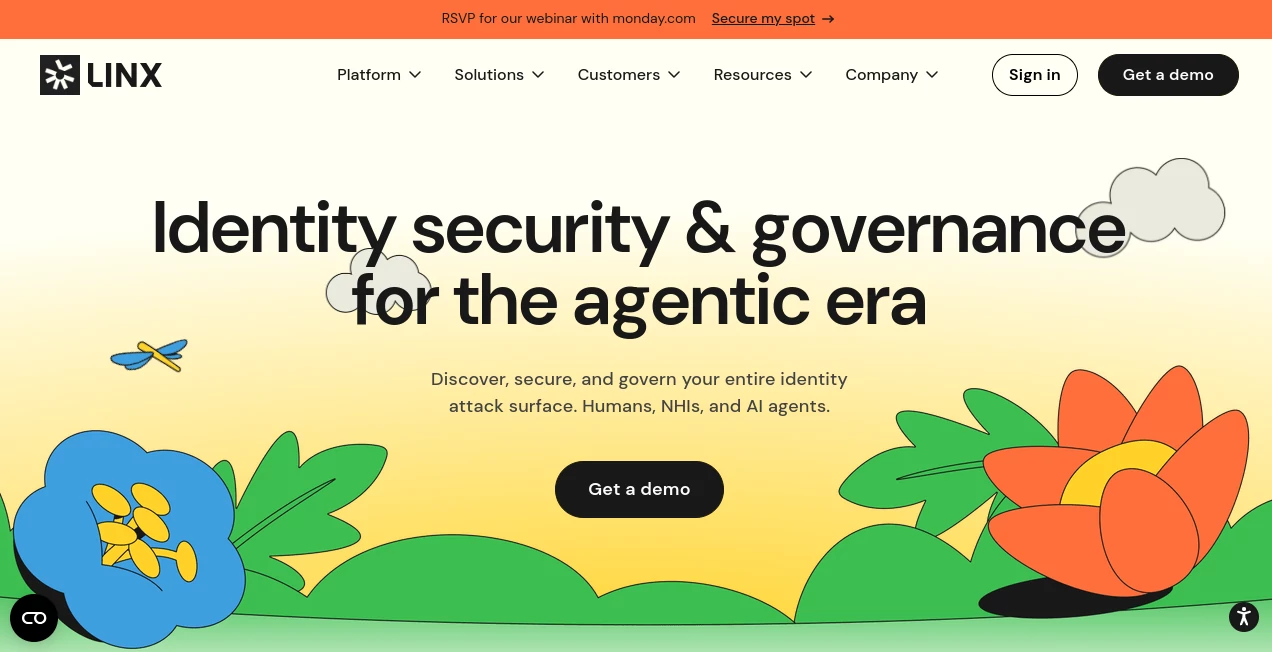
Linx Security is an AI-native identity security and governance platform designed for organizations that need a clearer view of who and what has access to their systems. It brings human identities, non-human identities such as service accounts and API keys, and AI agents into one security framework.
As companies add more cloud services, SaaS applications, automated workflows, and AI agents, managing access becomes increasingly difficult. A user may have permissions across several systems, while an API key or service account can remain active long after its original purpose has disappeared. The platform addresses this problem by continuously mapping identities, access relationships, resources, and risks through a live identity graph.
What makes the approach particularly interesting is that security is not treated as a collection of periodic checklists. Access requests, reviews, remediation, and lifecycle management can be prioritized according to risk and potential business impact. For security teams dealing with a large and constantly changing environment, that can make everyday identity work much more manageable.
Key Features
- Live identity graph connecting identities, permissions, resources, and access paths.
- Identity Security Posture Management for continuously identifying identity-related risks.
- AI-powered assistant for investigating identity questions and producing contextual recommendations.
- Autonomous remediation through an AI agent designed to monitor identity risks continuously.
- Just-in-time access that replaces unnecessary standing privileges with temporary permissions.
- Identity lifecycle management for joiner, mover, and leaver processes.
- Governance for service accounts, API keys, bots, and AI agents.
- Access reviews, policies, provisioning, and remediation workflows in one environment.
- Agentless integrations across cloud, SaaS, on-premises, and custom applications.
User Interface
The interface is built around the identity graph rather than forcing security teams to jump between disconnected lists of users and permissions. The central dashboard provides visibility into identity and asset inventories, open security issues, human and non-human identity risks, and the relationships between identities and resources.
This graph-based approach is useful when investigating an unfamiliar access problem. Instead of simply showing that an account has a particular permission, the platform can help security professionals understand how that identity connects to applications, groups, roles, and resources. For a busy identity administrator, that context can save a considerable amount of manual investigation.
Accuracy & Performance
The platform continuously collects, cleanses, normalizes, and correlates identity and entitlement information across connected environments. This is important because identity data is rarely perfectly organized inside a large company. Different systems may use different naming conventions, roles, and account structures.
Its analysis goes beyond simple inventory. The identity graph is used to identify excessive privileges, dormant accounts, hidden privilege chains, missing MFA, administrative sprawl, and other potentially risky access patterns. AI-powered analysis can also examine contextual information such as job roles and responsibilities when evaluating whether access appears appropriate.
For organizations with constantly changing identities and permissions, continuous visibility is a more practical model than relying solely on occasional access reviews.
Capabilities
The platform covers several areas of modern identity security and governance. Identity Governance and Administration capabilities help coordinate access requests, approvals, provisioning, and access reviews across SaaS, cloud, and on-premises environments.
Identity Security Posture Management provides continuous visibility into identity-related risks, while just-in-time access can limit elevated privileges to the period when they are actually needed. Lifecycle management helps automate access changes as employees join the company, move between roles, or leave.
Another notable capability is support for non-human and agentic identities. Service accounts, API keys, bots, and AI agents can be brought into the same governance model as human users. This becomes increasingly important as AI systems begin taking actions inside business applications rather than simply generating information.
Security & Privacy
Security is central to the platform's design. Access decisions can be evaluated according to policies and risk, while remediation actions can be performed directly from the identity graph. This reduces the need to export findings into another system before taking action.
The platform also maintains an audit trail for actions and decisions. Its approach to AI is particularly focused on the organization's own identity environment: the AI assistant is designed to ground its answers in the live identity graph rather than returning generic security advice.
For agentic environments, the platform also provides an MCP gateway that can inspect AI-agent tool calls before execution, apply access policies, and maintain an auditable connection between an agent action and the underlying human or non-human identity.
Use Cases
One practical use case is reducing excessive employee access. Consider an employee who changes departments but retains permissions from their previous role. Instead of discovering the problem months later during a scheduled review, continuous identity analysis can help identify the mismatch and support remediation.
Another use case involves service accounts and API keys. These identities often do not have the same lifecycle controls as employees and can remain active without a clear owner. Bringing them into the same identity graph makes it easier to understand who owns them, what they can access, and whether their privileges are still justified.
AI-agent governance is another increasingly relevant scenario. An organization may deploy agents that interact with internal applications, databases, or development systems. The platform can treat these agents as governed identities and apply access controls, least-privilege principles, and auditability to their activities.
Security teams can also use the platform for access reviews, just-in-time privileged access, identity lifecycle automation, identity risk investigations, and continuous identity posture monitoring.
Pros and Cons
- Pros: Unified visibility across human, non-human, and AI identities.
- Pros: Live identity graph provides useful context around access relationships.
- Pros: AI-assisted investigation can speed up identity security analysis.
- Pros: Supports automated remediation and identity lifecycle workflows.
- Pros: Just-in-time access helps reduce unnecessary standing privileges.
- Pros: Agentless integrations are designed to reduce deployment complexity.
- Cons: The platform is primarily aimed at enterprise identity and security teams rather than individual users.
- Cons: Organizations looking for a simple standalone security utility may find its broad governance capabilities more than they need.
- Cons: Public pricing is not provided, so prospective customers need to contact the company for a tailored evaluation.
Pricing Plans
No public pricing tiers are listed on the website. Instead, the company invites organizations to book a demo and discuss their specific identity security requirements with its team.
This approach makes sense for an enterprise security platform because deployment requirements can vary significantly depending on the number of identities, applications, integrations, access policies, and governance workflows involved. A prospective customer can use the discovery process to understand which capabilities are relevant to their environment before discussing commercial terms.
How to Use It
Getting started is centered around connecting the organization's identity and application environment so that relevant identity and entitlement data can be brought into the platform. Its integration layer supports identity providers, HR systems, cloud infrastructure, SaaS applications, on-premises directories, and custom applications.
Once data is connected, identities and access relationships are represented in the identity graph. Security teams can then investigate risks, review access paths, configure policies, manage access requests, and initiate remediation.
For organizations using AI agents, the platform can also extend governance into the agentic layer. Security teams can define controls around agent activity and maintain visibility into which identities, tools, and resources are involved.
A sensible first step for a security team is to identify the most important applications and privileged identities, connect the relevant systems, review the highest-impact risks, and gradually automate remediation and lifecycle workflows.
Comparison with Similar Tools
Traditional identity governance products often focus heavily on access certification, provisioning, approval workflows, and periodic reviews. Those capabilities remain valuable, but modern environments introduce additional challenges such as service accounts, API keys, cloud permissions, and AI agents.
This platform takes a broader identity-security approach by combining governance with continuous identity posture monitoring, an identity graph, risk analysis, just-in-time access, and automated remediation.
Compared with tools that primarily generate security alerts, its emphasis is on connecting findings with the access relationships behind them and enabling action from the same environment. That distinction can be valuable for teams that want fewer disconnected investigations and more direct remediation.
The strongest fit is likely to be organizations with complex identity environments where access is distributed across multiple cloud platforms, SaaS applications, on-premises systems, and increasingly autonomous software agents.
Conclusion
Identity security has become considerably more complicated as organizations adopt cloud services, automation, APIs, and AI agents. Simply knowing which users exist is no longer enough. Security teams need to understand how identities connect to resources, which privileges they possess, and what could happen if those permissions are misused.
Linx Security takes a modern approach by placing a continuously updated identity graph at the center of security and governance. Its combination of identity intelligence, AI-assisted investigation, just-in-time access, lifecycle automation, and governance for non-human and agentic identities makes it particularly relevant for organizations building a more automated security operation.
For enterprise teams looking to reduce identity risk without creating another collection of disconnected security workflows, it is a compelling platform worth evaluating through a personalized demo.
Frequently Asked Questions (FAQ)
What is this platform used for?
It is used for identity security, identity governance, access management, identity lifecycle management, risk detection, and governance of human, non-human, and AI identities.
Does it support AI agents?
Yes. AI agents can be treated as governed identities, with visibility into their access and controls designed to limit what they can reach and do.
What is an identity graph?
An identity graph connects identities with accounts, roles, groups, applications, resources, and access relationships. It provides a contextual view of how access moves through an organization's environment.
Can it manage service accounts and API keys?
Yes. Non-human identities such as service accounts, API keys, and bots can be discovered and governed alongside human identities.
Does it provide just-in-time access?
Yes. Just-in-time access can provide temporary, policy-driven privileges instead of leaving elevated permissions active indefinitely.
Does it offer automated remediation?
Yes. Security risks can be remediated through automated workflows, while its autonomous security capabilities can continuously monitor identity changes and determine when action or human escalation is appropriate.
Is there a free plan?
No public free plan or standard self-service pricing is listed. Organizations are directed toward a demo and a discussion of their specific requirements.
Who is this platform best suited for?
It is best suited to enterprise security, identity, governance, risk, and IT teams managing complex environments with many users, applications, permissions, service accounts, and AI-driven workloads.
Does it integrate with existing systems?
Yes. The platform provides agentless data ingestion and connectors for identity providers, HR systems, cloud infrastructure, SaaS applications, on-premises directories, and custom applications.
Can AI help with identity investigations?
Yes. The AI assistant can answer questions about the organization's identity environment, generate investigation reports, provide contextual recommendations, and help initiate actions such as remediation and access changes.
These classifications represent its core capabilities and areas of application. For related tools, explore the linked categories above.
Linx Security details
Website unavailable — View Alternatives
Pricing
- Freemium
Apps
- Web App
Categories

Linx Security Alternatives Product

Ultimate Too…

gpt-plus.ai

Greek Numero…

Manifest

NYT Sudoku

Tea Checker

Free AI Dire…

royaldle

Any2URL