
















ListicleWriter.ai

What is ListicleWriter.ai?
Creating a strong listicle is more than putting a few products into a numbered list. A useful article needs clear comparisons, accurate details, readable sections, and enough context for both people and modern search systems to understand what each item offers. ListicleWriter.ai is built specifically around this type of content.
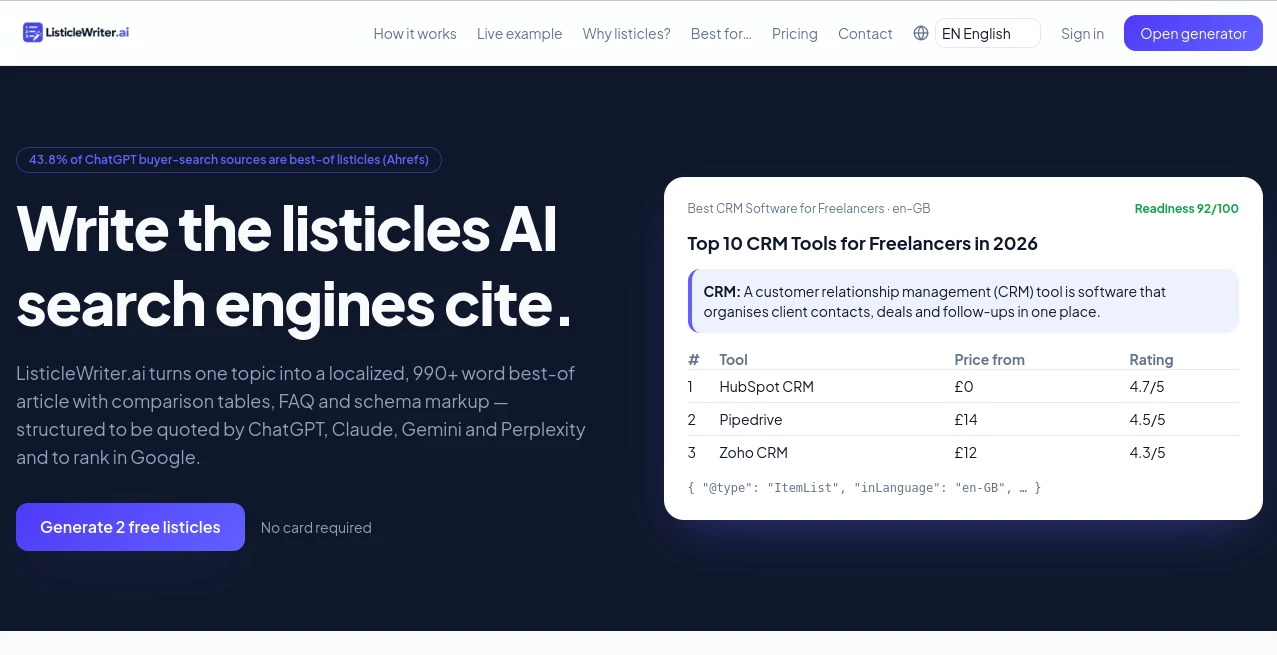
The platform turns a topic into a long-form best-of article with comparison tables, frequently asked questions, structured data, and localized content. Its approach is particularly focused on generative search, where systems such as ChatGPT, Claude, Gemini, and Perplexity need clearly structured information before they can retrieve or cite an answer.
Instead of starting with a blank document and manually planning every section, users can generate a publish-ready listicle and then review the result before publishing. The service also provides a citation-readiness check, giving content creators a practical way to identify areas that may need improvement.
Key Features
The platform combines several elements that are normally handled separately during a content workflow. A generated article can include a 990+ word structure, comparison information, FAQs, pros and cons, and machine-readable schema. The output can also be exported in formats suited to common publishing workflows.
Another useful feature is localization. Users can create content for different markets, with support for US English, UK English, French, German, Spanish for Spain, Spanish for Mexico, and neutral Spanish for Latin America. Currency, terminology, dates, and regional language can be adapted to the selected market.
User Interface
The workflow is designed around a straightforward content-generation process. A user starts with a topic, previews the result, and can then generate complete articles. The service provides a free trial that allows two complete listicles without requiring a payment card, making it possible to test the workflow before choosing a paid plan.
The publishing workflow is also practical for website owners. Generated content can be exported as Markdown or WordPress-ready HTML, while JSON-LD is provided separately for structured data implementation. This separation makes it easier to place visible article content and machine-readable information in the appropriate areas of a website.
Accuracy & Performance
A major focus is structured and verifiable content rather than simply producing a large block of text. The system uses query fan-out to break a topic into related research areas such as definitions, pricing, comparisons, and selection criteria. These elements are then brought together into one article.
The platform also includes a Citation Readiness Auditor that scores content out of 100. The score considers factors such as word count, modular sections, definitions, schema validity, and image metadata. The service states that its goal is to avoid invented statistics and provide transparent evaluation criteria.
One published example on the site reports a 2,696-word comparison article generated in 96 seconds, with a reported citation-readiness score of 100/100. Results can vary by topic and research requirements, so the generated article should still be reviewed before publication.
Capabilities
The main strength of the platform is its specialization. It is not positioned as a general-purpose writing assistant. Instead, it focuses on best-of and comparison-style articles that help readers evaluate several options in one place.
Each article can contain self-contained sections so that individual pieces of information remain understandable when extracted from the surrounding article. ItemList and FAQPage JSON-LD are also generated, helping publishers add structured information alongside their visible content.
For publishers working across several websites or markets, this combination can reduce repetitive editorial work. A marketer could use it for software comparisons, a niche publisher could build buying guides, and an SEO professional could create structured category content without manually assembling every component.
Security & Privacy
The website states that payments are processed securely through Stripe and that card details are not stored on the site. It also provides separate privacy, terms, and disclaimer pages for users who want to review the service's policies before using it.
For content production, users should still apply normal editorial safeguards. Generated articles should be checked for factual accuracy, especially when they contain prices, rankings, product specifications, or other information that can change over time.
Use Cases
This tool is particularly suitable for publishers who regularly create comparison-based content. For example, an SEO team building pages around software categories can use it to structure a complete “best tools” article instead of manually creating every comparison section.
Affiliate publishers can also benefit from the workflow. The paid Creator plan supports adding affiliate links without rebuilding the article, which can be useful when a listicle already has a defined structure and the publisher needs to add monetization links.
Another practical use is localized publishing. A website targeting readers in several countries can adapt its content to regional language, terminology, dates, and currency rather than publishing the same English article everywhere.
It can also help content teams experimenting with generative engine optimization. Instead of treating AI search visibility as an afterthought, the workflow considers definitions, standalone sections, FAQs, and structured data while the article is being created.
Pros and Cons
Pros:
- Focused specifically on long-form listicles and comparison articles.
- Generates articles with comparison tables, FAQs, pros and cons, and structured data.
- Includes a 100-point Citation Readiness Auditor.
- Supports multiple languages and regional markets.
- Provides Markdown, WordPress HTML, and JSON-LD output.
- Offers two complete listicles during the free trial without requiring a card.
- Creator users can add affiliate links to generated articles.
Cons:
- The service is specialized around listicles rather than general-purpose writing.
- Generated content still needs human review and fact-checking before publication.
- The higher-volume plans are more relevant to publishers with a regular content schedule.
- AI-search optimization cannot guarantee that an article will be cited by a particular search engine.
Pricing Plans
There are several options depending on publishing volume. The Free Trial costs nothing and includes two complete listicles, citation-readiness checks, localization options, and clean Markdown export.
The Creator plan costs $29 per month and includes 30 listicles. It also adds 990+ word citation-ready content, Markdown, WordPress HTML, JSON-LD, and affiliate-link support.
The Pro Publisher plan costs $79 per month and provides 100 listicles. It is designed for larger publishing schedules and includes priority generation together with the Creator features.
There is also a Lifetime Deal priced at $399 as a one-time payment. It provides 100 listicles every month on an ongoing basis, access to Pro Publisher capabilities, and early access to new locales.
How to Use It
Start by choosing the topic you want to turn into a listicle. A clear topic makes it easier to produce a useful comparison because the article can focus on a specific audience, category, or buying question.
After generating the article, review the individual sections, comparison information, prices, and FAQs. Pay particular attention to details that may change after the content was generated.
When the article is ready, export the format that matches your publishing setup. WordPress users can copy the generated HTML into a Custom HTML block, while the JSON-LD can be added separately through an appropriate schema or code-injection area. The visible article and structured data should remain consistent.
Finally, preview the published page and check the comparison table, links, FAQs, and schema before making the article public. A short editorial review can make a significant difference when the content is intended to represent real products or services.
Comparison with Similar Tools
There are many AI writing products that can create articles, but their workflows are not necessarily designed around listicles. General writing assistants typically give users broader control over the writing process, while specialized listicle tools concentrate on the structure required for comparison content.
The distinctive approach here is the combination of listicle generation, AI-search-oriented structure, localization, structured data, and citation-readiness auditing. This makes the workflow particularly relevant when the final goal is a comparison article rather than a conventional blog post.
For publishers who only need occasional paragraphs, rewrites, or short-form copy, a general writing assistant may provide a simpler workflow. For someone repeatedly producing “best” and comparison articles, the specialized structure can reduce the amount of manual formatting and planning required.
Conclusion
ListicleWriter.ai takes a focused approach to one of the most common formats in search-driven publishing: the comparison and best-of article. Its combination of long-form generation, structured sections, FAQs, localization, schema markup, and citation-readiness analysis gives publishers a workflow that goes beyond simply asking an AI model to write a blog post.
The platform is especially interesting for SEO professionals, affiliate publishers, content teams, and website owners who regularly create comparison content. The free trial also provides a straightforward way to test the output before committing to a paid plan.
As with any AI-generated content system, the strongest results come when the generated material is treated as a starting point rather than an automatic replacement for editorial judgment. Checking facts, reviewing comparisons, and keeping prices and product information current remain important parts of publishing useful content.
Frequently Asked Questions (FAQ)
What type of content does this tool create?
It focuses on long-form best-of and comparison listicles. A complete article can include a comparison table, pros and cons, FAQs, and structured data.
Can I try it without paying?
Yes. The free trial provides two complete listicles without requiring a payment card.
Does it support AI search optimization?
Yes. Its workflow is designed around generative engine optimization, using self-contained content sections, definitions, structured data, and a citation-readiness audit.
Which AI search systems is the content designed for?
The platform specifically mentions ChatGPT, Claude, Gemini, and Perplexity as target AI answer engines. However, structured content does not guarantee that any particular system will cite a page.
What is the Citation Readiness score?
It is a 100-point assessment that considers factors including word count, content modularity, definitions, ItemList and FAQPage schema validity, and image metadata.
Can I publish the generated articles on WordPress?
Yes. The service provides WordPress-ready HTML. It also provides separate JSON-LD output that can be added to the appropriate schema or code-injection area.
Does it support multiple languages?
Yes. Supported choices include US English, UK English, French, German, Spanish for Spain, Spanish for Mexico, and neutral Spanish for Latin America.
Are the generated articles ready to publish immediately?
The service is designed to produce publish-ready content, but the website itself recommends reviewing and fact-checking generated material before publishing. This is particularly important for prices, rankings, and other changing information.
Can affiliate links be added?
Yes. The Creator plan includes the ability to add affiliate links without rebuilding the article.
What does one credit provide?
One credit produces one complete listicle, including the article, outline, comparison table, pros and cons, FAQ section, and supported export formats.
How much does the paid version cost?
The available plans include Creator at $29 per month, Pro Publisher at $79 per month, and a Lifetime Deal at $399 as a one-time payment.
Can AI citation be guaranteed?
No. The platform can structure content for citation readiness and evaluate specific content signals, but no tool can guarantee that an external AI search engine will cite a particular article.
What should I check before publishing?
Review factual claims, prices, product details, rankings, links, comparison tables, FAQs, and the consistency between the visible article and its structured data. This final review helps keep the published page accurate and trustworthy.