

















What is LuAITools?
Finding the right AI tool can take almost as much time as using one. With hundreds of new products appearing across writing, image generation, video, coding, productivity, audio, and business, knowing where to start is often the hardest part. LuAI Tools takes a more organized approach by bringing AI products into one searchable directory and grouping them according to practical use cases.
The platform is designed for people who want to discover useful AI products without spending hours browsing unrelated websites. Its focus is straightforward: make AI discovery simpler by organizing tools, highlighting popular products, and providing additional guides and educational content alongside the directory.
For example, someone looking for an AI writing assistant can browse writing-focused tools, while a creator searching for an image or video generator can narrow the discovery process to those areas. This makes the platform particularly useful when you know what you want to accomplish but are not yet sure which product is the best fit.
Key Features
User Interface
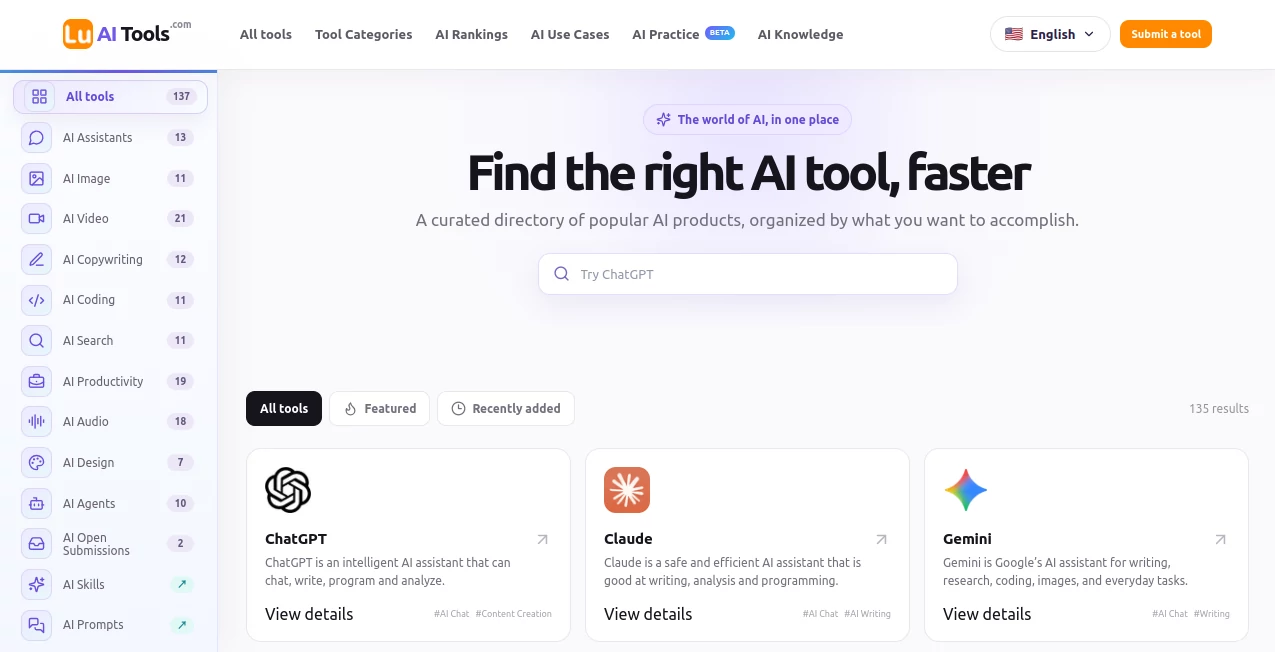
The interface is built around discovery rather than complicated setup. Visitors can search for tools by name, purpose, or keyword and then browse the available categories. The homepage also highlights popular and recently added products, making it easier to discover something new without starting with a specific product in mind.
The category structure covers a broad range of AI applications, including conversational assistants, image tools, video tools, writing and copywriting, programming, search, productivity, audio and music, design, and AI agents. This practical organization makes the directory approachable for both newcomers and experienced AI users.
Accuracy & Performance
A useful directory is only valuable when it helps people reach relevant products quickly. The platform combines searchable listings with category-based discovery and product descriptions, reducing the amount of manual research needed before opening an AI service.
Its content also goes beyond a simple collection of links. The site publishes guides and practical articles covering subjects such as AI music generation, AI SEO, commercial use of AI-generated artwork, and individual AI products. This gives visitors additional context when they are comparing different options.
One practical advantage is the combination of product discovery and educational content. A visitor can first identify several possible tools and then read a relevant guide before deciding which one deserves a closer look.
Capabilities
- Search AI tools by product, purpose, or keyword.
- Browse tools through dedicated AI categories.
- Discover popular and recently listed products.
- Explore AI tools for writing, images, video, audio, coding, productivity, design, search, and more.
- Read practical guides related to AI tools and use cases.
- Explore rankings and use-case-oriented AI resources.
- Discover AI products without having to search across multiple directories.
The directory currently presents more than 120 listed results on its main tool discovery area, with categories covering major areas of the modern AI ecosystem. The site also separates tool discovery from longer educational resources, which is helpful for visitors who want more than a basic product listing.
Security & Privacy
Because the platform primarily acts as a discovery and information service, users generally visit individual product websites when they decide to use a particular AI service. This distinction is important: privacy, account security, data retention, and commercial-use policies can differ considerably from one listed product to another.
The directory itself advises visitors to check the official website of each product for current service details and pricing. That is a sensible approach because AI products frequently change their plans, capabilities, and terms.
Use Cases
The platform is useful for several types of AI users. Beginners can use it as a starting point for understanding what types of AI products are available. Instead of searching for an individual product, they can begin with a category and explore several options.
Content creators can use the directory to discover image generators, video creation platforms, music tools, writing assistants, and other creative products. Developers can explore coding assistants, developer tools, APIs, and related solutions from a centralized starting point.
Businesses can also benefit from the category structure when researching AI for marketing, productivity, sales, customer service, automation, and other operational tasks. For someone evaluating several solutions at once, having products grouped by practical purpose can make the initial research stage considerably faster.
Another useful scenario is tool discovery by trend. If you already use several familiar AI products, browsing popular or recently added tools can reveal alternatives that may better fit a particular workflow.
Pros and Cons
Pros
- Centralizes AI product discovery in one place.
- Offers a broad selection of AI categories.
- Includes search and category-based navigation.
- Highlights popular and recently added tools.
- Provides educational articles in addition to product listings.
- Covers both mainstream AI products and specialized solutions.
- Useful for discovering alternatives when you do not already have a specific product in mind.
Cons
- Product pricing and availability can change and should be verified on the provider's official website.
- The directory is a discovery platform, so the actual features and performance depend on the individual AI service being reviewed.
- Users comparing specialized products may still need to visit several provider websites before making a final decision.
Pricing Plans
No standard subscription plan for using the directory is prominently presented on the main website. The platform functions primarily as an AI discovery and information resource, allowing visitors to browse its tool listings and educational content.
For individual AI products listed in the directory, pricing can vary significantly. Some services may offer free access, while others use subscriptions, usage-based pricing, or paid tiers. The site itself recommends checking the official product website for the latest pricing and service information.
How to Use the Platform
- Start by identifying the type of AI solution you need, such as writing, video, image generation, coding, productivity, or audio.
- Use the search function if you already know the product name or the task you want to accomplish.
- Browse the relevant category to discover multiple options.
- Open individual listings and review their descriptions to understand what each product is designed to do.
- Compare several alternatives instead of choosing the first result you find.
- Visit the official product website to verify current pricing, features, availability, and terms.
- Use the educational articles and guides when you need additional context before making a decision.
Comparison with Similar Tools
Compared with a simple collection of AI links, this platform puts more emphasis on categorization and content around the tools. Visitors are not limited to a single alphabetical list; they can approach the directory through categories, search, popular products, and recently added listings.
It also differs from using a general search engine. Search engines can return thousands of pages for a broad query such as “best AI video tools,” whereas a specialized AI directory starts with a curated product-discovery structure. This can be particularly convenient during the early stage of research, when the goal is to understand the available options rather than find one specific webpage.
The educational section adds another layer of value. Guides covering topics such as AI music generation, AI SEO strategies, and AI art licensing can help users understand a category before selecting a product.
Conclusion
For anyone who regularly experiments with artificial intelligence tools, a well-organized discovery platform can save a surprising amount of research time. The combination of searchable listings, practical categories, popular and newly added products, rankings, and educational material creates a convenient starting point for exploring the growing AI ecosystem.
It is especially useful when you have a particular goal but have not yet chosen the software to accomplish it. Rather than committing immediately to a familiar name, you can explore alternatives, compare different approaches, and then visit the provider's website for the final details.
As the AI market continues to expand, organized discovery becomes increasingly valuable. A directory built around real use cases gives users a simpler way to keep up with new products without having to follow every AI launch individually.
Frequently Asked Questions (FAQ)
What is this platform?
It is an online directory for discovering AI products across categories such as writing, image generation, video, coding, productivity, audio, design, search, and AI agents.
How many AI tools are listed?
The main directory currently displays more than 120 tool results, with products organized into multiple categories.
Can I search for an AI tool?
Yes. The platform provides a search function that can be used to find tools by product name, purpose, or keyword.
Does it provide AI tool reviews?
The platform provides product descriptions as well as longer educational articles and guides related to AI tools and practical use cases.
Are the listed AI tools free?
Not necessarily. Pricing depends on the individual product. Some AI services may offer free access or free tiers, while others require a subscription or paid plan.
Where should I check the latest pricing?
The safest approach is to check the official website of the individual AI product because pricing, features, and availability can change over time.
Who can benefit from using the directory?
Beginners, creators, developers, marketers, business users, and AI enthusiasts can all use it to discover products relevant to their specific needs.
Can I discover alternatives to popular AI products?
Yes. Browsing categories and recently added products can help users find alternative solutions instead of relying only on the AI products they already know.