

















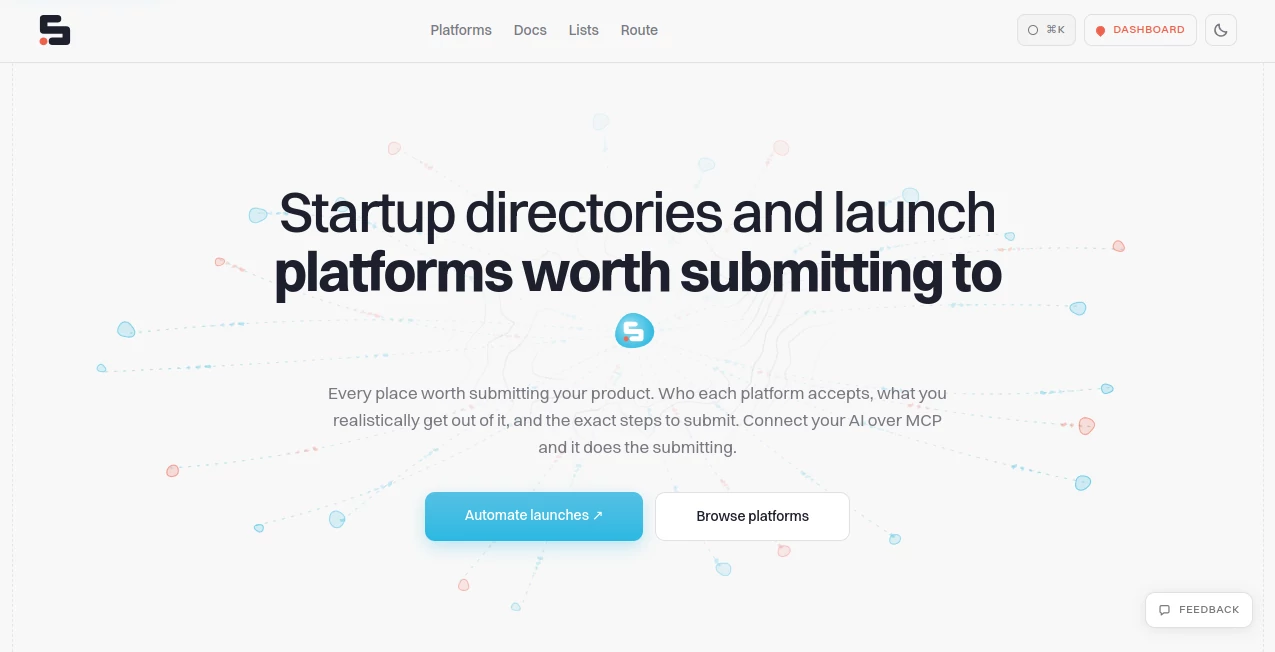
What is SubmitMap?
SubmitMap is a practical research and automation platform built for founders, makers, and teams that need to get a new product in front of the right launch platforms and startup directories. Instead of maintaining a long spreadsheet of websites and trying to remember which ones accept AI products, SaaS products, developer tools, or startups, the platform brings that information together in one searchable directory.
Its approach is particularly useful for product launches. Each listing explains who the platform accepts, what can lead to rejection, how submissions work, what kind of link may be provided, and what to expect after submitting. That makes the process much more predictable than relying on generic lists of directories.
There is also an automation layer for people who want to go beyond research. Through MCP, an AI agent can use the platform's structured information to determine where a product qualifies and help complete submissions in the user's own browser.
Key Features
- A large directory of startup directories and launch platforms
- Filters for AI tools, SaaS products, developer tools, marketing tools, startups, and other product types
- Information about pricing, approval times, domain ratings, and link value
- Eligibility requirements and rejection conditions for individual platforms
- Step-by-step submission instructions
- Curated lists for specific launch and promotion goals
- MCP support for connecting an AI agent to the submission workflow
- Submission tracking through the dashboard
User Interface
The interface is designed around discovery rather than unnecessary complexity. Users can browse the directory, search for platforms, filter results by product type and category, and compare useful details before deciding where to submit.
The individual platform pages are especially helpful because they turn scattered submission information into a structured checklist. A founder can quickly see whether a service accepts their type of product and what preparation is required before starting a submission.
Accuracy & Performance
The real strength of the service is the depth of information attached to each directory listing. Rather than simply providing names and links, the platform documents requirements, disqualifiers, submission steps, pricing, approval expectations, and other practical details.
This can save considerable time during a launch campaign. For example, if a directory requires a lifetime pricing plan, a badge, a particular type of product, or a minimum description length, that information can be checked before spending time on the submission form.
Capabilities
The platform currently covers a broad range of launch destinations, including AI directories, SaaS marketplaces, developer communities, startup platforms, product discovery sites, and other places where founders can promote their products.
Its filtering system makes the database more useful for targeted research. A developer can focus on developer-oriented platforms, while an AI founder can narrow the results to services that accept AI tools. The system can also identify whether a platform is free, freemium, or paid.
The MCP functionality takes this a step further. Once an AI agent is connected, it can work with structured platform data, determine which destinations are suitable, identify missing requirements, and assist with filling submission forms in the user's browser.
Security & Privacy
The workflow is designed so that users remain involved when a platform requires authentication or manual interaction. The submission process takes place in the user's own browser, while the user can sign in themselves whenever a website requires credentials.
For the MCP connection, an authorization token is used to connect the user's agent with the service. The documentation also explains that the token is shown only once during creation, which encourages users to handle their connection credentials carefully.
Use Cases
- Launching a new AI product: Find directories and launch platforms that specifically accept AI tools.
- Promoting a SaaS startup: Identify suitable software directories and startup communities before launch.
- Building backlinks: Research platforms based on their reported link type and domain rating.
- Product Hunt preparation: Use the submission information and launch guidance to prepare for a product launch.
- Developer product promotion: Find communities and directories that specifically accept developer tools.
- Automating repetitive submissions: Connect an AI agent through MCP to reduce repetitive form-filling work.
- Launch campaign research: Compare pricing, eligibility, approval time, and requirements before choosing where to submit.
Pros and Cons
Pros
- Combines directory discovery with practical submission instructions.
- Useful filters make it easier to find relevant launch platforms.
- Individual listings provide more context than ordinary directory lists.
- Eligibility and rejection information can prevent wasted submission attempts.
- MCP support adds an interesting automation option for AI-assisted workflows.
- The public directory can be explored without creating an account.
Cons
- The quality and value of individual launch platforms naturally varies.
- Some directories require paid submissions, badges, accounts, or manual approval.
- Automated workflows cannot completely remove the need for human interaction on every platform.
- Users running a large number of tracked submissions may need a paid dashboard plan.
Pricing Plans
The public directory, guides, curated lists, and basic research features are available without payment or an account. The dashboard includes a free allowance for one project and five tracked platforms.
For users who need more tracking capacity, the dashboard is offered at $29 per month, $190 per year, or $250 for a lifetime license. This structure makes it possible to use the directory for research without paying, while providing paid options for founders running larger launch campaigns.
How to Use It
- Open the directory and search for platforms that match your product.
- Use filters to narrow the results by product type, category, pricing, or other available criteria.
- Open an individual platform listing and review its eligibility requirements.
- Check the rejection conditions and submission requirements before applying.
- Follow the listed submission steps and prepare the requested assets.
- Use the dashboard if you want to track submissions and their status.
- For a more automated workflow, connect an AI agent through MCP and allow it to assist with qualifying and submitting your product.
Comparison with Similar Tools
Traditional startup directory lists usually focus on giving users a collection of names and links. That can be useful as a starting point, but it leaves much of the research to the founder. A typical list may not explain whether a platform accepts a particular product type, what can cause rejection, whether submission is free, or how the actual form works.
This platform takes a more operational approach. Its individual records are designed to answer the questions that normally appear after someone clicks a directory link. The addition of qualification and MCP-based automation also makes it more than a simple collection of websites.
For someone who only needs a handful of launch destinations, a basic directory may be enough. For founders planning a broader launch campaign, the combination of structured research, eligibility information, submission instructions, and tracking can be considerably more useful.
Conclusion
Launching a product is rarely difficult because there are too few places to promote it. The harder part is knowing which platforms are actually worth the effort and understanding their requirements before submitting.
SubmitMap addresses that problem by turning launch-platform research into a structured workflow. Its directory gives founders a clearer view of where they can submit, while the detailed platform pages help them avoid unsuitable destinations and unnecessary form-filling. The MCP integration adds another layer for users who want an AI agent to assist with the repetitive parts of the process.
For founders, indie makers, and teams preparing an AI, SaaS, developer, or startup launch, it offers a practical way to replace scattered research with a more organized submission strategy.
Frequently Asked Questions (FAQ)
What is this platform used for?
It helps founders discover startup directories and launch platforms, understand their requirements, and submit products to suitable destinations.
Can I browse the directory for free?
Yes. The public directory, guides, and curated lists can be accessed without creating an account.
Does it support AI products?
Yes. AI tools are one of the major product types covered by the directory, with filters designed to help users find platforms that accept them.
Can an AI agent submit my product?
Yes. The MCP integration allows a compatible AI agent to access structured platform information and assist with submissions in the user's browser.
Does every submission become automated?
No. Some websites still require manual actions such as signing in, solving a CAPTCHA, or completing an interaction that cannot be safely automated. The workflow is designed to stop and let the user handle those steps when necessary.
Is an account required to use the service?
No account is required to browse the public directory. An account is used for dashboard features such as qualification and submission tracking.
Is there a paid plan?
Yes. The dashboard includes a free allowance and paid options for users who need more tracked platforms or projects. The public research portion remains free.
Who would benefit most from using it?
It is particularly useful for startup founders, indie makers, SaaS teams, AI product creators, and developers who regularly submit products to multiple launch platforms and directories.