
Modelence
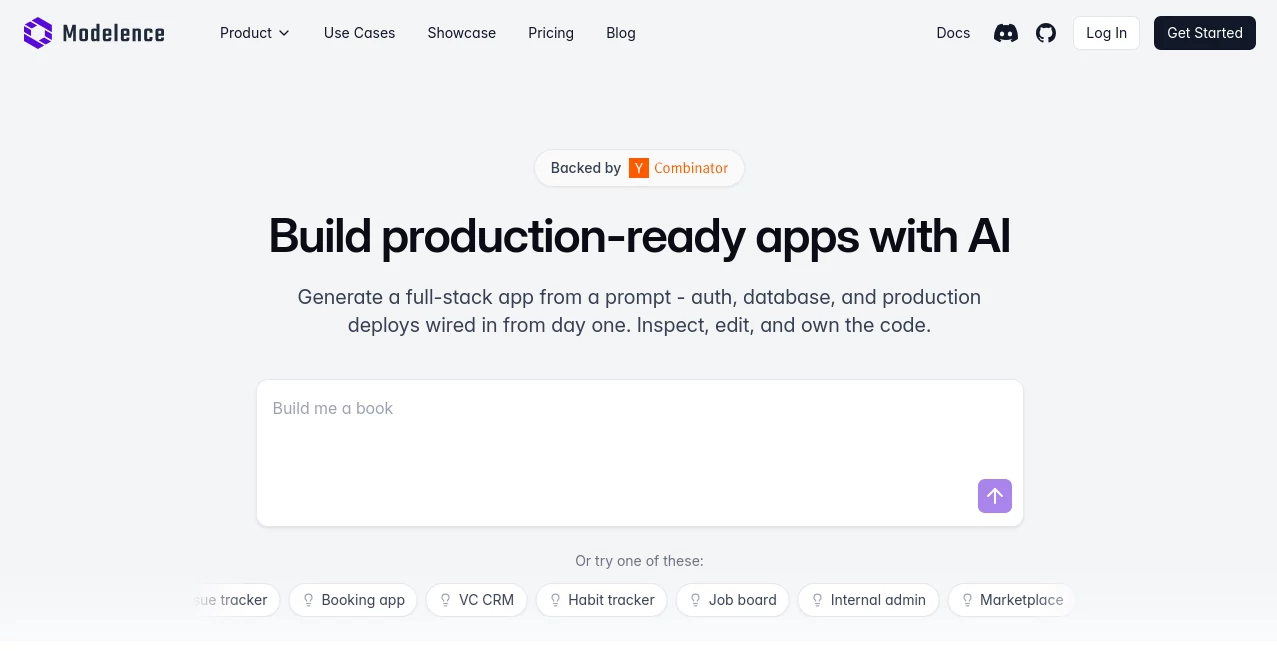
What is Modelence?
Building a web application traditionally requires a long list of moving parts: frontend development, backend architecture, authentication systems, database management, deployment pipelines, monitoring, and ongoing maintenance. For startups, solo founders, agencies, and product teams, these requirements often create a significant barrier between an idea and a working product.
This platform takes a refreshingly different approach. Instead of forcing users to stitch together multiple services and tools, it transforms simple descriptions into complete production-ready web applications. From authentication and database setup to deployment and monitoring, everything is generated as a unified system designed for real-world use.
What makes this solution particularly appealing is its focus on production readiness. Many AI-powered builders can generate attractive prototypes, but turning those prototypes into scalable products usually requires extensive manual work. Here, the emphasis is on creating applications that can serve actual customers from day one while remaining fully accessible and customizable for future growth.
Whether someone wants to launch an MVP, build an internal business tool, create a customer portal, or develop a SaaS product, the platform dramatically shortens the journey from concept to deployment.
Key Features
User Interface
The platform offers a clean and straightforward experience designed for both technical and non-technical users. Instead of navigating through complex configuration panels, users simply describe what they want to build in natural language.
The development process feels conversational. New features, changes, and refinements can be requested using plain English, making the entire workflow accessible even to individuals with little or no coding background.
Accuracy & Performance
Applications generated through the platform are designed with production workloads in mind. Rather than generating isolated frontends, the system creates complete full-stack applications with integrated databases, authentication, and deployment capabilities.
Built-in monitoring, performance metrics, and observability tools help ensure applications remain reliable as traffic grows. This focus on operational stability makes it suitable for projects that move beyond experimentation into real business use.
Capabilities
The platform supports a wide variety of application types, including:
- Customer relationship management systems
- Booking platforms
- Project management tools
- Internal business dashboards
- Membership websites
- Knowledge bases
- Marketplaces
- Customer portals
- Survey applications
- SaaS products
Generated applications include essential functionality such as user authentication, role management, database integration, deployment workflows, monitoring systems, and cloud infrastructure support.
Security & Privacy
Security is treated as a core component rather than an optional add-on. Applications include built-in authentication systems, user management, sessions, and role-based access controls.
Automatic SSL certificates, managed infrastructure, and production-grade deployment environments help reduce common security risks. Additionally, developers maintain ownership of their code and data, providing flexibility and reducing concerns related to vendor lock-in.
Use Cases
- Launching startup MVPs without hiring a full engineering team
- Building internal tools for business operations
- Creating client projects for agencies
- Developing SaaS applications rapidly
- Building customer portals and member platforms
- Creating inventory and asset management systems
- Launching booking and reservation platforms
- Building knowledge management solutions
- Developing CRM and lead management applications
- Rapid product prototyping and validation
Pros and Cons
Pros
- Creates complete full-stack applications rather than simple prototypes
- No coding experience required
- Built-in authentication and database support
- One-click deployment capabilities
- Integrated monitoring and observability tools
- Ownership of generated code and data
- Custom domain support
- Scalable cloud infrastructure
- Suitable for both individuals and teams
Cons
- Focused primarily on web application development
- Advanced customizations may still require technical knowledge
- Large enterprise projects may require higher-tier plans
- Some organizations may prefer fully manual development workflows
Pricing Plans
The platform offers multiple pricing tiers designed to accommodate different stages of development.
- Free Plan: Ideal for experimentation and early prototypes.
- Starter Plan: Suitable for launching production applications with custom domains and additional resources.
- Pro Plan: Designed for scalable production environments and multiple deployments.
- Enterprise Plan: Custom solutions with dedicated support and advanced infrastructure options.
Cloud resources are billed according to actual usage, allowing projects to scale efficiently as demand grows.
How to Use Modelence
Getting started is remarkably simple.
- Describe the application idea in plain language.
- Allow the platform to generate the full-stack architecture.
- Review and refine functionality through conversational instructions.
- Test the application in the provided environment.
- Deploy the finished product with a single click.
- Connect a custom domain if desired.
- Monitor performance and continue improving the application over time.
This streamlined workflow removes many of the technical obstacles that traditionally slow down product development.
Comparison with Similar Tools
Many AI-powered builders focus primarily on frontend generation or rapid prototyping. While those solutions can be useful for visual mockups, they often require additional services for authentication, databases, hosting, and monitoring.
In contrast, this platform provides an integrated environment where all essential components are generated together. This significantly reduces setup complexity and creates a smoother path from concept to production.
Another notable advantage is code ownership. Users retain control over their applications and are not forced into long-term platform dependency. This flexibility is especially valuable for growing businesses that need freedom to scale on their own terms.
Conclusion
For entrepreneurs, agencies, developers, and product teams looking to accelerate application development, this platform presents a compelling alternative to traditional software creation workflows. Its ability to generate production-ready applications from simple prompts dramatically reduces development time while maintaining the flexibility required for long-term growth.
By combining application generation, deployment, authentication, database management, monitoring, and infrastructure into a single experience, it offers a practical solution for turning ideas into functional products without unnecessary complexity.
The result is a development environment that feels less like a collection of disconnected tools and more like a complete product-building ecosystem.
Frequently Asked Questions (FAQ)
Can beginners build applications without coding experience?
Yes. The platform is specifically designed to allow users to create applications using natural language descriptions.
Are the generated applications production-ready?
Yes. Applications include authentication, databases, deployment capabilities, monitoring tools, and scalable infrastructure.
Can users access the generated code?
Yes. Full ownership and access to the generated codebase are provided.
Does it support custom domains?
Yes. Users can connect custom domains and benefit from automatic SSL certificate management.
What types of applications can be created?
Users can build SaaS platforms, CRMs, booking systems, dashboards, marketplaces, customer portals, internal tools, and many other web applications.
Is there a free plan available?
Yes. A free tier allows users to experiment with the platform and build initial prototypes before upgrading.
AI Website Builder , AI No-Code & Low-Code , AI Developer Tools , AI App Builder .
These classifications represent its core capabilities and areas of application. For related tools, explore the linked categories above.

Modelence Alternatives Product

Skillselion

Standard Com…

Fillout.com

Vibebot.gg

Emergent
Kimi K2.5

BootstrapKing

Jujutsu Zero…

Tate-A-Tate