
Medical Record Review Tool
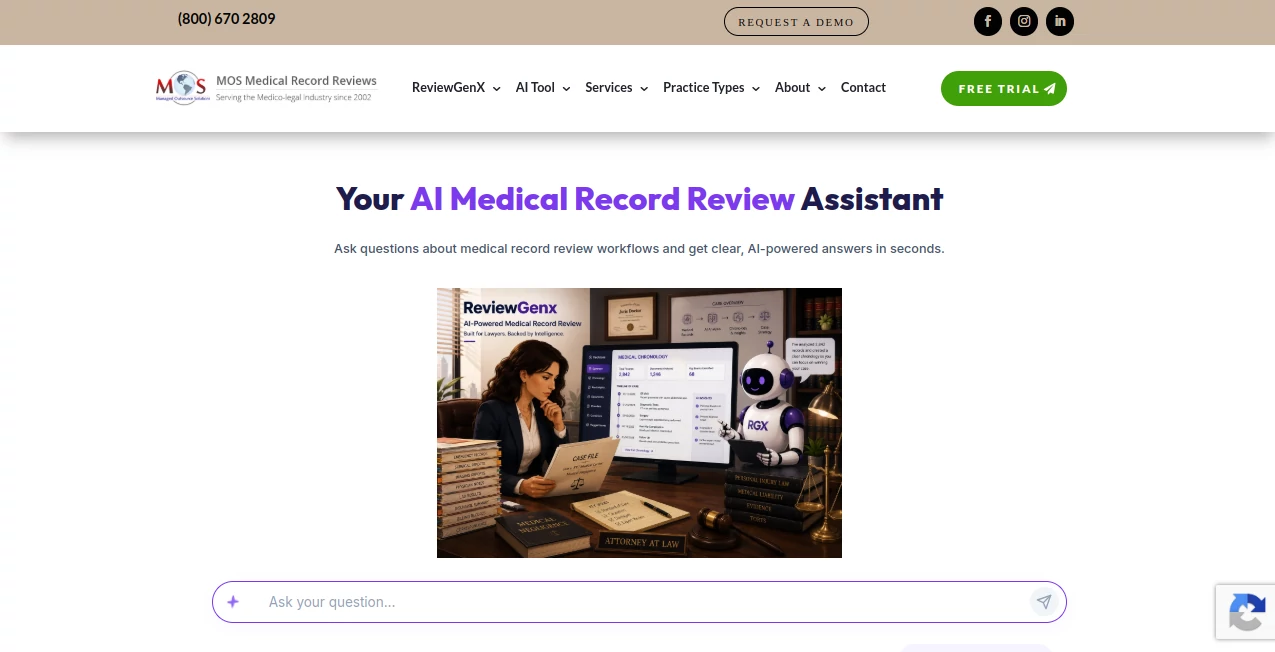
What is Medical Record Review Tool?
Medical records can be difficult to navigate, especially when they contain years of diagnoses, treatments, medications, clinical events, and documentation. ReviewGenXGPT is designed as an AI-powered assistant that helps users ask questions about medical record review workflows and receive clear answers in seconds.
The tool is built around medical record review rather than general-purpose conversations. It can help users focus on clinically relevant information, explore potential documentation issues, and better understand what deserves attention during a review. This makes it particularly useful for healthcare organizations, medical reviewers, legal professionals, insurance teams, and others who regularly work with medical documentation.
It is worth keeping expectations realistic. The service itself states that AI can make mistakes and that generated information should be independently verified. It is best viewed as a review assistant that supports professional workflows rather than a replacement for clinical, legal, or medical judgment.
Key Features
- Medical record questions: Users can ask questions about diagnoses, treatments, medications, clinical timelines, documentation concerns, and medical record review practices.
- Context-aware assistance: The conversational format is designed to provide answers based on the medical-record-review context instead of behaving like a generic chatbot.
- Important information identification: The service can help users locate details such as diagnoses, treatments, medications, and significant clinical events.
- Intelligent data extraction: Its underlying workflow includes intelligent extraction to help users find clinically relevant information in large records.
- Missing and inconsistent information: The assistant can help bring attention to incomplete, missing, or inconsistent documentation that may deserve closer professional review.
- Specialized AI persona: Users can work with a Medical Coding Specialist persona or create custom instructions for a more tailored interaction.
- Free access: The guest experience provides five free medical AI queries per session, giving users an opportunity to test the workflow before signing up.
User Interface
The interface keeps the main interaction straightforward: users can select suggested questions or enter their own question in a conversational input field. Suggested prompts cover practical concerns such as important sections of a medical record, common record issues, missing information, and errors that could affect patient care.
The persona selection feature adds another useful layer. Instead of forcing every user into the same interaction style, the platform allows a Medical Coding Specialist persona to be selected and also provides an option to create custom instructions. For someone reviewing records repeatedly, that flexibility can make the experience more practical.
Accuracy & Performance
The platform is designed to provide answers quickly, with the free trial offering standard response times. Its purpose-built medical focus is also an advantage when compared with asking a general chatbot questions about record-review workflows.
That said, medical documentation is a high-stakes area where a confident-sounding AI response is not automatically a correct one. The service explicitly warns that AI can make mistakes. Any diagnosis, clinical interpretation, documentation concern, or other important finding should therefore be checked against the original records and reviewed by an appropriately qualified professional.
Capabilities
The assistant can address questions involving diagnoses, treatments, medications, clinical timelines, documentation issues, and general medical record interpretation. It is also designed to help users work through large and complex records by surfacing relevant information and providing context around what they are reviewing.
For organizations handling more advanced workflows, the broader platform offers capabilities including medical chronologies and event mapping, medical record summaries, intelligent data extraction, workflow automation, customizable reporting, deduplication, and human-in-the-loop review. The free tool provides a useful entry point into this wider ecosystem.
Security & Privacy
Medical information requires careful handling, so privacy and security should be considered before entering any sensitive information into an AI service. The website displays a HIPAA Certified badge and positions its broader service around professional medical record review workflows.
Users should nevertheless review the provider's current privacy terms and applicable data-handling policies before submitting protected or confidential information. As with any AI system used around sensitive records, organizations should follow their own compliance procedures and avoid sharing information unless they are authorized to do so.
Use Cases
Healthcare organizations: Teams can use the assistant to explore medical record questions, locate relevant clinical details, and support documentation review.
Medical record reviewers: Reviewers dealing with lengthy records can use conversational questions to focus their attention on particular diagnoses, treatments, events, or documentation concerns.
Legal professionals: Personal injury, medical negligence, workers' compensation, and other legal teams working with medical documentation may find the tool useful for organizing questions and identifying information that warrants further examination.
Insurance teams: Insurance professionals can use AI-assisted questions to help navigate complex medical documentation during review workflows.
Medical coding workflows: The Medical Coding Specialist persona makes the service particularly relevant to users who need assistance thinking through coding-related medical documentation questions.
Learning and preparation: Someone unfamiliar with medical record review can use the suggested questions as a starting point for understanding which sections and details deserve attention.
Pros and Cons
Pros
- Focused specifically on medical record review rather than general conversation.
- Offers five free medical AI queries per session.
- Provides suggested questions that help new users get started quickly.
- Can help identify diagnoses, treatments, medications, clinical events, and documentation concerns.
- Includes a specialized Medical Coding Specialist persona.
- Supports custom instructions for more tailored interactions.
- Useful across healthcare, insurance, medical review, and legal workflows.
Cons
- AI-generated answers still require independent verification.
- The free experience is limited to five medical AI queries per session.
- Advanced capabilities such as document upload analysis are reserved for the Pro plan.
- It should not be used as a substitute for professional clinical, legal, or medical judgment.
- Users handling sensitive records need to consider their organization's privacy and compliance requirements before submitting information.
Pricing Plans
The service currently offers a free trial with five medical AI queries per session, access to standard personas, standard response times, advanced web grounding, and priority support.
The Pro plan expands the experience with unlimited AI queries, custom and premium personas, live web grounding, document upload analysis, and priority 24/7 support. The page does not publish a specific Pro price, so interested users should check the provider's current plan information for the latest pricing.
How to Use the Tool
- Open the medical record review assistant.
- Start with one of the suggested questions or enter a specific question in the chat box.
- Ask about topics such as diagnoses, treatments, medications, clinical timelines, or documentation issues.
- Review the response and compare important claims with the original medical documentation.
- Use the available persona options when a more specialized interaction is helpful.
- Create custom instructions when you need the assistant to follow a particular review approach.
- For advanced workflows, sign up to explore the additional capabilities available through the Pro plan.
Comparison with Similar Tools
General AI chatbots can answer questions about medicine, but they are not necessarily designed around the workflow of reviewing medical records. This service takes a more specialized approach by focusing its prompts, personas, and functionality on medical documentation and review.
Another important distinction is the broader workflow surrounding the assistant. Features such as medical chronologies, event mapping, intelligent data extraction, deduplication, customizable reporting, and human-in-the-loop processes are aimed at the practical challenges that arise when professionals work through substantial medical records.
For someone who simply wants general health information, a conventional AI assistant may be sufficient. For a user whose task specifically involves analyzing or reviewing medical documentation, a purpose-built solution can provide a more relevant starting point.
Conclusion
Reviewing medical records is rarely a simple matter of reading from the first page to the last. Important details can be separated by months or years of documentation, while inconsistencies and missing information may only become apparent after looking at the broader timeline. This AI assistant provides a convenient conversational layer for asking focused questions and finding areas that deserve closer attention.
Its free trial is especially useful for users who want to test the experience without committing immediately. The combination of medical-focused responses, specialized personas, intelligent information extraction, and broader review capabilities gives it a practical place in modern medical documentation workflows.
The most sensible way to use it is as an additional pair of eyes rather than the final authority. When its answers are checked against the source records and professional judgment remains in control, it can make the process of navigating complex medical documentation considerably more manageable.
Frequently Asked Questions (FAQ)
What is this medical record review tool?
It is an AI-powered assistant designed to help users understand medical record review workflows, ask questions about medical documentation, and locate clinically relevant information.
Can it identify important information in medical records?
Yes. It can help highlight information such as diagnoses, treatments, medications, clinical events, and other details that may be relevant during a medical record review.
Can it help with large or complex medical records?
The service is designed to help users navigate large and complex medical records by providing context-aware answers and assistance with locating relevant details.
Can it find missing or inconsistent information?
It can help identify potentially missing, incomplete, or inconsistent information. These findings should always be checked against the original documentation.
Is it a replacement for a doctor or medical professional?
No. AI-generated information should not replace professional medical, clinical, coding, or legal judgment. Important findings should be independently verified by an appropriately qualified professional.
How many free questions can I ask?
The free trial currently provides five medical AI queries per session.
Does it have a paid plan?
Yes. The Pro plan provides unlimited AI queries, custom and premium personas, live web grounding, document upload analysis, and priority 24/7 support.
Who can benefit from this type of tool?
Healthcare organizations, medical record reviewers, legal professionals, insurance teams, and other professionals involved in analyzing medical records can use it as an aid during their review workflows.
Can I upload documents?
Document upload analysis is listed as a Pro plan feature. Availability and supported document types may depend on the current service configuration.
What should I do if an AI answer looks incorrect?
Check the answer against the original medical records and consult an appropriately qualified professional. The service itself advises users to verify AI-generated information for accuracy.
AI Document Extraction , AI Research Tool , AI Healthcare , AI Legal Assistant .
These classifications represent its core capabilities and areas of application. For related tools, explore the linked categories above.
Medical Record Review Tool details
Website unavailable — View Alternatives
Pricing
- Freemium
Apps
- Web App
Categories

Medical Record Review Tool Alternatives Product

Harvey

Needle

Geoleaper

Roipad

Arobis AI Vi…

PlateLens

Grok 4

Grow A Garde…

Reverse Imag…