
Nenuphar Travel
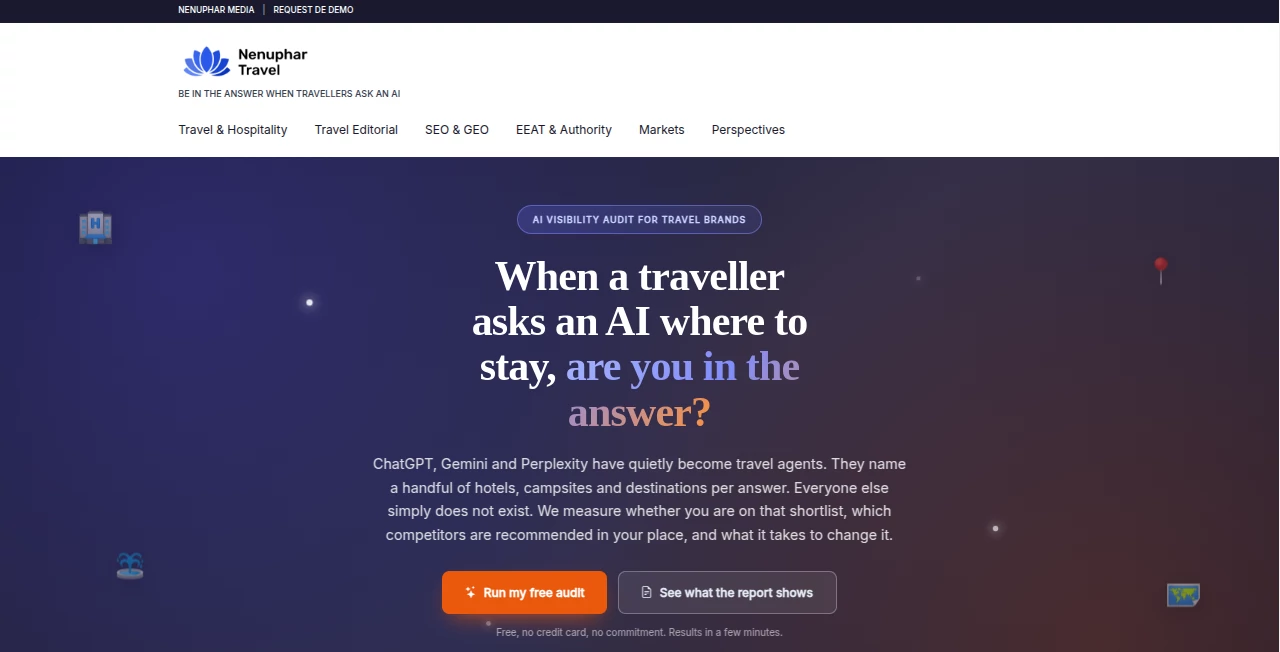
What is Nenuphar Travel?
Nenuphar Travel is a digital media platform built specifically for the travel industry, helping hotels, tourism boards, travel publishers, and destination brands turn their expertise into an owned media channel. Instead of depending entirely on online travel agencies, social platforms, or paid advertising, businesses can build a branded publication on their own domain and use it to attract travelers through search, useful editorial content, and lead generation.
The platform combines AI-assisted editorial technology, SEO architecture, multilingual publishing, and lead-generation capabilities in one infrastructure. Its approach is particularly interesting for travel businesses that want more than a conventional blog: the goal is to create a long-term media asset capable of attracting organic traffic, strengthening brand authority, and supporting direct commercial results.
Key Features
- AI-driven editorial planning for identifying relevant destinations, topics, and content opportunities.
- AI-assisted production of destination guides, travel articles, landing pages, and other editorial formats.
- SEO-focused content architecture designed for organic search visibility.
- Support for multilingual and multi-destination travel media projects.
- Publishing capabilities designed for media, social channels, and partner networks.
- Lead-generation tools that connect editorial traffic with commercial opportunities.
- Support for affiliate, sponsorship, advertising, and direct monetization models.
- AI and generative-search readiness for travel content.
User Interface
The experience is designed around the workflow of a travel media operation rather than a simple AI writing box. The platform brings editorial planning, content production, publishing, and monetization into a broader media infrastructure.
That distinction matters for teams managing a large destination portfolio or publishing across several markets. Instead of treating every article as an isolated task, the system is positioned around building a connected editorial operation where content, search visibility, and lead generation work together.
Accuracy & Performance
Performance is presented as a combination of content strategy, structured publishing, and search optimization rather than AI generation alone. The platform states that its network manages more than 500 travel media pages, supports 12 languages out of the box, and reports an average threefold organic traffic growth during the first year.
Those figures are platform-reported rather than independent benchmarks, so businesses should evaluate them against their own market, domain authority, publishing frequency, and starting traffic. Still, the underlying strategy makes practical sense: consistent destination-focused content can create a growing library of pages capable of capturing travelers at different stages of the planning journey.
Capabilities
The platform is organized around four main areas: editorial planning, content production, multichannel publishing, and lead generation with monetization. Its editorial planning system is intended to identify topics and destinations that audiences are actively searching for, while the production layer helps teams create travel content at scale.
For hotels and tourism organizations, one useful capability is the ability to move beyond purely transactional pages. A hotel can publish destination guides, local experience stories, seasonal travel content, and practical visitor information that attracts potential guests before they are ready to book.
The multilingual architecture is another strong point for international travel businesses. A destination brand serving visitors from several countries can build content around different languages and markets rather than relying on one generic version of its website.
Security & Privacy
The platform emphasizes ownership of the media asset, brand, data, and audience rather than publishing primarily through third-party platforms. Its website states that businesses retain their brand, data, and audience through the owned-media approach.
For organizations considering the platform, privacy and data-handling details should still be reviewed directly with the provider before deployment, particularly when lead forms, CRM integrations, first-party data, or customer information are involved.
Use Cases
Hotels can use the platform to build destination media around their properties and attract travelers during the inspiration and research stages. Instead of waiting for someone to search for a specific hotel, a property can publish useful guides covering neighborhoods, attractions, restaurants, seasonal activities, and local experiences.
Tourism boards and destination marketing organizations can use it to create a centralized editorial presence around a region. This can include destination guides, cultural content, seasonal recommendations, and local experiences while giving the destination greater control over its digital narrative.
Travel publishers can use the infrastructure to increase editorial output without expanding their teams at the same pace. AI-assisted production can support research-driven articles, destination content, trends, and multilingual publishing while editors remain responsible for quality and direction.
It can also suit travel businesses looking to reduce dependence on third-party discovery channels. Building an owned audience takes time, but successful content can continue attracting visitors long after a paid campaign has ended.
Pros and Cons
- Pros: Purpose-built for travel and hospitality, combines editorial and marketing infrastructure, supports multilingual publishing, focuses strongly on SEO and generative search, includes lead-generation and monetization strategies, and is designed for long-term owned-media growth.
- Cons: It may be more infrastructure than a small travel business needs, pricing is not publicly displayed, results depend heavily on content quality and implementation, and businesses should request specific performance evidence before committing to a long-term program.
Pricing Plans
No standard public pricing table is displayed on the website. Instead, prospective customers are encouraged to discuss their project and request a demonstration. This makes sense for a platform intended for hotels, tourism organizations, publishers, and larger travel brands, since requirements can vary considerably between a single-property publication and a multilingual, multi-destination media operation.
Organizations evaluating the service should ask for a customized proposal covering setup, content production, editorial strategy, publishing, integrations, support, and any additional costs associated with scaling across destinations or languages.
How to Use It
Start by defining the travel brand, destination, audience, and commercial objective you want the media platform to support. A hotel might focus on attracting visitors researching a city, while a tourism board may want to build authority around an entire region.
Next, establish an editorial strategy around destinations, traveler questions, local experiences, seasonal demand, and commercially relevant topics. Use the editorial tools to identify opportunities and build a consistent publishing plan.
Produce and publish the selected content through the branded media environment, keeping editorial quality and local expertise at the center. Over time, connect high-performing content with lead-generation, booking pathways, affiliate opportunities, sponsorships, or other monetization channels.
Finally, monitor organic visibility, audience behavior, leads, and assisted commercial outcomes. The strongest results should come from continuously improving the topics and content formats that attract qualified travelers rather than simply increasing article volume.
Comparison with Similar Tools
Traditional AI writing tools generally focus on producing individual pieces of text. That can be useful for drafting an article, but it leaves businesses responsible for the surrounding strategy, website architecture, publishing workflow, SEO structure, and conversion system.
Conventional content agencies take a broader role, but their work often centers on delivering content rather than providing an entire owned-media infrastructure. This platform takes a different approach by combining AI-assisted editorial production with SEO architecture, publishing, lead generation, and monetization.
For a small company looking for occasional travel articles, a simple AI writer may be sufficient. For a hotel group, tourism organization, or travel publisher attempting to build a serious digital publication, the more comprehensive infrastructure can be considerably more valuable.
Conclusion
For travel businesses that want to build an audience instead of continually renting attention from search platforms, OTAs, social networks, and advertising channels, this platform presents a compelling approach. Its strongest idea is not simply using AI to write faster. It is turning travel expertise into a structured media asset that can attract visitors, build authority, and eventually contribute to revenue.
The combination of editorial planning, AI-assisted content production, multilingual architecture, SEO, generative-search readiness, and lead generation gives the product a clear focus. It is best suited to organizations willing to treat content as a long-term business asset rather than a collection of occasional blog posts.
Frequently Asked Questions (FAQ)
What is this platform designed for?
It is designed for hotels, tourism boards, travel publishers, and other travel businesses that want to create and operate a branded digital media platform.
Can it help hotels attract direct bookings?
Yes. The platform is designed to attract travelers through destination-focused content and connect that audience with lead-generation and direct commercial pathways, potentially supporting direct bookings while reducing reliance on third-party channels.
Does it support multiple languages?
Yes. The website states that its architecture supports 12 languages out of the box, making it suitable for travel brands targeting international audiences.
Does it only generate AI articles?
No. Its positioning goes beyond article generation. The platform combines editorial strategy, content production, publishing, SEO architecture, lead generation, and monetization into a broader travel media infrastructure.
Who would benefit most from it?
Hotels, hotel groups, tourism boards, destination organizations, and travel publishers are the clearest target users, especially those looking to build long-term organic visibility and an audience they can reach directly.
Is pricing available publicly?
The website does not present a standard public pricing table. Prospective customers can request a demonstration and discuss their specific project requirements.
How quickly can results appear?
The platform states that many partners see initial organic traction within approximately 8 to 12 weeks, while meaningful lead generation typically begins around months three to four. Actual results will vary depending on the market, website authority, content strategy, competition, and publishing consistency.
AI SEO Assistant , AI Content Generator , AI Digital Marketing Generator , AI Marketing Plan Generator .
These classifications represent its core capabilities and areas of application. For related tools, explore the linked categories above.
Nenuphar Travel details
Website unavailable — View Alternatives
Pricing
- Subscription
Apps
- Web App
Categories

Nenuphar Travel Alternatives Product

Serplux

Domain Rank …

BuildRoy

Orchestra

extractkeywo…

GPT Image 2

SEOTakeoff

RichlyAI

BlogBuster