NOXEL SEO
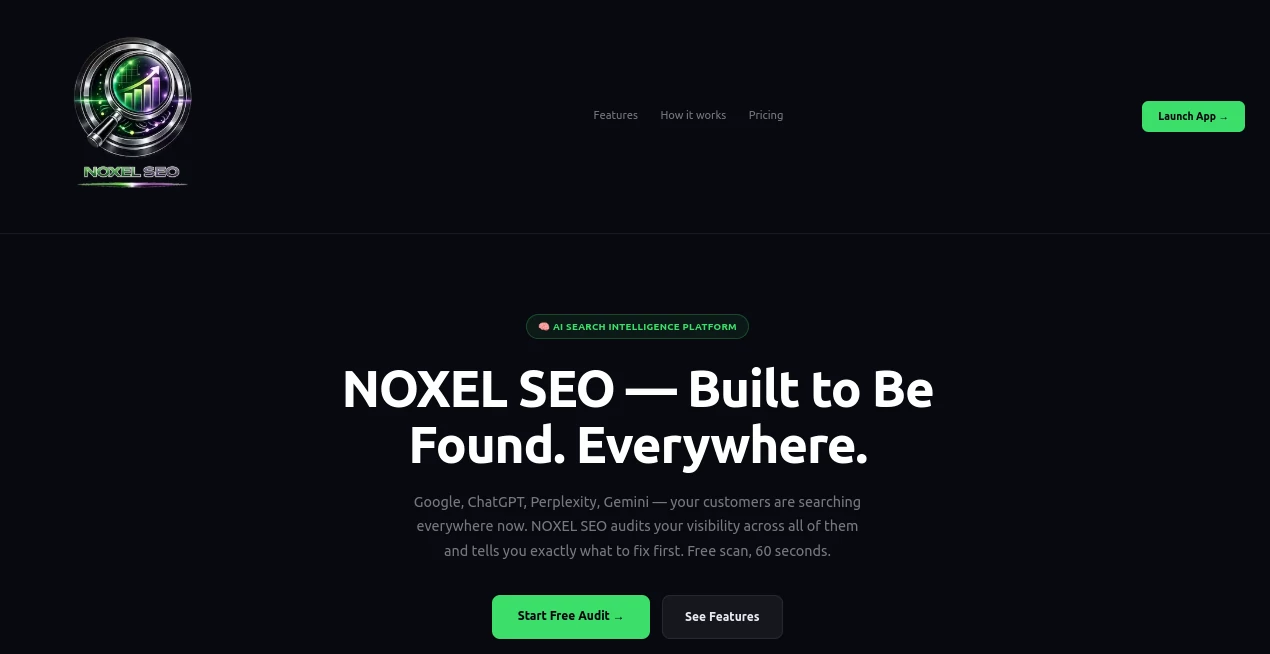
What is NOXEL SEO?
SEO can become complicated very quickly. A website may have strong content and a good product, yet still lose visibility because of broken links, weak metadata, missing schema, slow pages, or technical issues that are easy to overlook. NOXEL SEO takes a practical approach by scanning a website and turning those problems into a clear list of actions.
The platform is designed around modern search visibility rather than traditional SEO alone. Alongside Google-focused technical analysis, it looks at visibility across AI answer engines and provides recommendations designed to help website owners understand what needs attention first. A full audit can be completed in under 60 seconds, with no setup, plugin, or browser extension required.
For a small business owner, developer, marketer, or SEO agency, that simplicity is particularly useful. Instead of spending time interpreting a long collection of disconnected metrics, you get a prioritized view of the problems affecting a website and practical guidance for addressing them.
Key Features
- Technical SEO audits covering more than 50 signals.
- Core Web Vitals analysis for important performance metrics such as LCP, CLS, and TBT.
- AI Copilot powered by Claude AI for explaining findings and generating code-based fixes.
- Priority Matrix that ranks issues according to impact and effort.
- Schema and structured-data validation for JSON-LD and common schema types.
- Support for 115 languages with RTL support.
- Multilingual PDF report generation.
- Scan history for tracking SEO improvements over time.
- Security header checks covering technologies such as HSTS and Content Security Policy.
- SEO-focused analysis that also considers AEO, GEO, SXO, and E-E-A-T signals.
- AI-generated meta tags that can be created from the audit.
- SEO Academy with interactive lessons for users who want to improve their technical SEO knowledge.
User Interface
The experience starts with a simple idea: enter a public URL and let the platform inspect it. There is no complicated installation process and no requirement to add a browser extension before getting started.
The results are organized around actionable findings rather than simply presenting a wall of numbers. Each issue can be evaluated according to its potential ranking impact, crawl impact, user-experience effect, and the effort required to fix it.
This approach makes the interface especially approachable for people who understand their website but are not necessarily technical SEO specialists. An agency can also use the generated reports when explaining technical problems to clients who want clear answers rather than SEO jargon.
Accuracy & Performance
The platform checks more than 50 technical SEO signals in a single audit, including metadata, headings, canonical directives, hreflang, robots directives, redirects, broken links, internal linking, schema, security headers, and content-related signals.
Performance analysis is another important part of the audit. Real measurements for Core Web Vitals are used to identify performance problems on both mobile and desktop, helping users distinguish between issues that are merely technical and those that may have a meaningful effect on the visitor experience.
The service states that a complete audit typically takes less than 60 seconds. That makes it practical for quick checks before publishing a page, reviewing a redesign, onboarding an SEO client, or comparing a website with competitors.
Capabilities
One of the more interesting capabilities is the combination of traditional technical SEO with AI-search visibility. Modern users do not always discover businesses through a conventional Google result. They may ask ChatGPT, Perplexity, Gemini, or another answer engine for recommendations instead.
The AI Copilot adds another useful layer. Rather than simply telling you that something is wrong, it can explain the finding in plain language, suggest what should be done next, and produce copy-and-paste code fixes where appropriate. This can save considerable time when working through technical recommendations.
Competitor analysis is also available by entering a website alongside up to five competitor URLs. The resulting comparison can help identify differences across technical SEO, content, and performance signals.
Reports are available in 115 languages, including major European languages as well as Arabic, Japanese, and Hindi. RTL support makes the reporting experience more practical for teams working in right-to-left languages.
Security & Privacy
Security is addressed through dedicated checks for important HTTP security headers, including HSTS, X-Content-Type-Options, X-Frame-Options, and Content-Security-Policy. These checks can expose configuration gaps that may affect website security, trust, and sometimes performance-related signals.
For website owners, this is a useful reminder that SEO is not completely separate from technical security. A site can have excellent content while still suffering from avoidable infrastructure weaknesses.
Use Cases
The platform fits a wide range of SEO workflows. A startup can use it before launching a new website to catch technical problems that might otherwise remain hidden. A marketer can audit landing pages before an important campaign. Developers can use the findings to identify technical SEO issues during a redesign or migration.
SEO agencies can also benefit from the reporting functionality. A multilingual PDF report can be useful during client onboarding, monthly reviews, or technical audits. Instead of manually turning raw SEO findings into a presentation, the report provides a ready-to-share format.
It is also useful for competitor research. If another website appears to be outperforming yours, comparing technical and performance signals can reveal areas worth investigating rather than relying purely on assumptions about backlinks or content.
Pros and Cons
Pros
- Free to start without requiring a credit card.
- Full technical audit completed in under 60 seconds.
- More than 50 SEO signals checked in each scan.
- AI Copilot explains technical findings in accessible language.
- Prioritizes problems instead of simply listing them.
- Combines traditional SEO with AI-search visibility considerations.
- 115-language reporting with RTL support.
- Multilingual PDF reports are useful for agencies and client work.
- Includes Core Web Vitals and security-header analysis.
Cons
- The most advanced AI Copilot and reporting capabilities require an upgrade.
- Users looking for a large-scale keyword database or extensive backlink intelligence may still need a specialized SEO platform alongside it.
- Technical recommendations are most valuable when the user is prepared to implement the suggested fixes.
Pricing Plans
The service follows a free-to-start model, allowing users to run an initial audit without an account or credit card. According to the pricing information presented on the site, paid access starts at around $19 per month and unlocks additional capabilities through the NOXEL360 suite.
Advanced features include AI Copilot access, unlimited scans, full PDF reporting, and additional intelligence modules. This structure makes the product easy to test before committing to a paid plan, which is particularly helpful for freelancers and small businesses that want to evaluate an SEO workflow before adding another recurring expense.
How to Use It
Getting started is straightforward. First, enter the public URL of the page you want to examine. This can be a homepage, landing page, blog article, product page, or another publicly accessible URL.
Next, wait for the audit to complete. The system examines technical SEO signals, performance, Core Web Vitals, structured data, security headers, content quality, and internal linking. Findings are then organized by severity and priority.
If you need more explanation, use the AI Copilot to ask questions about the results. It can translate technical findings into plain language and suggest practical fixes, including code snippets when appropriate.
After making changes, run another scan and compare the new results with previous audits. Keeping the scan history makes it easier to see whether technical improvements are actually moving the website in the right direction.
Comparison with Similar Tools
Large SEO suites such as Semrush and Ahrefs remain valuable for broader SEO research, especially when extensive keyword, backlink, and competitive intelligence is required. The approach here is somewhat different.
The focus is on turning an audit into an actionable repair plan. Instead of leaving users with hundreds of metrics to interpret, the platform emphasizes what should be fixed first and why it matters. Its AI Copilot also adds an explanatory layer that can be helpful when a technical recommendation is unfamiliar.
Another distinction is its attention to AI-search visibility. Traditional SEO remains important, but the way people discover information is expanding. Evaluating visibility across AI answer engines alongside Google gives website owners a broader picture of how their digital presence may be discovered.
For someone who already uses a large SEO suite, this can work as a complementary technical auditing and action-planning tool. For smaller teams, the free starting point provides an inexpensive way to see whether the workflow fits their needs before paying for more advanced functionality.
Conclusion
Technical SEO is rarely about fixing one dramatic problem. More often, rankings and user experience are affected by a collection of smaller issues: missing metadata, weak structured data, slow pages, broken links, incorrect directives, or security configuration gaps.
This platform does a good job of bringing those details into one workflow and, more importantly, putting them into an order that makes sense. The combination of technical auditing, Core Web Vitals, AI-assisted explanations, structured-data checks, multilingual reporting, and AI-search visibility makes it particularly interesting for modern website owners.
The free starting option also lowers the barrier to testing it. If you want a fast technical snapshot of a website and prefer recommendations you can actually act on rather than another dashboard full of unexplained numbers, it is well worth putting through an audit.
Frequently Asked Questions (FAQ)
What does this SEO platform do?
It performs technical SEO audits, analyzes Core Web Vitals, checks structured data and security headers, identifies website issues, and provides AI-assisted recommendations for fixing them.
Is it free to use?
Yes. Users can start with a free audit without creating an account or entering credit-card information. Advanced functionality is available through paid access.
How long does an audit take?
A full audit is designed to take less than 60 seconds, making it suitable for quick checks of homepages, landing pages, blog posts, and other public URLs.
Does it analyze Core Web Vitals?
Yes. The platform measures important performance metrics such as LCP, CLS, and TBT and identifies performance issues that may affect mobile and desktop experiences.
Does it support AI search optimization?
Yes. Its approach goes beyond conventional Google SEO and includes visibility concepts associated with AI answer engines, including AEO and GEO.
What does the AI Copilot do?
The AI Copilot can access audit findings, explain technical problems in plain language, suggest prioritized actions, and generate copy-and-paste code fixes for relevant issues.
How many languages are supported?
The platform supports reports and recommendations in 115 languages, including RTL languages such as Arabic.
Can agencies use it for client reports?
Yes. Multilingual PDF exports make the audit results easier to share with clients, while scan history helps agencies track improvements over time.
Can competitor websites be analyzed?
Yes. Users can enter their own website and up to five competitor URLs to compare technical SEO, content, and performance signals.
Who is this tool best suited for?
It is a good fit for website owners, founders, marketers, developers, SEO professionals, and agencies that want fast technical audits with clear priorities and practical recommendations.
These classifications represent its core capabilities and areas of application. For related tools, explore the linked categories above.

NOXEL SEO Alternatives Product

zGEO Ranker

ModelsLab

DidYouSEO

Lutains

Youfiliate

extractkeywo…
Analyse
RankPeak
Website Audi…