Obsess AI
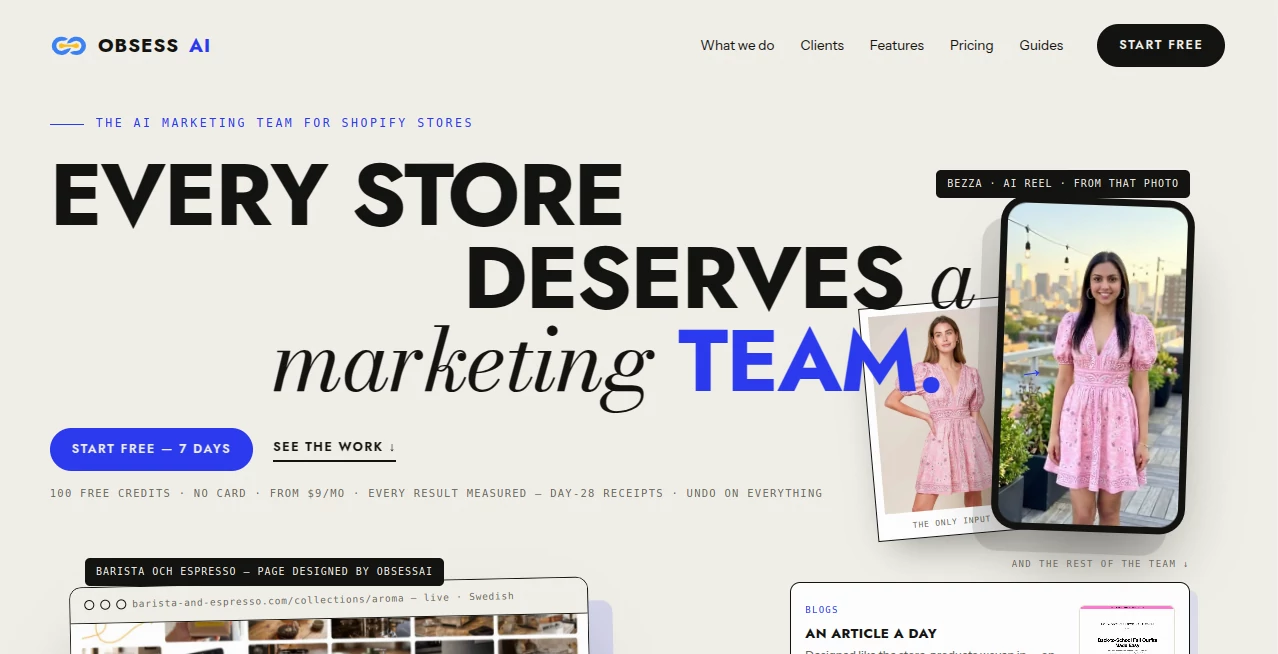
What is Obsess AI?
Running a Shopify store involves far more than adding products and waiting for customers to arrive. Store owners have to maintain product descriptions, create landing pages, publish useful articles, keep social channels active, improve search visibility, and make sure everything still looks like part of the same brand. ObsessAI approaches that workload as an ongoing marketing operation rather than another standalone writing tool.
The platform is designed specifically for Shopify stores and works with the store's existing theme, catalog, content, and search data. Instead of asking merchants to start from a blank prompt, it studies the store first and uses that information when creating pages, articles, product copy, images, and social content.
One particularly practical part of the workflow is the preview system. Generated work can be reviewed on the actual storefront before it is published, which gives merchants an opportunity to make changes without immediately affecting their live store. The platform also provides measurement after publication, including a day-28 performance verdict for supported work.
Key Features
- AI-generated collection, landing, home, and product hero pages
- Automated blog content designed around the store's existing style
- Product descriptions, SEO titles, meta descriptions, and image alt text
- Bulk product copy generation for larger catalogs
- Blog refreshes for older or underperforming content
- UGC video creation from catalog photography
- Social media publishing and scheduling
- Custom presenter avatars created from approved recordings
- Keyword intelligence based on Search Console data
- SEO issue detection and reversible fixes
- Diagnosis reports and performance receipts
- AI-assisted editing through natural-language instructions
User Interface
The interface is built around the workflow of a Shopify merchant rather than a traditional AI text editor. After installation, the platform can examine the store's theme sections, product catalog, existing copy, and historical Search Console information. This gives the system useful context before it begins generating anything.
Generated pages and content appear as previews on the storefront. A merchant can inspect the result as a customer would see it, make adjustments, publish it, or discard it. The conversational editing experience is also useful when a first draft is close but not quite right. A simple instruction such as asking for a warmer tone or a shorter FAQ can be used to refine the preview.
Accuracy & Performance
The biggest advantage here is context. The platform does not rely solely on a generic prompt about what a store sells. It works from the merchant's own catalog, existing brand copy, theme structure, and search information.
Product information is treated as the source of truth, while approved product photography is used when creating visual material. This is particularly helpful for ecommerce businesses where inventing product characteristics or changing important purchasing information could create serious problems.
Performance measurement is another strong point. Published work can have a baseline recorded at launch and then evaluated later. The platform's own examples include a day-28 verdict and comparisons intended to show whether a particular content or SEO change actually helped.
Capabilities
The range of work goes well beyond article generation. Merchants can create collection pages, landing pages, home pages, product-focused sections, blog posts, refreshed articles, product descriptions, social posts, and short UGC-style videos.
For stores with a large catalog, bulk product copy can save considerable manual work. A product description task can cover the description itself as well as SEO title, meta description, and alt text. Social publishing can also be scheduled across connected platforms, while keyword intelligence helps identify search opportunities based on the store's own data.
The platform can also work with the store's existing theme rather than forcing merchants into a separate page-building environment. Commerce-critical elements such as pricing, variants, inventory, cart, and checkout remain controlled by the store's native theme.
Security & Privacy
Store owners should always review the permissions and privacy terms of any application connected to their Shopify store. The service is built around access to store content, product information, theme components, and search-related data, so understanding what information is accessed and how generated content is handled is important before installation.
A useful safeguard is that generated pages, articles, and posts are presented for review before publication. The platform also emphasizes reversibility, allowing merchants to undo changes rather than permanently replacing original content without a review step.
Use Cases
For a growing Shopify store, one of the most obvious uses is maintaining product content. Instead of manually rewriting hundreds of descriptions, a merchant can generate updated copy across a catalog while keeping the original wording available until the new version is approved.
Content-heavy stores can use the blog workflow to maintain a regular publishing schedule. Older articles can also be refreshed when they have lost visibility, giving existing content another opportunity to perform in search.
Another practical scenario is seasonal ecommerce marketing. A store launching a new collection can use the platform to create supporting pages, product-focused content, social posts, and promotional material without coordinating several separate tools.
It can also be useful for smaller teams. Imagine a store owner who handles product sourcing, customer support, and marketing alone. Instead of spending an entire afternoon preparing a collection page and several social posts, much of that production work can be delegated to the platform and then reviewed before going live.
Pros and Cons
Pros
- Designed specifically for Shopify stores
- Works with the store's existing theme and brand voice
- Combines content, design, SEO, and social workflows in one platform
- Supports bulk product content generation
- Provides storefront previews before publishing
- Includes measurable performance tracking for supported work
- Offers reversible changes and rollback options
- Uses a credit system where costs are shown before a run begins
- Includes a free trial with no credit card requirement
Cons
- The platform is primarily aimed at Shopify merchants
- Some advanced features are restricted to higher-tier plans
- Credits reset monthly and unused credits do not roll over
- Businesses with very large content requirements may need a higher plan
- Merchants should still review AI-generated content before publishing
Pricing Plans
The pricing model is based on credits rather than the number of team members. Every plan starts with a 7-day trial and 100 credits, with no credit card required for the trial. Each type of work has a published credit cost, and the platform shows the expected credit usage before a run begins.
- Starter – $9/month: 250 credits with access to pages, blog content, product copy, and social posts. Video is not included.
- Growth – $39/month: 1,250 credits with bulk copy generation and UGC video capabilities.
- Professional – $99/month: 3,500 credits with keyword intelligence, AI assistant features, autopilots, and priority access.
- Enterprise – $299/month: 12,000 credits with API access, dedicated support, and top-up options.
The credit system is relatively straightforward. A blog post costs 35 credits, a social post costs 10 credits, a product description task costs 5 credits per product, and UGC video is priced according to the finished video's duration. This makes it easier to estimate the cost of a particular campaign before starting it.
How to Use the Tool
Start by installing the Shopify application and connecting the store you want to manage. The initial setup is designed to be simple because the platform examines the store's existing theme, catalog, copy, and available search information rather than requiring merchants to manually configure every part of the system.
Once the store has been analyzed, choose the type of work you want to create. This could be a product description, blog article, collection page, landing page, social post, SEO improvement, or another supported task.
Review the generated result on the storefront preview. If something feels too long, too formal, or simply doesn't sound like the brand, describe the change in plain language and refine it. When the result is ready, publish it to the store.
For automated workflows, merchants can configure a cadence for recurring content and social activity. More advanced plans can also use keyword intelligence and automation features to help determine what should be worked on next.
Comparison with Similar Tools
Many AI marketing products focus on one particular job. Some are primarily writing assistants, others concentrate on SEO, social media scheduling, page building, or product copy. The main difference here is the attempt to bring these jobs together around an existing Shopify store.
Compared with a general-purpose AI writer, the platform has a stronger ecommerce context because it can work from the store's products, theme, existing content, and search history. Compared with a traditional page builder, it takes more responsibility for deciding what content and structure should be created instead of simply providing a collection of components.
It also takes a different approach to SEO. Rather than presenting SEO as a completely separate workflow, keyword opportunities and content decisions are connected to the store's actual search history. For merchants who want one system to handle several parts of their marketing workload, this integrated approach can be more convenient than moving between several specialized applications.
Conclusion
ObsessAI is a strong option for Shopify merchants who have reached the point where marketing work is becoming a daily operational burden. Its appeal comes from combining several responsibilities that normally require different tools: storefront content, product copy, blog publishing, social media, visual content, and SEO improvement.
The most convincing part of the experience is not simply that it can generate content. It is the way the platform connects that content to the merchant's existing store. Using the store's theme, products, brand voice, and search information makes the output more relevant than starting every task with a blank AI prompt.
For a small ecommerce team, that can translate into a much more manageable marketing workflow. The ability to preview work before publishing, measure results afterward, and undo changes adds another layer of control. Businesses that want an AI-assisted marketing operation inside Shopify should find plenty to explore here.
Frequently Asked Questions (FAQ)
Is this tool designed for Shopify?
Yes. The platform is specifically built for Shopify stores and is designed to work with the store's existing theme, catalog, content, and ecommerce workflow.
Can it write product descriptions?
Yes. It can generate product descriptions along with SEO titles, meta descriptions, and alt text. Product copy can also be generated in bulk for larger catalogs.
Can it create blog content?
Yes. The blog engine can produce store-branded articles, while the blog refresh feature is intended for older content that needs improvement or another opportunity to perform in search.
Does it create social media content?
Yes. Social posts can be created and scheduled for connected platforms. The system can also produce UGC-style vertical videos from suitable catalog photography.
Can I review content before it is published?
Yes. Generated pages, articles, and posts are shown in a preview on the storefront before publication, allowing merchants to review or discard the work.
Does it provide SEO features?
Yes. Higher-tier plans include keyword intelligence, while the broader platform can identify SEO issues, recommend fixes, and track the performance of published changes.
Does it automatically change my Shopify checkout or product purchasing system?
No. The platform states that pricing, variants, inventory, cart, and checkout remain controlled by the store's native theme rather than being AI-rendered.
Is there a free trial?
Yes. Every plan starts with a 7-day trial and 100 credits, and the trial does not require a credit card.
How does the credit system work?
Different types of work consume different amounts of credits. The expected credit cost is shown before a run begins, so merchants can decide whether to proceed before using their allowance.
Which businesses can benefit most from it?
It is particularly suitable for Shopify stores that regularly publish products, articles, landing pages, collection pages, and social content. It can be especially useful for small ecommerce teams that need more marketing output without adding several separate tools.
AI SEO Assistant , AI Content Generator , AI Social Media Assistant , AI E-commerce Assistant .
These classifications represent its core capabilities and areas of application. For related tools, explore the linked categories above.

Obsess AI Alternatives Product

ScriptHook

EditForge

SuperAI

Liftburst

Aura++

SeoWebChecker

Serplux

Cataseo AI

Nano Banana