
Ogre
What is Ogre?
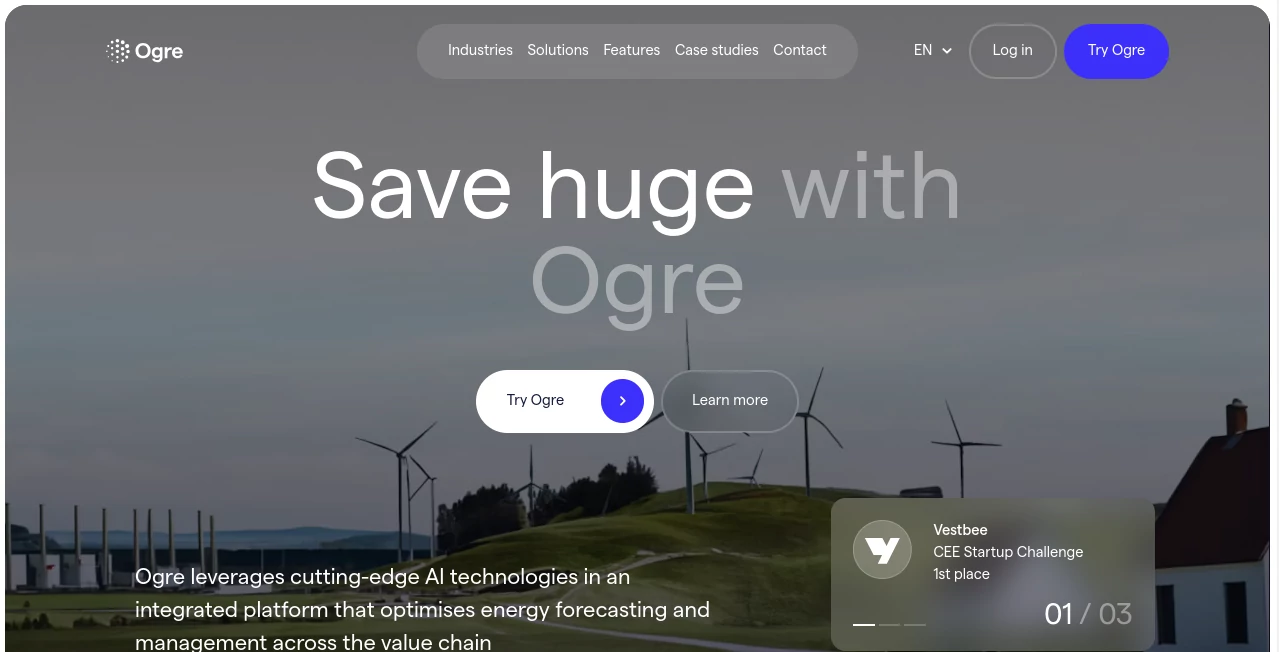
Ogre is an AI-powered energy forecasting and management platform built for organizations that need a clearer view of demand, supply, market changes, and operational performance. Instead of treating forecasting as a separate reporting task, the platform brings forecasting, analytics, and optimization together in one environment.
Its focus is firmly on the energy sector, with solutions designed for electricity, gas, water and wastewater, district heating, renewable energy, and other energy-intensive operations. The platform combines machine learning with real-time data processing to turn complex energy data into forecasts and practical recommendations that can support everyday decisions.
What makes the approach particularly interesting is its emphasis on integration. Businesses can connect the platform with existing IT infrastructure rather than rebuilding their entire energy management workflow from scratch. For teams dealing with volatile demand or renewable generation, that can make a meaningful difference.
Key Features
- AI and machine learning forecasting: Advanced proprietary machine learning models are used to generate predictions and continuously improve as new data becomes available.
- Real-time data processing: Live data streams can be analyzed quickly, allowing forecasts to respond to changing energy conditions.
- Predictive and prescriptive analytics: The platform goes beyond predicting what may happen by providing insights that can help teams decide what to do next.
- Data integration and management: Data from multiple sources can be brought together with validation and cleaning processes designed to improve the quality of forecasting inputs.
- Scenario simulation: Teams can explore different situations and assess the potential impact of strategic decisions before putting them into practice.
- Interactive visualization: Dashboards and reporting tools make complex energy information easier to interpret and monitor.
- Scalable architecture: The modular design is intended to accommodate increasing data volumes and additional business requirements.
- Cloud, on-premises, and hybrid deployment: Different deployment approaches are available for organizations with varying infrastructure and data-sovereignty requirements.
User Interface
The platform is designed around a centralized interface where forecasting and analytical information can be viewed without jumping between multiple disconnected systems. Interactive dashboards help turn large amounts of operational data into information that is easier for energy teams to understand.
This matters in practical situations. An energy manager looking at demand forecasts, for example, needs to spot changes quickly rather than spend time deciphering complicated spreadsheets. The focus on visualization and customizable reporting makes the information more accessible to both technical specialists and operational decision-makers.
Accuracy & Performance
Forecasting accuracy is at the heart of the platform. Its machine learning models analyze historical and real-time information to anticipate energy demand, generation, supply, losses, anomalies, and other important variables.
The real-time processing capability is another strength. Energy markets and consumption patterns can change quickly, particularly when renewable generation is involved. Being able to incorporate fresh data allows forecasts to adapt instead of relying entirely on static historical assumptions.
There are also practical examples behind these claims. Organizations working with the platform have reported improved demand and generation forecasting, better peak-demand planning, and more efficient grid management. Results naturally depend on the quality and availability of the underlying data, but the technical foundation is well suited to forecasting-heavy energy operations.
Capabilities
The platform covers a broad range of energy forecasting requirements. Renewable energy providers can use it to forecast generation from assets such as photovoltaic installations, while utilities can use demand forecasting to better understand consumption patterns and prepare for changing loads.
Its capabilities also extend to technical losses, anomaly detection, fraud-related analysis, and operational planning. A particularly useful application is electric vehicle charging. Forecasting charging demand can help operators prepare for peak periods, allocate resources more effectively, improve station availability, and explore opportunities such as dynamic pricing.
The system is also designed to work across different parts of the energy value chain rather than serving only one narrow forecasting scenario. That breadth makes it more relevant to organizations managing several energy-related processes at once.
Security & Privacy
Security is an important consideration for energy companies because forecasting platforms may work with operational and commercially sensitive information. The platform states that it uses encryption and multi-factor authentication as part of its security approach.
Deployment flexibility can also be useful for organizations with strict data-management requirements. Cloud, on-premises, and hybrid options give businesses more control over where and how their systems are operated, particularly when data sovereignty or internal infrastructure policies are important.
Use Cases
- Electricity demand forecasting: Predict upcoming consumption patterns to support grid planning, procurement, and operational decisions.
- Renewable energy forecasting: Estimate renewable generation and better prepare for fluctuations in solar and other variable energy sources.
- EV charging management: Forecast charging demand across stations, points, and clusters to improve resource allocation and peak-demand planning.
- Energy procurement: Use more informed forecasts to support purchasing decisions and reduce unnecessary operational costs.
- Grid management: Anticipate demand changes and improve planning around peak periods.
- Water and wastewater: Apply forecasting techniques to water usage and resource management while supporting leak-detection initiatives.
- District heating: Forecast heat demand to help optimize distribution and reduce energy waste.
- Industrial energy management: Help manufacturers understand energy requirements and identify opportunities for more efficient operations.
Pros and Cons
Pros
- Designed specifically around energy and utility use cases.
- Combines forecasting, analytics, and optimization in one platform.
- Supports real-time data processing.
- Offers scalable and modular architecture.
- Supports cloud, on-premises, and hybrid deployment approaches.
- Can be customized for different organizations and infrastructure.
- Useful for electricity, renewable energy, gas, water, and district heating applications.
Cons
- It is primarily an enterprise energy solution rather than a general-purpose AI tool for individual users.
- Pricing is not publicly presented as a standard self-service subscription.
- Getting the most value from the platform requires suitable operational and historical data.
- Organizations looking for simple consumer-level forecasting software may find its feature set more extensive than necessary.
Pricing Plans
No public fixed pricing plans are listed on the website. Instead, organizations are invited to request a trial by providing information such as their name, email address, company, industry, and the product they want to implement.
This approach makes sense for an enterprise platform because forecasting requirements can vary considerably between an electricity grid operator, renewable energy producer, EV charging network, and industrial organization. The platform can be tailored to the customer's data sources, infrastructure, forecasting requirements, and reporting needs rather than forcing every business into the same subscription package.
How to Use the Platform
Getting started is centered on choosing the relevant industry and product, then contacting the team to explore the appropriate implementation. The platform is designed to integrate with existing systems and combine historical information with real-time and external data sources.
- Choose your application: Identify the forecasting or energy-management problem you want to address.
- Connect your data: Bring together relevant historical, real-time, and external information.
- Configure the solution: Adapt forecasting, processing, interfaces, and reporting to the organization's requirements.
- Analyze forecasts: Use AI-powered models and dashboards to understand expected energy trends.
- Take action: Apply the resulting insights to planning, procurement, resource allocation, grid management, or other operational decisions.
- Continue improving: As new information becomes available, the machine learning models can continue adapting to changing patterns.
Comparison with Similar Tools
Many analytics platforms can process data or produce business forecasts, but this solution takes a much narrower and more specialized approach. Its main advantage is the combination of AI forecasting, energy-specific analytics, real-time processing, and operational optimization in a single environment.
A general business intelligence platform may provide excellent charts and dashboards but still require an organization to build its own energy forecasting models. A generic machine learning environment offers more flexibility but usually places much more responsibility on the customer's technical team. Here, the focus is on applying those capabilities directly to energy and utility challenges.
That specialization is likely to be the deciding factor. A small company looking for a basic analytics dashboard may not need such a platform. An electricity provider, renewable energy operator, EV charging network, or large industrial organization dealing with complex forecasting requirements is much more likely to benefit from its purpose-built approach.
Conclusion
For organizations operating in energy and utilities, accurate forecasting is not simply a nice analytical feature. It can influence procurement, grid planning, renewable integration, resource allocation, operational costs, and long-term sustainability decisions.
This platform stands out by bringing those forecasting requirements into a dedicated AI environment rather than treating them as isolated analytics projects. Its combination of machine learning, real-time processing, scenario analysis, visualization, and flexible deployment makes it a strong option for organizations dealing with complex energy data.
The lack of publicly displayed standard pricing means it is better suited to businesses prepared to discuss their requirements directly with the provider. For the right organization, however, that customized approach can be an advantage rather than a limitation, particularly when energy operations are too complex for an off-the-shelf forecasting product.
Frequently Asked Questions (FAQ)
What is this platform used for?
It is an AI-powered platform for energy forecasting and management. It can help organizations forecast demand and generation, analyze energy data, identify anomalies and losses, and make more informed operational decisions.
Which industries can use it?
The platform is designed for electricity, gas, water and wastewater, district heating, renewable energy, EV charging, and other energy-related applications.
Can it process real-time data?
Yes. Real-time data processing is one of its core technological features, allowing forecasting models to incorporate changing information and respond to evolving energy conditions.
Can the platform be customized?
Yes. The provider states that the platform can be customized to different client requirements, including interfaces, data-processing capabilities, and existing infrastructure.
Does it support renewable energy forecasting?
Yes. Renewable energy forecasting is one of its core applications, including forecasting for photovoltaic assets and other variable renewable generation.
Can it be used for EV charging networks?
Yes. The platform supports forecasting for charging stations, charging points, and clusters. These forecasts can help operators manage peak demand, allocate resources, and improve station availability.
Is there a free plan?
No standard free plan or public subscription price is presented on the website. Organizations can request a trial and discuss their specific implementation requirements.
Does it support on-premises deployment?
Yes. Cloud-based, on-premises, and hybrid deployment options are available, giving organizations flexibility around infrastructure and data-management requirements.
Who is the platform best suited for?
It is best suited to utilities, energy suppliers, renewable energy companies, EV charging operators, industrial businesses, and other organizations where accurate energy forecasting and operational planning are important.
AI Research Tool , AI Analytics Assistant , AI Monitor & Report Builder .
These classifications represent its core capabilities and areas of application. For related tools, explore the linked categories above.

Ogre Alternatives Product

VideoDubber'…

ForexCoupons

WhatsMyName …

EstatePass

Fina Money

Pips Hint

Omphalis

LSGRO
CoolVerdict