
Opper
What is Opper?
Building an AI application often starts simply enough: choose a model, connect an API, and start testing. The complexity usually appears later. Teams want to compare models, change providers, keep applications reliable when a model is unavailable, control spending, and understand what is happening across thousands of AI requests.
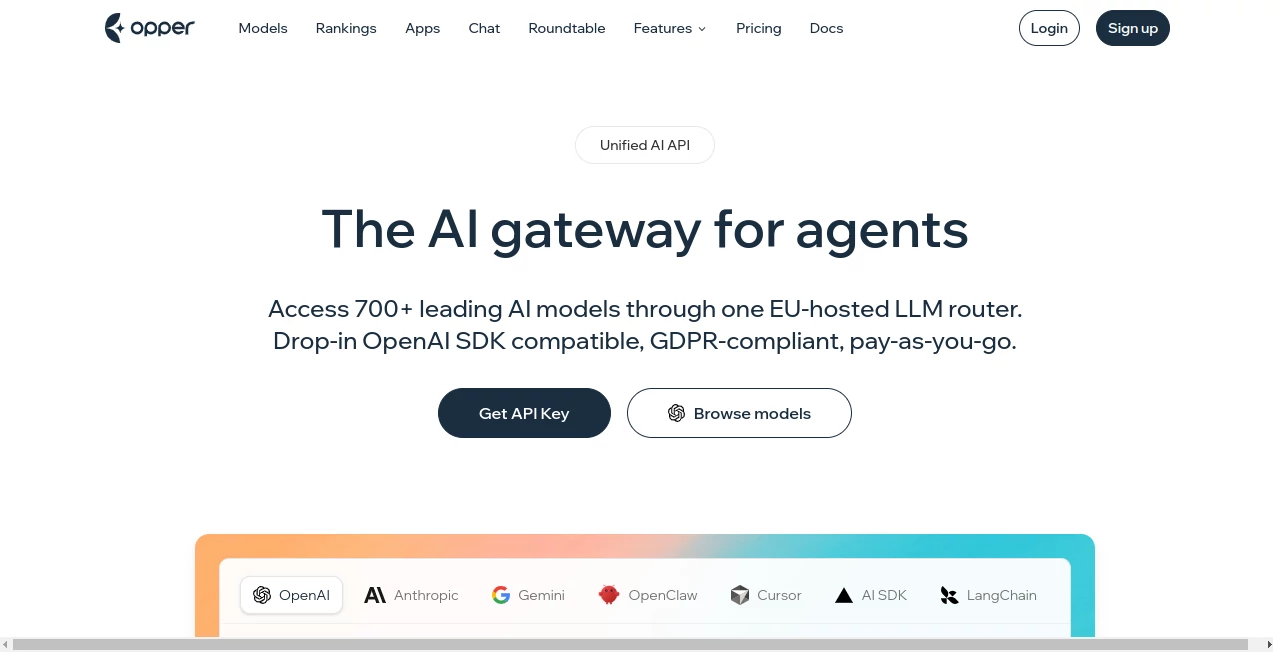
Opper brings these pieces together through a single AI gateway designed for developers and teams building AI-powered applications and agents. It provides access to more than 700 models across multiple providers and modalities through one integration, while also offering routing, observability, security controls, and usage management.
The approach is particularly useful for developers who do not want their application tightly coupled to a single model provider. Instead of rebuilding an integration whenever a better or more suitable model becomes available, teams can work through one consistent gateway and choose the model that fits each job.
Key Features
- Access to 700+ AI models through one API.
- Support for text, image, voice, and video models.
- OpenAI SDK-compatible integration for easier migration.
- Automatic failover across providers to improve availability.
- Model routing based on application requirements.
- Prompt caching for repeated requests.
- Tracing and usage visibility for AI calls.
- Budget controls and prepaid credit management.
- Bring-your-own-key support for supported providers.
- Structured outputs for applications that need predictable data.
- Agent-focused SDKs and tooling for Python and TypeScript developers.
- EU hosting and privacy-focused infrastructure options.
User Interface
The interface is designed around the needs of people who work with multiple AI models rather than around a single chatbot experience. Developers can browse the available model catalog, compare models, inspect pricing and capabilities, and experiment with different options before committing them to an application.
The model comparison experience is especially practical when choosing between several providers. Pricing, context windows, hosting regions, privacy characteristics, and other technical details can be considered side by side instead of being collected manually from different provider websites.
For developers, the API and documentation are equally important. Existing projects using the OpenAI SDK can be adapted with relatively little friction, which makes the gateway easier to evaluate without rewriting an entire application.
Accuracy & Performance
Performance ultimately depends on the model selected, but the gateway adds another important layer: reliability. Multiple providers can serve the same or comparable models, allowing requests to fall back when a particular route becomes unavailable.
The platform also exposes model availability and routing information, helping teams make decisions based on practical factors rather than model names alone. For applications where downtime can directly affect customers, this extra layer can be valuable.
There is also a useful distinction between model performance and application performance. A strong model does not automatically make an AI product reliable. Routing, monitoring, fallback behavior, and cost visibility matter just as much once an application moves beyond experimentation.
Capabilities
The platform is built for a wide range of AI development tasks. Developers can use a single integration to work with large language models as well as models handling images, voice, and video. This makes it suitable for applications that combine several AI capabilities rather than relying on text generation alone.
Agent development is another major focus. Developers can use SDKs, structured calls, tracing, tool integration, and multi-agent workflows to create applications that do more than generate a single response.
Structured outputs are useful for tasks such as extraction, classification, parsing, and automation because the application can request predictable data rather than dealing with completely free-form responses.
Routing is also more flexible than simply selecting one model in a configuration file. Custom routes can be designed to pass requests through different models or decision points, then deployed and called like a normal model endpoint.
Security & Privacy
Privacy is one of the more important considerations when an application sends AI requests through a third-party gateway. The service is hosted in AWS Stockholm and is designed around EU residency, with GDPR compliance positioned as a core part of the infrastructure.
Prompts are not stored by default, with metadata used for analytics. Enterprise customers can also use zero-retention options. The infrastructure uses encryption in transit and AES-256 encryption at rest, while data is isolated between organizations.
For organizations with compliance requirements, centralized access to multiple AI providers can also simplify administration. Instead of separately managing every model provider relationship, teams can apply governance and policy controls through a single layer.
Use Cases
AI Agents: Teams building autonomous agents can connect their applications to multiple models while keeping model selection separate from the core application logic.
Multi-Model Applications: A product may need a fast and inexpensive model for simple requests and a more capable model for difficult tasks. Centralized model access makes this kind of architecture easier to manage.
AI Customer Applications: Products serving large numbers of users can benefit from provider fallback and centralized usage monitoring, particularly when reliability is important.
AI Content and Data Processing: Structured outputs make the platform useful for extraction, classification, transformation, and other workflows where predictable responses matter.
Development and Coding Agents: Developers can connect coding agents and other AI development tools to different models without rebuilding their infrastructure for every provider.
Enterprise AI: Organizations can use routing, budgets, audit capabilities, privacy controls, and regional restrictions to introduce AI services while maintaining greater control over how requests are handled.
Pros and Cons
- Pros: Access to a very large model catalog through one API.
- Pros: OpenAI SDK compatibility can make migration easier.
- Pros: Automatic provider failover can improve reliability.
- Pros: EU hosting and privacy controls are useful for organizations with regulatory requirements.
- Pros: Model comparison and pricing information make experimentation easier.
- Pros: Routing, observability, and governance are available as applications grow.
- Cons: The platform is primarily aimed at developers and technical teams rather than casual AI users.
- Cons: Working with hundreds of models can introduce decision-making complexity for teams that are new to multi-model architectures.
- Cons: Usage costs still depend on the individual model providers and the volume of requests.
Pricing Plans
The pricing model is pay-as-you-go rather than based on a traditional per-seat subscription. The gateway currently charges a 3% platform fee when credits are purchased, while model token prices are passed through at provider cost without an additional token markup.
The Control Plane option uses a 5.5% platform fee and adds advanced features such as deeper tracing, routing controls, governance, and observability. Additional usage-based charges can apply to features that run separate evaluation models.
There are no minimum spending requirements or long-term lock-ins for the standard gateway. Credits can be purchased manually or automatically topped up, and supported provider credentials can also be used through bring-your-own-key functionality.
Enterprise customers can access custom arrangements such as volume pricing, annual commitments, invoicing, dedicated support, SSO, audit logging, zero data retention, and deployment options tailored to organizational requirements.
How to Use It
- Create an account and obtain an API key.
- Add credits to the account or connect supported provider credentials.
- Choose a model from the available catalog based on price, capabilities, region, context size, and privacy requirements.
- Connect the gateway to an existing application using the compatible SDK or API.
- Send requests through the selected model.
- Add routing or fallback logic when the application requires higher reliability.
- Monitor usage, costs, traces, and model behavior as the application grows.
A developer already using the OpenAI SDK can take a particularly straightforward route. The compatible endpoint allows an existing integration to be redirected toward the gateway while keeping much of the application structure intact. This can make experimentation with different providers considerably less disruptive.
Comparison with Similar Tools
AI gateways such as OpenRouter and LiteLLM solve part of the same problem: giving developers a more unified way to work with multiple models. The main difference is the surrounding product philosophy.
This platform puts considerable emphasis on being an infrastructure layer for production AI agents, with EU hosting, governance, routing, observability, compliance controls, and enterprise features alongside model access. That makes it particularly interesting for teams that expect their AI application to move from experimentation into a production environment.
For a small developer project, a simple direct provider integration may still be enough. For a product that needs to switch models frequently, monitor AI usage, apply organizational policies, or maintain regional requirements, a dedicated gateway can become much more valuable.
Conclusion
Choosing an AI model is becoming less about finding one permanent winner and more about finding the right model for each task. A coding agent, customer-support workflow, document extraction process, and creative application may all benefit from different models.
This platform addresses that reality by putting a unified gateway between applications and a broad collection of AI providers. The combination of model choice, fallback routing, observability, structured outputs, developer tooling, and EU-focused privacy controls makes it a strong option for teams building serious AI products.
Its greatest advantage may be flexibility. Developers can experiment with new models without repeatedly redesigning the application's infrastructure, while growing teams gain additional tools for managing reliability, costs, and governance.
Frequently Asked Questions (FAQ)
What is this platform used for?
It provides a unified gateway for accessing and managing a large collection of AI models from different providers. It is mainly designed for developers, AI applications, and agent-based systems.
How many AI models are available?
The platform currently provides access to more than 700 models across more than 30 providers, covering multiple modalities including text, image, voice, and video.
Does it support the OpenAI SDK?
Yes. The compatible API makes it possible to adapt applications built with the OpenAI SDK without replacing the entire integration architecture.
Does it add a markup to model token prices?
No. The gateway passes model token pricing through at provider cost. The standard gateway applies a 3% fee when credits are purchased.
Is there a free plan?
The service uses a pay-as-you-go credit system rather than requiring a traditional monthly subscription. There are no minimum spending requirements for the standard gateway.
Is EU hosting available?
Yes. The infrastructure is hosted in AWS Stockholm, and EU residency is supported. Specific model routes can have their own regional availability, so developers should check the model catalog before selecting a route.
Can developers use their own provider API keys?
Yes. Bring-your-own-key functionality is available, allowing teams to use their existing provider credits while accessing the gateway's infrastructure.
Is it suitable for AI agents?
Yes. Agent development is one of its central use cases, with SDKs, routing, tracing, structured calls, and tools designed to support production AI agents.
Can requests automatically fail over to another provider?
Yes. Multiple providers can be used for fallback routing, helping applications maintain availability when a particular route or provider experiences an issue.
Who should consider using it?
It is best suited to developers, startups, AI product teams, and enterprises that need access to multiple models without maintaining separate integrations for every provider.
AI Research Tool , AI API Design , Large Language Models (LLMs) , AI Developer Tools .
These classifications represent its core capabilities and areas of application. For related tools, explore the linked categories above.

Opper Alternatives Product

Blackbox AI
Skillselion

Ptero

Geoleaper

EntreDash

Surmado
HostFinder

Dedoctive

NetlifyAPP