


















Orasio
What is Orasio?
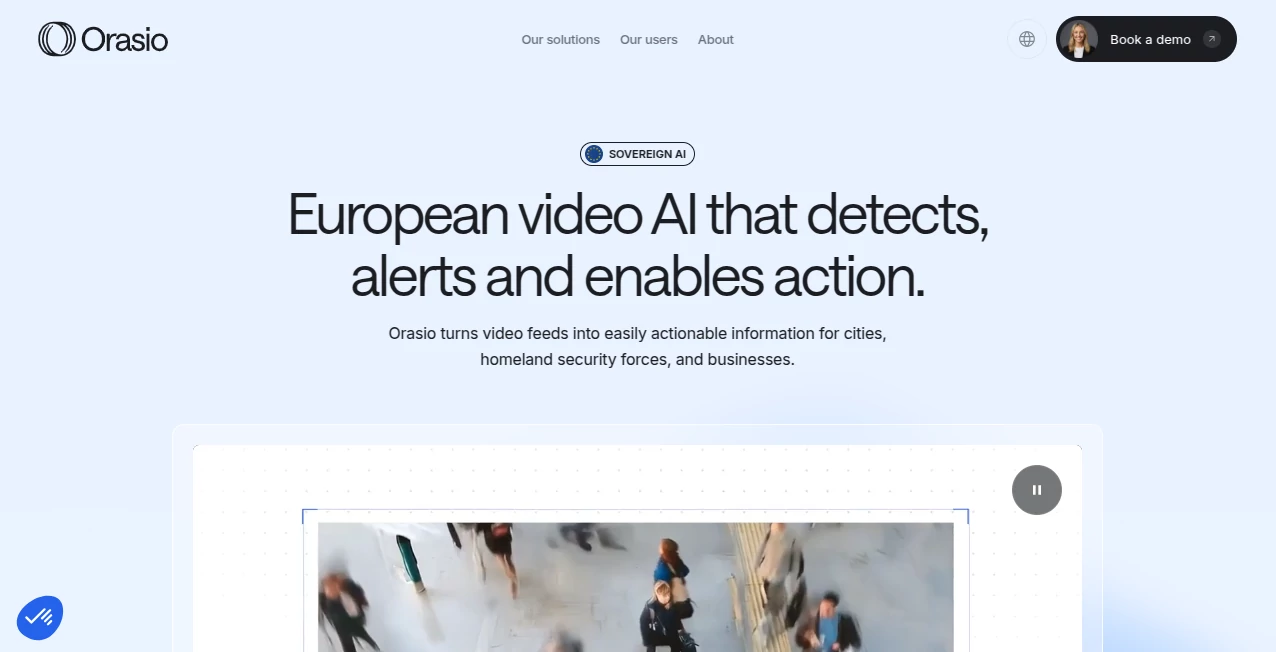
Orasio is a European video intelligence platform designed to turn video feeds into practical information for organizations that need to understand what is happening around them. Instead of relying only on people to watch hours of camera footage, the platform uses multimodal AI to identify incidents, suspicious behavior, anomalies, and other relevant situations.
The product is aimed at demanding environments such as cities, security organizations, sensitive business sites, and defense-related operations. Its approach is particularly interesting for teams that need both immediate alerts and the ability to investigate recorded footage later.
What makes the platform stand out is its focus on European AI sovereignty. Data is hosted in Europe, while the technology is designed to reduce dependence on non-European providers. The company also positions its solutions around GDPR and EU AI Act requirements, which can be an important consideration for organizations working with sensitive video data.
Key Features
- Real-time detection: AI can identify suspicious behaviors, incidents, and anomalies directly from video streams, helping teams react without continuously monitoring every camera manually.
- Post-event video analysis: Large amounts of recorded footage can be searched and filtered to locate relevant events much faster than conventional manual review.
- Context-based alerts: Organizations can create targeted alerts around specific operational scenarios instead of receiving notifications for every minor movement or event.
- Natural-language search: Users can formulate searches in ordinary language, allowing the multimodal system to interpret requests and describe situations found in video.
- Multimodal understanding: The technology combines visual information with language capabilities to provide a more detailed interpretation of complex scenes.
- Flexible deployment: The platform can be deployed through cloud, on-premises, or edge environments depending on operational requirements.
User Interface
The platform is built around an operational workflow rather than a conventional consumer-facing AI interface. Its purpose is to help professional teams move from video footage to an understandable result with fewer manual steps.
The natural-language search capability is especially useful in this context. Instead of remembering exactly when an event occurred, an operator can describe what they are looking for and use the system to narrow down the relevant footage. This makes the experience more practical when dealing with long recordings or multiple video sources.
Accuracy & Performance
Performance is one of the central priorities of the platform. Its models are designed to interpret complex scenes where traditional video-analysis approaches may struggle, combining image and language processing to provide a deeper understanding of what is happening.
Real-time detection is intended for situations where speed matters, while retrospective analysis focuses on quickly finding useful information inside previously recorded footage. In practice, this combination can reduce the amount of time security and operations teams spend manually reviewing video.
The system is also designed for demanding environments, including constrained deployments where network availability, computing resources, or operational independence may be important considerations.
Capabilities
The platform covers several stages of video intelligence. It can monitor live streams, identify potentially important events, generate contextual alerts, and help users investigate recorded footage afterwards.
For example, a security team could use automated detection to flag an unusual situation as it happens. Later, the same team could search through recorded footage using a natural-language description rather than manually reviewing hours of recordings. That combination makes the technology useful not only for prevention but also for investigation and incident analysis.
Its multimodal approach is another notable capability. By connecting visual understanding with language-based queries, the system is designed to make video information easier for people to search, interpret, and act upon.
Security & Privacy
Security and data sovereignty are major parts of the product's positioning. The company states that its data is hosted in Europe and that its technology is developed with the goal of minimizing dependence on extra-European technologies and providers.
The platform is presented as compliant with European GDPR and AI Act requirements, with an emphasis on data protection and algorithmic transparency. This focus is particularly relevant for organizations handling sensitive footage or operating in regulated environments.
Deployment flexibility also contributes to its security model. Depending on the organization's needs, the technology can operate in cloud, on-premises, or edge environments, including highly constrained scenarios where maintaining local control over data and processing is important.
Use Cases
- Public safety: Cities and public authorities can use video intelligence to identify incidents and potentially suspicious situations across monitored areas.
- Security operations: Security teams can receive targeted alerts and investigate incidents without manually reviewing every recorded camera feed.
- Critical infrastructure: Industrial facilities, transportation networks, ports, airports, warehouses, and other sensitive locations can use automated video analysis to improve situational awareness.
- Defense: The ability to operate in constrained or disconnected environments makes the technology relevant to defense scenarios where conventional cloud-only systems may not be appropriate.
- Incident investigation: Teams can search through recorded footage after an event and quickly identify moments that match a particular description.
- Operational monitoring: Organizations can create scenario-specific alerts designed around their own security and operational requirements.
Pros and Cons
Pros
- Strong focus on European AI sovereignty and data control.
- Real-time detection combined with retrospective video analysis.
- Natural-language search for investigating video footage.
- Multimodal AI designed to understand complex visual situations.
- Cloud, on-premises, and edge deployment options.
- Designed for demanding security, public-sector, and enterprise environments.
- Strong emphasis on GDPR and EU AI Act compliance.
Cons
- The platform is primarily aimed at professional organizations rather than casual individual users.
- Pricing is not publicly presented as a standard self-service subscription.
- Organizations may need technical planning before deploying the system across existing video infrastructure.
- The most advanced capabilities are likely to be most valuable for teams managing substantial video volumes or demanding security requirements.
Pricing Plans
The website does not present conventional public subscription tiers or fixed monthly pricing. Instead, the product is positioned as an enterprise and professional solution, with organizations invited to contact the company and discuss their requirements.
This approach makes sense for video intelligence deployments because costs can depend on factors such as the number of cameras, processing requirements, deployment model, infrastructure, security requirements, and the operational scenarios being addressed.
Organizations interested in using the platform can therefore request a demonstration and discuss the appropriate deployment and commercial model directly with the provider.
How to Use It
- Define the security or operational scenarios that need to be monitored.
- Determine which existing video feeds or camera systems should be connected.
- Choose the most appropriate deployment environment, such as cloud, on-premises, or edge.
- Configure relevant detection scenarios and contextual alerts.
- Use real-time detection to identify important events as they occur.
- Use natural-language search and retrospective analysis when investigating recorded footage.
- Review detected situations and use the resulting information to support operational decisions.
Comparison with Similar Tools
Many video analytics products focus on a specific task such as object detection, surveillance recording, or basic motion alerts. This platform takes a broader approach by combining real-time detection, post-event investigation, contextual alerts, and natural-language interaction with video.
Another important distinction is deployment philosophy. Organizations looking for a purely cloud-based consumer surveillance service may find other products more suitable. However, teams that need cloud, on-premises, or edge deployment options and place significant importance on European data sovereignty have a more specialized solution here.
The natural-language search capability is also a practical differentiator. Rather than treating video simply as a stream of frames, the system is designed to connect visual information with human-readable queries, which can make large video archives considerably easier to investigate.
Conclusion
Orasio presents a compelling approach to professional video intelligence by combining AI-based detection with investigation, contextual alerts, and natural-language search. Its focus goes beyond simply recognizing objects in a camera feed; the goal is to transform large amounts of video into information that people can actually use.
The strongest appeal is likely to be for organizations where security, privacy, operational speed, and data sovereignty all matter at the same time. Flexible deployment options further broaden its usefulness, particularly for environments where cloud-only processing is not practical.
For cities, security teams, critical infrastructure operators, and organizations working in demanding environments, this type of video intelligence can reduce the burden of manual monitoring while giving teams a faster way to understand and investigate events.
Frequently Asked Questions (FAQ)
What is this platform used for?
It is designed for video intelligence, including real-time incident detection, contextual alerts, recorded-video analysis, and natural-language search across video footage.
Can it analyze live video?
Yes. Its real-time detection capability is designed to identify suspicious behaviors, incidents, and anomalies in live video streams.
Can users search recorded footage?
Yes. The platform provides retrospective analysis and assisted search, allowing users to find relevant events inside recorded footage.
Does it support natural-language queries?
Yes. Users can formulate requests in natural language, while the multimodal AI interprets the request and searches for relevant situations in video.
Where can it be deployed?
The technology supports cloud, on-premises, and edge deployment models, allowing organizations to choose an environment that fits their infrastructure and operational constraints.
Is it designed for European data protection requirements?
The company states that its technology follows European data protection and AI transparency requirements, including GDPR and the EU AI Act.
Is pricing publicly available?
No fixed public pricing plans are displayed. The solution is positioned for professional and enterprise use, so organizations are encouraged to contact the provider for a demonstration and discuss their requirements.
Who can benefit from this technology?
Potential users include cities, public safety organizations, security teams, critical infrastructure operators, businesses with sensitive sites, and defense-related organizations that require advanced video analysis.
AI Video Search , Video , AI Analytics Assistant , AI Monitor & Report Builder .
These classifications represent its core capabilities and areas of application. For related tools, explore the linked categories above.

Orasio Alternatives Product

QuickFlip.AI

YT Video Sum…

x video down…

UseWok

DidYouSEO

CrawlReady

Sound Level …

Website Traf…

zGEO Ranker
